Join us on a literary world trip!
Add this book to bookshelf
Grey
Write a new comment Default profile 50px
Grey
Subscribe to read the full book or read the first pages for free!
All characters reduced
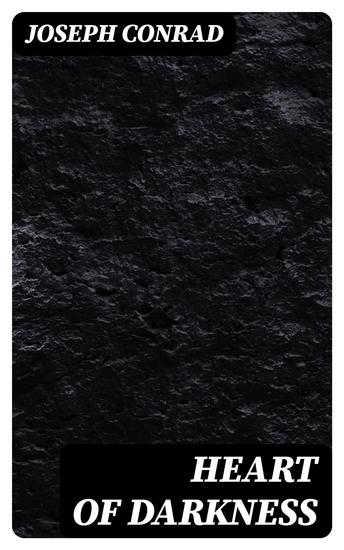
Heart of Darkness - cover

Heart of Darkness

Joseph Conrad

Publisher: DigiCat

  • 0
  • 0
  • 0

Summary

In Joseph Conrad's seminal work, "Heart of Darkness," readers embark on a harrowing journey through the depths of the Congo River, exploring the complexities of imperialism, civilization, and the human psyche. The novella is renowned for its intricate narrative style, utilizing a frame story that enhances its allegorical dimensions, while its vivid imagery captures the surreal, often nightmarish qualities of colonial exploitation. Set against the backdrop of the late 19th-century European colonial expansion, the text critiques the moral ambiguities of both civilization and savagery, positioning darkness as both a literal and metaphorical force within humanity. Joseph Conrad, born in Poland and later settled in Britain, draws upon his own experiences as a sailor and a witness to colonial atrocities, which profoundly influenced his perspective on imperialism. His unique background as a European outsider offers rich insights into the contradictory nature of Western civilization. "Heart of Darkness" is often seen as a reflection of Conrad's personal struggles with identity and morality, as well as a critique of the greed and corruption embedded in colonial enterprises. This novella is essential for readers interested in the intersections of literature, history, and psychology. Conrad's masterful prose and deep philosophical inquiries invite critical reflection, making "Heart of Darkness" a timeless exploration of the darkness that resides within humanity—a must-read for anyone seeking to understand the complexities of moral choice in a tumultuous world.
Available since: 05/17/2022.
Print length: 177 pages.

Other books that might interest you

  • Dodsworth - cover

    Dodsworth

    Sinclair Lewis

    • 0
    • 0
    • 0
    Explore the complexities of love, ambition, and identity in Dodsworth by Sinclair Lewis, a literary masterpiece that examines the discontent and aspirations of the American upper class during the interwar years. 
    The story follows Sam Dodsworth, a retired automobile magnate, as he embarks on a European journey with his restless and socially ambitious wife, Fran. What begins as a grand adventure quickly unravels into a tale of marital discord and personal discovery. Sam confronts questions of loyalty, fulfillment, and what it truly means to live authentically as he navigates the cultural contrasts of Europe and the shifting dynamics of his marriage. 
    Sinclair Lewis’s sharp social commentary and vivid character portrayals make Dodsworth a compelling exploration of the human condition. With expert narration, this audiobook brings to life the elegance and turbulence of the 1920s and 1930s, immersing listeners in the emotional depth and timeless themes of Lewis’s work. 
    Perfect for fans of literary fiction and stories of personal transformation, Dodsworth offers a deeply resonant listening experience. 
    Start listening to Dodsworth today and join Sam Dodsworth on his journey of self-discovery and reinvention!
    Show book
  • Virginibus Puerisque and Other Papers (Unabridged) - cover

    Virginibus Puerisque and Other...

    Robert Louis Stevenson

    • 0
    • 0
    • 0
    We are all busy in this world building Towers of Babel; and the child of our imaginations is always a Changeling when it comes from nurse. This is not only true in the greatest, as of wars and folios, but in the least also, like the trifling volume in your hand. Thus I began to write these papers with a defi nite end: I was to be the Advocatus, not I hope Diaboli, but Juventutis, ' I was to state temperately the beliefs of youth as Opposed to the contentions of age; to go over all the field where the two differ, and produce at last a little volume of special pleadings, which I might call, without misnomer, Life at Twenty five. But times kept changing, and I shared in the change. I clung hard to that entrancing age; but, with the best will, no man can be twenty-five forever. The old, ruddy convictions deserted me, and, along with them, the style that fits their presentation and defence. I saw, and indeed my friends in formed me, that the game was up. A good part Of the volume would answer to the long-projected title; but the shadows Of the prison-house are on the rest.
    Content: Virginibus Puerisque I / Virginibus Puerisque II / Virginibus Puerisque III: On Falling in Love / Virginibus Puerisque IV: The Truth of Intercourse / Crabbed Age and Youth / An Apology for Idlers / Ordered South / Æs Triplex / El Dorado / The English Admirals / Some Portraits by Raeburn / Child's Play / Walking Tours / Pan's Pipes / A Plea for Gas Lamps
    Show book
  • The Strange Case of Dr Jekyll and Mr Hyde - cover

    The Strange Case of Dr Jekyll...

    Robert Louis Stevenson

    • 0
    • 0
    • 0
    Dr. Jekyll, a well-respected doctor, concocts a potion to unleash his hidden evil as Mr. Hyde. Initially relishing this dark freedom, Jekyll loses control as Hyde's monstrous nature takes over, leading to a battle for his identity.
    Show book
  • Top 10 Short Stories The - The 19th Century - The English - The top ten short stories written from 1800 - 1899 by English authors - cover

    Top 10 Short Stories The - The...

    George Eliot

    • 0
    • 0
    • 0
    Short stories have always been a sort of instant access into an author’s brain, their soul and heart.  A few pages can lift our lives into locations, people and experiences with a sweep of landscape, narration, feelings and emotions that is difficult to achieve elsewhere. 
     
    In this series we try to offer up tried and trusted ‘Top Tens’ across many different themes and authors. But any anthology will immediately throw up the questions – Why that story? Why that author?  
     
    The theme itself will form the boundaries for our stories which range from well-known classics, newly told, to stories that modern times have overlooked but perfectly exemplify the theme.  Throughout the volume our authors whether of instant recognition or new to you are all leviathans of literature. 
     
    Some you may disagree with but they will get you thinking; about our choices and about those you would have made.  If this volume takes you on a path to discover more of these miniature masterpieces then we have all gained something. 
     
    In this Century England assembles more of the world’s territories, people and materials for her own Empire.  The arts also flourish with names in this volume that are bywords for talent beyond the reach of almost all other writers.  An ever hungry audience demands yet more and more. 
     
    1 - The Top 10 - The 19th Century - The English - An Introduction 
    2 - The Lifted Veil - Part 1 by George Eliot 
    3 - The Lifted Veil - Part 2 by George Eliot 
    4 - The Signalman by Charles Dickens 
    5 - The Man Who Would Be King - Part 1 by Rudyard Kipling 
    6 - The Man Who Would Be King - Part 2 by Rudyard Kipling 
    7 - The Magic Shop by H G Wells 
    8 - The Withered Arm by Thomas Hardy 
    9 - The Old Nurse's Story by Elizabeth Gaskell 
    10 - A Little Dinner At Timmin's by William Makepeace Thackeray 
    11 - Father Giles of Ballymoy by Anthony Trollope 
    12 - Lost Hearts by M R James 
    13 - A Terribly Strange Bed by Wilkie Collins
    Show book
  • Alice in Blunderland - cover

    Alice in Blunderland

    John Kendrick Bangs

    • 0
    • 0
    • 0
    ""Alice in Blunderland: An Iridescent Dream" is a novel by John Kendrick Bangs, first published in 1907 by Doubleday, Page & Co. of New York. Illustrated by Albert Levering, this work serves as a political parody of Lewis Carroll's famous Alice books: "Alice's Adventures in Wonderland" (1865) and "Through the Looking-Glass" (1871).    In this whimsical tale, Alice finds herself in "Blunderland", also humorously referred to as "Municipal Ownership Country". Here, she encounters familiar characters from Wonderland, including the dormouse, the Mad Hatter, and the Cheshire Cat. However, instead of whimsical adventures, Alice grapples with issues critical of collectivism, taxation, corporate greed, and corruption.    The novel playfully transports readers to a satirical realm where absurdity meets political commentary. "
    Show book
  • Great Change The (Unabridged) - cover

    Great Change The (Unabridged)

    H. G. Wells

    • 0
    • 0
    • 0
    Herbert George "H. G." Wells (1866 - 1946) was an English writer.
    He was prolific in many genres, including the novel, history, politics, social commentary, and textbooks and rules for war games. Wells is now best remembered for his science fiction novels and is called a "father of science fiction"
    THE GREAT CHANGE: My uncle had been hectic all day. I knew and dreaded what was coming, and said nothing that by any chance could lead up to it.
    Show book