Join us on a literary world trip!
Add this book to bookshelf
Grey
Write a new comment Default profile 50px
Grey
Subscribe to read the full book or read the first pages for free!
All characters reduced
Heart of Darkness - A Haunting Literary Classic of Imperialism Morality and the Human Soul - cover

Heart of Darkness - A Haunting Literary Classic of Imperialism Morality and the Human Soul

Joseph Conrad

Publisher: Zenith Maple Leaf Press

  • 0
  • 0
  • 0

Summary

A journey into the Congo… and into the darkest corners of the human heart.
When sailor Charles Marlow accepts a commission to captain a river steamer for a Belgian trading company, he sets off deep into the heart of the African Congo. Along the way, he hears whispers of the enigmatic ivory trader Mr. Kurtz—a man both revered and feared. What Marlow discovers is more than a story of colonial exploitation; it's a chilling exploration of moral decay, power, and the fragile line between civilization and savagery.

First published in 1899, Heart of Darkness is Joseph Conrad's most famous and controversial novella. It remains a profound critique of imperialism, human greed, and the psychological toll of unchecked ambition. Its influence extends far beyond literature, inspiring films like Apocalypse Now and countless works examining the cost of power.

"One of the greatest short novels in the English language."
– The New York Times

"A masterpiece of psychological and political insight."
– The Guardian

✅ Why Readers Love It:
🌍 A powerful critique of European colonialism

🖤 An intense psychological portrait of moral corruption

📚 A timeless literary work studied around the world

🎯 Click 'Buy Now' to embark on Conrad's unforgettable journey into the moral wilderness.
Available since: 08/13/2025.
Print length: 152 pages.
Other books that might interest you

  • The Talking Draft Method - Hollywood’s Secret for a Fast First Draft - cover

    The Talking Draft Method -...

    Frederick Gooltz

    • 0
    • 0
    • 0
    The Talking Draft Method is the fastest way for playwrights and screenwriters to create scenes. A writer records audio of themselves improvising the dialogue and the action lines, the audio is transcribed, then the text is reformatted into a script. This is not new, as the book reveals, it is actually one of old Hollywood's best-kept secrets. 
    Today it can be done instantly and for free. This practical guide shows exactly how to use The Talking Draft Method for a fast first draft of your script. This book also contains many of Hollywood's most popular outlining structures, plus great revision tricks of the trade to ensure that your next drafts are as great as they can be. 
    The Talking Draft Method is also the best way to achieve a creative flow state while writing. This book contains some of the latest findings about flow state neuroscience and provides helpful steps to harness the peak performance of the flow state as a writer while using the Talking Draft Method. 
    Inside This Practical Guide to The Talking Draft Method:how to achieve a creative flow stateovercome common first draft trapspopular screenplay structurescommon beat sheet examplesproven techniques for revisionsthe screenwriter's "notes" decodernever fear a blank page againthe history of the methodtips for aspiring writers
    Show book
  • My Whirlwind Lives - Navigating Decades of Storms - cover

    My Whirlwind Lives - Navigating...

    Dee Knight

    • 0
    • 0
    • 0
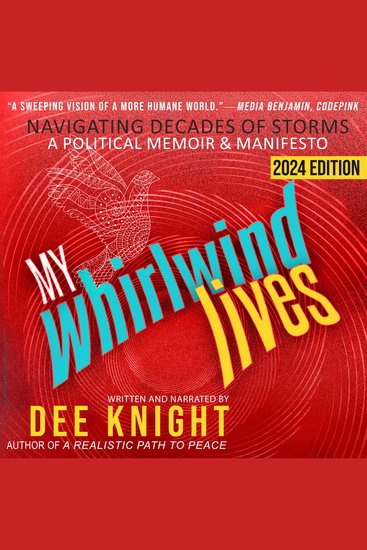
    Our recent storms didn't start in 2020 or 2016. They started decades ago in the 1960s - a whirlwind of threatened nuclear catastrophe, then police dogs and rednecks terrorizing civil rights marchers down south, then Vietnamese children fleeing from napalm flames. Then draft notices to go to Vietnam to "fight commies." 
    A small town boy started by supporting rightist Goldwater against the "peace candidate" Johnson, but rapidly changed in the face of the civil rights and anti-war movements, and started a quest that hasn't ended yet. 
    This book tells Dee Knight's story of "waking up" to the truth about the US war in Vietnam, then refusing the draft and going to Canada where he lived for six years. It relates the years-long campaign for amnesty, in which Knight was a leader. After war resisters won a partial amnesty, Knight continued campaigning against US wars up to the present day. 
    There are chapters on: 
    The political storms of 1968 
    Exile life in Canada 
    The years-long campaign for universal unconditional amnesty 
    Antiwar veterans and active duty soldiers and sailors, including the sanctuary movement 
    Witnessing Portugal's "Carnation Revolution" of 1975 
    Living and working in Sandinista Nicaragua 
    Socialism and the Green New Deal 
    "Messages from the Future" 
    Reflections on the Pandemic 
    The Battle to Expand and Protect Democracy 
    Appendices on Vietnam's victory in 1975, and on the reality of life and politics in China
    Show book
  • Civil War Turning Points in the East The: The Battle of Antietam and the Battle of Gettysburg - cover

    Civil War Turning Points in the...

    Editors Charles River

    • 0
    • 0
    • 0
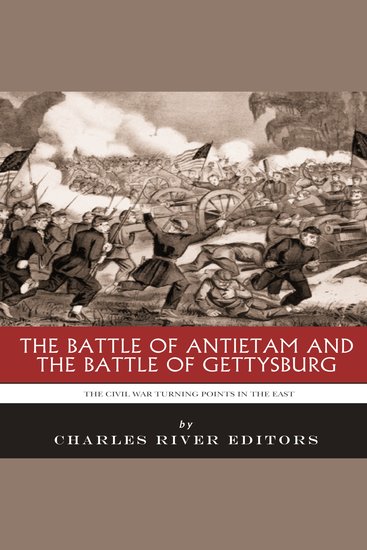
    The bloodiest day in American history took place on the 75th anniversary of the signing of the Constitution. On September 17, 1862, Robert E. Lee’s Confederate Army of Northern Virginia fought George McClellan’s Union Army of the Potomac outside Sharpsburg along Antietam Creek. That day, nearly 25,000 would become casualties, and Lee’s army would barely survive fighting the much bigger Northern army. Although the battle was tactically a draw, it resulted in forcing Lee’s army out of Maryland and back into Virginia, making it a strategic victory for the North and an opportune time for President Abraham Lincoln to issue the Emancipation Proclamation, freeing all slaves in the rebellious states. For those reasons, Antietam is remembered as one of the major turning points of the Civil War, even as it is often overlooked that the bloody battle only represented the climactic culmination of a 3 week campaign that saw George McClellan cautiously pull a fragmented Union army together and begin tracking Lee’s army into Maryland.  
    	Without question, the most famous battle of the American Civil War took place outside of the small town of Gettysburg, Pennsylvania, which happened to be a transportation hub, serving as the center of a wheel with several roads leading out to other Pennsylvanian towns. From July 1-3, Robert E. Lee’s Confederate Army of Northern Virginia tried everything in its power to decisively defeat George Meade’s Union Army of the Potomac, unleashing ferocious assaults that inflicted nearly 50,000 casualties in all. Day 1 of the battle would have been one of the 25 biggest battles of the Civil War itself, and it ended with a tactical Confederate victory. But over the next two days, Lee would try and fail to dislodge the Union army with attacks on both of its flanks during the second day and Pickett’s Charge on the third and final day.
    Show book
  • The Influence of Greek and Roman Cultures on Egypt - cover

    The Influence of Greek and Roman...

    Omar Khalil

    • 0
    • 0
    • 0
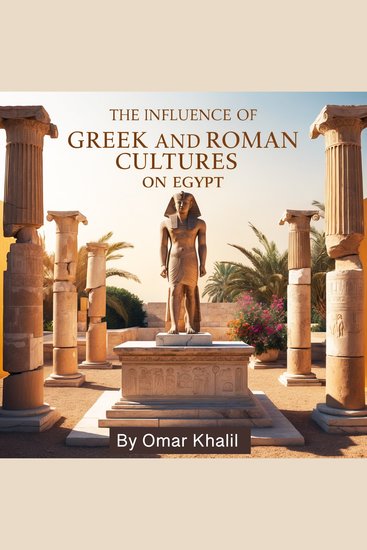
    The interaction between Greek, Roman, and Egyptian civilizations represents one of the most dynamic periods of cultural blending in ancient history. As neighboring powers came into contact through trade, diplomacy, and conquest, their customs, ideas, and beliefs began to intertwine, giving rise to a unique fusion that would leave a lasting imprint on Egyptian society. This chapter explores how these cultural exchanges began and how they shaped Egypt during the Hellenistic and Roman periods. 
    The initial encounter between Egypt and the Greeks occurred long before Alexander the Great’s arrival, through trade across the Mediterranean. However, it was Alexander’s conquest of Egypt in 332 BCE that marked a significant turning point. His establishment of the city of Alexandria set the stage for a new era, where Greek customs and governance took root alongside ancient Egyptian traditions. The subsequent Ptolemaic dynasty, descended from one of Alexander’s generals, became a bridge between Greek and Egyptian worlds, adopting pharaonic symbols while introducing Hellenistic art, language, and administrative systems. 
    Cultural transmission was not solely the result of conquest—it also flourished through everyday interactions. Greek settlers in Egypt brought with them their language, religion, and lifestyle, but they also adapted to local customs, often integrating Egyptian deities and rituals into their own belief systems. Temples began to reflect a blend of architectural styles, and literature began to emerge in both Greek and Demotic scripts, reflecting a hybrid intellectual life.
    Show book
  • Cosmos and Republic - Arendtian Explorations of the Loss and Recovery of Politics - cover

    Cosmos and Republic - Arendtian...

    Wolfgang R. Heuer

    • 0
    • 0
    • 0
    In 20 essays inspired by Hannah Arendt's analysis of crisis-ridden modernity, Wolfgang R. Heuer addresses aspects of depoliticization and the loss of politics, and thus of freedom. The wide-ranging essays are grouped in five sections: When Politics Vanishes, The Call of Responsibility, Images and Emotions, Federations, and From Plurality to Cosmos. They lead to the insight that the crises of our time require a common change of perspective towards ecological and political sustainability, the unity of »Cosmos and Republic«.
    Show book
  • The Rage of Replacement - Far Right Politics and Demographic Fear - cover

    The Rage of Replacement - Far...

    Michael Feola

    • 0
    • 0
    • 0
    The "Great Replacement" narrative, which imagines that historic white majorities are being intentionally replaced through immigration policies crafted by global elites, has effectively mobilized racist, nationalist, and nativist movements in the United States and Europe. The Rage of Replacement tracks how this narrative has shaped the politics and worldview of the far right, binding its various camps into a community of rage obsessed with nostalgia for a white-supremacist past. 


    Showing how the replacement narrative has found significant purchase in recent mainstream discourse, Michael Feola diagnoses the dangers this racist theory poses as it shapes the far-right imagination, expands through civil society, and deforms political culture. In particular, he tracks how the replacement narrative has given rise to malignant political strategies designed to "take back" the nation from its perceived enemies—by force if deemed necessary. 


    Feola shows how it has motivated a variety of dangerous political projects in pursuit of illiberal, antidemocratic futures. From calls for the creation of segregated white ethnostates to extremist violence such as the mass shootings in Christchurch, El Paso, and Buffalo, The Rage of Replacement makes clear that replacement theory poses a dire threat to democracy and safety.
    Show book