¡Acompáñanos a viajar por el mundo de los libros!
Añadir este libro a la estantería
Grey
Escribe un nuevo comentario Default profile 50px
Grey
Suscríbete para leer el libro completo o lee las primeras páginas gratis.
All characters reduced
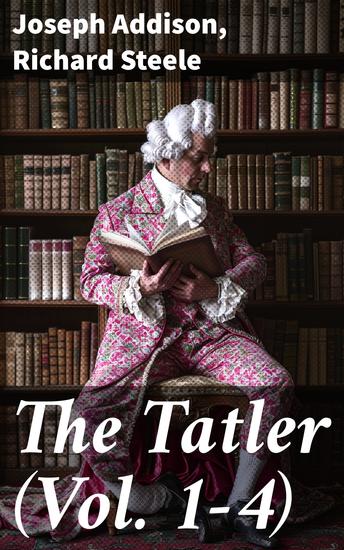
The Tatler (Vol 1-4) - The First Society Magazine in History Complete Edition - cover

The Tatler (Vol 1-4) - The First Society Magazine in History Complete Edition

Joseph Addison, Richard Steele

Editorial: Good Press

  • 0
  • 0
  • 0

Sinopsis

Spanning the vibrant literary world of early 18th-century England, "The Tatler (Vol. 1-4)" offers a robust anthology of societal commentary and vivid character sketches, blending wit with moral instruction. This collection captures the heartbeat of the era, as seen through the reflective and satirical lenses of two of its most insightful observers. Across these four volumes, a vivid panorama of styles emerges, ranging from the sarcastic to the earnest, inviting readers into coffeehouses, salons, and parlors of London where the public and private converged in lively debate. A standout piece might be the dissection of gentlemanly conduct or the subtle criticism of social mores, each contributing to a timeless exploration of human folly and virtue. At the helm of this eclectic collection are Joseph Addison and Richard Steele, figures who stand as pillars of early periodical literature. Both illustrious essayists and playwrights in their own rights, Addison and Steele curated "The Tatler" as an innovative platform for dialogue, grounded in Enlightenment principles. Together, they carved a niche in literary history, contributing to the rise of the periodical essay. Their collaboration underscores the anthology's alignment with burgeoning cultural movements, offering readers historical and cultural insights into the burgeoning issues of their time. "The Tatler (Vol. 1-4)" is an invaluable resource for anyone eager to engage with the rich tapestry of Enlightenment thought and social critique. This collection is a veritable treasure trove of perspectives, presenting an unmatched narrative composed of humorous, incisive, and thought-provoking pieces. Through its multifaceted presentations and cultural relevance, this anthology not only enhances one's understanding of the period's literary landscape but also fosters intellectual dialogue with readers of today. Enrich your literary repertoire with the voices that shaped and challenged the ideals of their age, and emerge with a greater appreciation for the enduring power of the written word.
Disponible desde: 27/12/2023.
Longitud de impresión: 1615 páginas.

Otros libros que te pueden interesar

  • Was God Pro-Choice Or Pro-life When He Gave His Son Jesus Christ? - Abortion! What Did God Do? What Would God Do Today? - cover

    Was God Pro-Choice Or Pro-life...

    ANONYMOUS ABORTED ANGELS

    • 0
    • 0
    • 0
    Many of us remember the saying” What would Jesus do! when one encountered a questionable situation where you were not sure of what you should do. The answer was to think of what Jesus would do and just do that. Today the world is struggling to find the answer to the question of being pro-choice or pro-life? Can and should a woman have a choice to have an abortion and end her pregnancy and the life of her unborn baby; or must she follow the law and continue the pregnancy and give birth to her baby without having any say in the matter. What would GOD DO? 
    The term pro-choice is defined by many different individuals, groups and organizations in many ways. The prevailing view is that to be pro-choice means believing that a woman has the right to choose to end her pregnancy at viability or 6 weeks and for any reason she chooses regardless of the circumstances. If the pregnancy was unplanned, or due to rape, or due to incest, or medical complications it should be the woman’s right or choice to decide to have or not have an abortion. What would GOD do? 
    Pro-life advocates believe that abortion is killing an unborn baby and can be done only if any one of the following conditions exist. The fetus cannot be older than six weeks, or the mother must be a victim of rape or incest, or if the mother’s health is at risk. What would GOD do? John 3:16 AND 17 are the most well known and most often quoted verses in the bible. In fact, most people have been "led to Jesus Christ" and begin their new lives as "Christians" by hearing a version of these words: John 3:16 reads: “for God so loved the world, that he gave his only begotten Son, that whosoever believeth in him should not perish, but have everlasting life. John 3:17 reads: for God sent not his Son into the world to condemn the world; but that the world through him might be saved. But what do these and other bible verses reveal to us about God and his position, his stance on abortion and the pro-choice or pro-life movements?
    Ver libro
  • Désirée's Baby - From their pens to your ears genius in every story - cover

    Désirée's Baby - From their pens...

    Kate Chopin

    • 0
    • 0
    • 0
    Katherine O'Flaherty was born on the 8th February 1850 in St Louis, Missouri to parents of French and Irish descent. 
    At age 5, she was sent to the Sacred Heart Academy and, apart from a 2 year period at home when her father died, remained there until graduating in 1868.  Whilst there she began writing and became an avid reader of almost anything that crossed her path.   
    Kate married Oscar Chopin in 1870 and the couple moved to New Orleans, and later to the rural setting of Cloutierville, Louisiana to raise their 6 children.  
    In 1882 her husband died leaving her in a deep trench of debt.  Despite her best efforts to turn the businesses around they were sold, and she moved the family back to St Louis and the financial help of her mother.  Sadly, her mother died within the year.  Kate, now struggling with depression, pushed herself to write and gained a local reputation as a writer of short stories that captured the local color and vibrancy of her surroundings.  
    By the early 1890’s her short stories were published nationally.  With this widespread audience also came negative reviews, controversy, and cries of immorality as themes such as interracial relationships, the rights of women and other burning issues of the day were written about. 
    Despite the criticism, which unnerved her, she continued to write though in the main her works, around 100 short stories and two novels, were not attributed with any literary worth. 
    Kate Chopin died from a brain haemorrhage in St Louis Missouri on the 22nd of August 1904.  She was 54. 
    For much of the 20th Century her work was forgotten and out of print.  It was only in early 1970’s, with the rise of feminism and the call for a more just society that she was given the status her works had long described and shone a literary light at.  She is now safely revered as one of America’s great authors.
    Ver libro
  • The First Book of Maccabees - The Epic Struggle for Faith and Freedom - cover

    The First Book of Maccabees -...

    Anonymous Jewish Historian, Tim...

    • 0
    • 0
    • 0
    What does it take to fight for what you believe in? 
    The First Book of Maccabees tells the powerful true story of how the Jewish people rose up against the mighty Seleucid Empire to reclaim their faith, freedom, and homeland. 
    Spanning decades of conflict, this historical and spiritual epic follows Mattathias and his sons—especially the legendary Judah Maccabee—as they lead a courageous revolt and restore the Temple in Jerusalem, giving birth to the festival of Hanukkah. 
    This modern translation preserves the rich historical detail and stirring narrative of the original while making it clear and engaging for today’s listeners. 
    What you'll discover inside: 
    •	The Maccabean Revolt – How a small group of rebels defied a powerful empire 
    •	The Battle for Religious Freedom – The fight to preserve Jewish identity and tradition 
    •	The Miracle of Hanukkah – The true story behind one of Judaism’s most beloved celebrations 
    •	A Timeless Tale of Faith and Resistance – A story of courage, sacrifice, and spiritual resilience 
    •	A Fresh, Accessible Translation – Perfect for scholars, students, and seekers alike 
    What does it mean to stand against oppression? How far would you go to defend your beliefs? 
    Get your copy today and relive the inspiring legacy of the Maccabees.
    Ver libro
  • The Most Bizarre Cult Ever - The Strange Beliefs and Practices of the Pythagorean Cult - cover

    The Most Bizarre Cult Ever - The...

    John Harpoon

    • 0
    • 0
    • 0
    The Pythagorean Cult, founded by the ancient Greek philosopher and mathematician Pythagoras, stands as one of the most mysterious and intriguing movements in history. Emerging in the 6th century BCE, it blended religious, philosophical, and scientific ideals into a unique and complex system that shaped the intellectual landscape of ancient Greece. At the heart of the cult was the figure of Pythagoras, revered as a divine being by his followers. His teachings, rooted in the belief that numbers and mathematics governed the universe, attracted a dedicated group of adherents who sought enlightenment and understanding of the natural and spiritual world. 
    Pythagoras’s teachings extended far beyond the realms of geometry and mathematics. His philosophy emphasized harmony, proportion, and balance, both in the cosmos and within the individual. The Pythagoreans viewed numbers not only as abstract symbols but as the very essence of reality. Everything, from the movements of the stars to the music of the spheres, was thought to be governed by mathematical principles. This belief in the fundamental nature of numbers formed the cornerstone of the cult's worldview, setting them apart from other philosophical schools of thought at the time. 
    In addition to their intellectual pursuits, the Pythagoreans practiced a strict code of conduct that demanded both physical and spiritual discipline. Their lifestyle was based on a set of moral and ethical principles, which included dietary restrictions, meditation, and an unwavering commitment to silence and contemplation. This approach aimed at achieving spiritual purity, with the ultimate goal of transcending the limitations of the physical body and achieving union with the divine. Pythagoras himself was seen as both a teacher and a spiritual guide, and his followers believed he possessed an almost supernatural understanding of the world.
    Ver libro
  • A Legend of Old Egypt - From their pens to your ears genius in every story - cover

    A Legend of Old Egypt - From...

    Boleslaw Prus

    • 0
    • 0
    • 0
    Aleksander Głowacki who wrote under the nom de plume Boleslaw Prus was born on 20th August 1847 at Hrubieszów in the Kingdom of Poland, at that time, controlled by the Russian Empire. 
    At three his mother died and then at nine his father.  Female relatives helped raise him but at 15 he joined the Polish uprising against the might of Imperial Russia.  Wounded on the battlefield, arrested and imprisoned, he was later released into the care of a relative and resumed secondary school and then Warsaw University but poverty forced him to leave after two years.  At some point he developed agoraphobia which often caused problems. 
    In 1869, he enrolled in the Forestry Department at Puławy but was soon sacked and so he began a system of self-education that led to work as a newspaper columnist on a wide-ranging series of topics that eventually became the ‘Weekly Chronicles’ and spanned 40 years. 
    With his finances now stabilized he married and then adopted his late brother-in-law’s son.  
    It seems he had doubts as to the scale of his talents and early on adopted the name ‘Boleslaw Prus’ for both his journalistic and literary offerings. 
    His work as a short-story writer met with much acclaim. He wrote several dozen of them, originally published in newspapers and ranging in length from micro-story to novella. His keen observation of everyday life and sense of humor are evident in them.  
    During his career he also wrote novels. After ‘Pharoah’, in 1895, he embarked on a four-month journey taking in Berlin, Dresden, Nuremberg, Rapperswil in Switzerland, where he stayed for two months, and his final destination, Paris.  Here his agoraphobia was so bad he couldn’t cross the Seine.  
    However, his writing continued and in 1911 his novel ‘Changes’, though uncompleted, began to be serialised.  It was never finished. 
    Boleslaw Prus died on 19th May 1912, at his Warsaw apartment.  He was 64.  A National Hero, thousands attended both his funeral service and interment.
    Ver libro
  • Frida Kahlo Her photos - cover

    Frida Kahlo Her photos

    Pablo Ortíz Monasterio

    • 0
    • 0
    • 0
    When Frida Kahlo, died, her husband Diego Rivera asked the poet Carlos Pellicer to turn the Blue House into a museum that the people of Mexico Could visit to admire the work of the artista.
    
    Pellicer selected those of Frida's paintings which were in the house, along with drawings, photographs, books, and ceramics, maintaining the spaces just as Frida and Diego had arranged them t olive and work in. The resto f the objects, clothing, documents, drawings, and letters, as well as over 6.000 photographs collected by Frida in the course of her life, were put away in bathrooms converted into storerooms.
    Ver libro