Join us on a literary world trip!
Add this book to bookshelf
Grey
Write a new comment Default profile 50px
Grey
Subscribe to read the full book or read the first pages for free!
All characters reduced
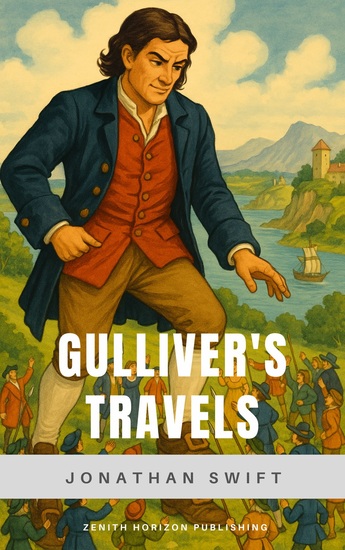
Gulliver's Travels - Jonathan Swift's Satirical Voyage Through Strange Lands - cover

Gulliver's Travels - Jonathan Swift's Satirical Voyage Through Strange Lands

Jonathan Swift, Zenith Horizon Publishing

Publisher: Zenith Horizon Publishing

  • 0
  • 0
  • 0

Summary

Four voyages. Countless wonders. One biting satire of the human race.

In Gulliver's Travels, Jonathan Swift unleashes his sharp wit and vivid imagination through the incredible adventures of Lemuel Gulliver. From the miniature Lilliputians to the towering Brobdingnagians, and from the flying island of Laputa to the noble Houyhnhnms, this iconic tale is both a fantasy epic and a razor-sharp social commentary.

A masterpiece of satire, political allegory, and adventure, Gulliver's Travels is as entertaining as it is thought-provoking.

đź§­ This edition includes:

The complete, unabridged text

Stunning illustrations bringing each strange land to life

Kindle-optimized layout for easy digital navigation

📚 Perfect for fans of classic literature, fantastical adventures, and timeless wit.

Travel far. Laugh hard. Reflect deeply.
Get your illustrated edition now.
Available since: 06/13/2025.
Print length: 306 pages.
Other books that might interest you

  • Hound The (Unabridged) - cover

    Hound The (Unabridged)

    H. P. Lovecraft

    • 0
    • 0
    • 0
    The story opens with the unnamed narrator preparing to commit suicide. Lamenting his fate, he reflects upon the events which led him to this moment. The narrator and his friend, St. John, are a pair of loners who both have a deranged interest in robbing graves. They constantly defile crypts and often keep souvenirs of their nocturnal expeditions. Since they reside in the same house, they have the opportunity to set up a sort of morbid museum in their basement. Using the objects collected from the various graves they have robbed, the two men organize a private exhibition. The collection consists of headstones, preserved bodies, skulls, and several heads in different phases of decomposition. It also included statues, frightful paintings, and a locked portfolio bound in tanned human skin. One day, the two learn of a particular grave, which sparks a profound interest in them: an old grave in a Holland cemetery which holds a legendary tomb raider within, one who is said to have stolen, many years ago, a "potent thing from a mighty sepulchre." They travel to the old cemetery where the man was buried. The thought of exhuming the final resting place of a former grave robber is irresistibly appealing to them. That, and the fact that the body had been buried several centuries before, drives them to travel such long distances to reach the site. Upon reaching the old cemetery, they notice the distant baying of a giant hound in the distance. They ignore it and begin their excavation. After some time, they hit a solid object in the ground. Clearing the last of the dirt from it, the two men unearth a strange and elaborately-made casket. Upon opening the casket, they see that several places on the skeletal remains appear torn and shattered, as if attacked by a wild animal, yet the whole of the skeleton is still completely distinguishable. At that moment, they notice a jade amulet hanging from the skeleton's neck. They examine it and, after some observation, they recognize the amulet as one mentioned in "the forbidden Necronomicon of the mad Arab Abdul Alhazred." They immediately know they must have the amulet at all cost. They remove it from the skeleton and flee into the night. As they do, they notice once again the continuous sound of a baying hound in the distance. After they return home to England, strange events begin to occur. Odd sounds can be heard within and around their house, including the distant howling they heard in the cemetery. One night, St. John is violently attacked and killed by a mysterious creature, which the narrator claims the amulet had brought unto him. He destroys the macabre museum he and his friend made, before fleeing from the house and traveling to London. Still plagued by bizarre occurrences, he decides that he must return the amulet to its rightful owner. He travels to Holland, but the amulet is stolen from him before he can return it. The next day, he reads in the newspaper about a band of thieves savagely killed by an unknown creature. Slowly going insane, he returns to the churchyard and exhumes the coffin once more, only to find the skeleton within covered in caked blood and bits of flesh and hair, holding the lost amulet in its hand. Suddenly, the skeleton begins howling, the same howl that had tormented him since he first stole the amulet. The narrator flees the graveyard, succumbing to madness and despair. He states that he intends to kill himself with a revolver, believing death to be his only refuge from the crawling horror which grows within him.
    Show book
  • The black arrow A tale of two roses - cover

    The black arrow A tale of two roses

    Robert Louis Stevenson

    • 0
    • 0
    • 0
    "The Black Arrow" is a swashbuckling adventure that follows the protagonist, Richard Shelton, as he becomes embroiled in the conflict between the House of Lancaster and the House of York during the tumultuous Wars of the Roses. The novel is filled with action, intrigue, and romance, as Richard navigates through political and personal challenges.
    Show book
  • Mary Shelley’s Frankenstein - Short & Sweet Edition - cover

    Mary Shelley’s Frankenstein -...

    Simon Foster

    • 0
    • 0
    • 0
    Simon Foster’s short & sweet edition cuts out the fluff from Frankenstein by Mary Shelley and gets straight to the good part. Savor the best literature of all time without spending years of your life treading through endless pages of traditional books. 
    Simon Foster books are suitable for the human attention span, helping you to remember the key details of every book and maximize enjoyment. By the end, you’ll be able to impress your friends, family, or even a professor with your knowledge of Frankenstein without spending hours reading the original edition. 
    Stop wasting hours trying to dissect complex english from old classic books. English has changed over time, and books from hundreds of years ago feel like a different language than modern English.  
    There is no shame in enjoying classics the modern way. Once you discover the joy of listening to classics with Simon Foster, you will never want to go back to old stuffy paperback classics. Welcome to the future of literature!
    Show book
  • Lady of the Shroud The (Unabridged) - cover

    Lady of the Shroud The (Unabridged)

    Bram Stoker

    • 0
    • 0
    • 0
    The Lady of the Shroud is a novel by Bram Stoker, published by William Heinemann in 1909.
    The book is an epistolary novel, narrated in the first person via letters and diary extracts from various characters, but mainly Rupert. The initial sections, leading up to the reading of the uncle's will, told by other characters, suggest that Rupert is the black sheep of the family, and the conditions of having to live in the castle in the Blue Mountains for a year before he can permanently inherit the unexpectedly large million-pound estate suggest the uncle is somehow testing the heir.
    Show book
  • The Wound Dresser - The Lost Manuscript - cover

    The Wound Dresser - The Lost...

    Walt Whitman

    • 0
    • 0
    • 0
    Walter Whitman was an American poet, essayist and journalist. A humanist, he was a part of the transition between transcendentalism and realism, incorporating both views in his works. Whitman is among the most influential poets in the American canon, often called the father of free verse. His work was controversial in its time, particularly his 1855 poetry collection Leaves of Grass, which was described as obscene for its overt sensuality. Whitman's own life came under scrutiny for his presumed homosexuality. 
     
    Born in Huntington on Long Island, as a child and through much of his career, he resided in Brooklyn. At age 11, he left formal schooling to go to work. Later, Whitman worked as a journalist, a teacher, and a government clerk. Whitman's major poetry collection, Leaves of Grass, was first published in 1855 with his own money and became well known. The work was an attempt at reaching out to the common person with an American epic. He continued expanding and revising it until his death in 1892. During the American Civil War, he went to Washington, D.C. and worked in hospitals caring for the wounded. His poetry often focused on both loss and healing. On the death of Abraham Lincoln, whom Whitman greatly admired, he wrote his well-known poems, "O Captain! My Captain!" and "When Lilacs Last in the Dooryard Bloom'd", and gave a series of lectures. After a stroke towards the end of his life, Whitman moved to Camden, New Jersey, where his health further declined. When he died at age 72, his funeral was a public event. 
     
    Whitman's influence on poetry remains strong. Mary Whitall Smith Costelloe argued: "You cannot really understand America without Walt Whitman, without Leaves of Grass ... He has expressed that civilization, 'up to date,' as he would say, and no student of the philosophy of history can do without him." Modernist poet Ezra Pound called Whitman "America's poet ... He is America.
    Show book
  • Jilting of Jane The (Unabridged) - cover

    Jilting of Jane The (Unabridged)

    H. G. Wells

    • 0
    • 0
    • 0
    The Jilting of Jane is a short story by H. G. Wells. Herbert George "H. G." Wells (21 September 1866 - 13 August 1946) was an English writer, now best known for his work in the science fiction genre. He was also a prolific writer in many other genres, including contemporary novels, history, politics and social commentary, even writing textbooks and rules for war games. Wells is sometimes called "The Father of Science Fiction," as are Jules Verne and Hugo Gernsback. His most notable science fiction works include The War of the Worlds, The Time Machine, The Invisible Man and The Island of Doctor Moreau. Wells's earliest specialised training was in biology, and his thinking on ethical matters took place in a specifically and fundamentally Darwinian context. He was also from an early date an outspoken socialist, often (but not always, as at the beginning of the First World War) sympathising with pacifist views. His later works became increasingly political and didactic, and he sometimes indicated on official documents that his profession was that of "Journalist."
    Show book