Join us on a literary world trip!
Add this book to bookshelf
Grey
Write a new comment Default profile 50px
Grey
Subscribe to read the full book or read the first pages for free!
All characters reduced
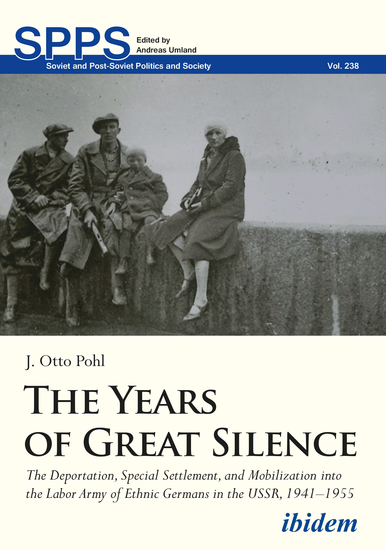
The Years of Great Silence - The Deportation Special Settlement and Mobilization into the Labor Army of Ethnic Germans in the USSR 1941–1955 - cover

The Years of Great Silence - The Deportation Special Settlement and Mobilization into the Labor Army of Ethnic Germans in the USSR 1941–1955

Jonathan Otto Pohl

Publisher: ibidem

  • 0
  • 0
  • 0

Summary

This monograph provides a detailed yet concise narrative of the history of the ethnic Germans in the Russian Empire and USSR.
Available since: 03/22/2022.
Print length: 298 pages.

Other books that might interest you

  • Watergate: The Scandal That Brought Down a President - cover

    Watergate: The Scandal That...

    Editors Charles River

    • 0
    • 0
    • 0
    Increasingly and mistakenly viewed as a single scandal within the United States government, what is commonly referred to as the Watergate scandal serves as an overarching term for a series of scandals beginning in 1971 and extending through 1974, although more than any other, it refers to the specific break-in at the Watergate Hotel and office complex in Washington, D.C. The crisis, originating in a secretive battle between the two major political parties, the Nixon White House’s paranoia, and the ensuing conflict concerning the release of confidential information to the public, induced senior government officials into committing crimes (most notoriously petty burglary) and coverups for the purposes of character assassination and inter-political espionage, and it ultimately resulted in the first and only resignation of a sitting American president, Richard Milhous Nixon. Watergate has since become so synonymous with scandal that “gate” is typically added to the end of words associated with scandals even today. 
    	In the wake of the seemingly peculiar burglary, gradual media and judicial pursuits of the thread of scandals led from one thing to another over the following years until it began to culminate with Congressional impeachment proceedings and a momentous showdown between the President and the Supreme Court over the release of presidential tapes, a moment in which Nixon seriously considered defying the Court and initiating a constitutional crisis. When he at last surrendered them, excerpts were blatantly missing, most famously an 18 minute stretch. Given the flurry of activities, it has only been in recent years that historians have gained a full measure of the nation’s perilous status during the intense battle between the various branches of the federal government, and the American public’s view of government in general took a decidedly negative turn.
    Show book
  • Light in the Dark - The Last Sanctuary from the Holocaust - cover

    Light in the Dark - The Last...

    Robert Marshall

    • 0
    • 0
    • 0
    An extraordinary true story of survival and courage through the Holocaust. 


    Poland, 1943. It was the last refuge of the desperate, a warren of sewers underneath their city. Above, as the Nazis destroyed the ghetto of the city of Lvov, a small band of Jews escaped into a grim network of tunnels, living for fourteen months with the city's waste, the sudden floods, the fumes and the damp, the rats, the darkness, and the despair. 


    Their only support was a lone sewer worker, an ex-criminal who constantly threatened to leave them. Many died; some falling into the rushing waters of the river, some simply of exhaustion. At one point the survivors found themselves trapped in a chamber, filling to the roof with storm-water. 


    Yet survive they did, even infiltrating the camps above to find their missing relatives. When the Russians liberated Lvov, they emerged from the sewers filthy, bent double, emaciated, unrecognizable . . . but alive. 


    This powerful story based on a long series of interviews, and a hitherto private diary, creates a blazing testimony to human faith and endurance.
    Show book

  • The Ethiopian Famine of 1984-1985 - International Response and the Impact of Drought and Civil Conflict - cover

    The Ethiopian Famine of...

    Sarah Willards

    • 0
    • 0
    • 0
    The Ethiopian Famine of 1984-1985 was a catastrophic event that left an indelible mark on the country and the world. Its origins are complex, shaped by a combination of environmental, political, and socio-economic factors. To understand the famine, it is essential to examine the historical and climatic conditions that set the stage for this disaster. 
    Ethiopia's geography and climate have always made the region vulnerable to periodic droughts, and these climatic conditions played a critical role in the 1984-1985 famine. The country is located in the Horn of Africa, a region prone to irregular rainfall and long dry periods. The 1984-1985 famine was preceded by several years of drought that severely impacted the country's agricultural production. The lack of rain led to crop failures, and the country's reliance on subsistence farming meant that many rural populations were unable to feed themselves. The loss of staple crops such as maize, teff, and sorghum caused widespread food shortages, making the situation more dire. 
    In addition to the environmental factors, Ethiopia's agricultural practices also contributed to the severity of the famine. Traditional farming methods, which had been practiced for centuries, were often inefficient and poorly adapted to the changing climate. The reliance on rain-fed agriculture, coupled with limited access to irrigation or modern farming technology, left farmers vulnerable to the effects of drought. Soil erosion, deforestation, and inadequate land management further exacerbated the situation, reducing the land's ability to produce enough food for the population.
    Show book
  • Francisco Pizarro - The Spanish Explorer and Conquistador in Peru - cover

    Francisco Pizarro - The Spanish...

    Kelly Mass

    • 0
    • 0
    • 0
    Conquistadores (or Conquistadors) were the Spanish and Portuguese conquerors who invaded parts of the world that hadn’t been discovered by the Europeans before the 16th century. Some of these conquerors behaved fairly nice and respectful towards the local population in South America, Asia, Africa, and Central America. Others were incentivized by greed, lust, and dominance, which caused them to pillage, steal, and enslave the indigenous people they encountered. Many of their leaders were notorious for their brutality. Yet, like any other sad part in history, it’s important to recognize what has transpired to understand the origins of Catholicism in many of those countries, as well as the Spanish and Portuguese language they still speak today in countries like Brazil, Peru, the Philippines, and Mexico. 
    In this book, you will learn more about one infamous sadist in particular: Francisco Pizarro, who abused and attacked the Peruvian peoples, acted as an inquisitor for the Catholic Church, and inflicted physical and psychological wounds on his subjects. Let’s learn more about him to understand what was going on back then.
    Show book
  • Espionage - A Concise History - cover

    Espionage - A Concise History

    Kristie Macrakis

    • 0
    • 0
    • 0
    A concise introduction to the history and methods of espionage, illustrated by spy stories from antiquity to today's high-tech world. 


    Espionage is one of the most secret of human activities. It is also, as the popularity of spy stories suggests, one of the most intriguing. This book pulls the veil back on the real world of espionage, revealing how spying actually works. In a refreshingly clear, concise manner, Kristie Macrakis guides listeners through the shadowy world of espionage, from the language and practice of spycraft to its role in international politics, its bureaucratic underpinnings, and its transformation in light of modern technology. Espionage is a mirror of society and human foibles with the added cloak of secrecy and deception. Accordingly, Espionage traces spying all the way back to antiquity, while also moving beyond traditional accounts of military and diplomatic intelligence to shine a light on industrial espionage and the new techno-spy. As thorough—and thoroughly enjoyable—as it is compact, the book is an ideal introduction to the history and anatomy of espionage.
    Show book
  • Ukraine & Russian History 9 Books In 1 - Kievan Rus Tsardom Of Russia Soviet Union Russian Federation & Ukraine - cover

    Ukraine & Russian History 9...

    HISTORY FOREVER

    • 0
    • 0
    • 0
    9 books in 1Book 1 - The History Of Russia: The Rise And Fall Of Soviet Communism: Russian History Of The Tsars, Lenin And The Bolsheviks, Stalin & The Russian RevolutionBook 2 - Soviet Union: Russian History Of The Tsars And The Collapse Of The Ussr After World War 2Book 3 - Russia Ukraine War 2022: Putin's Invasion Of Ukraine: History Of Russia-Ukraine Relations And The Russia's War On UkraineBook 4 - Vladimir Putin: Tsar Of The 21st Century: Ex-KGB Agent To President - Putin’s Dictatorship And RegimeBook 5 - KGB History: 100 Years Of Soviet Terror: The Secret Police Of Russia: Cheka, GPU, OGPU, NKVD, KGB, FSK & FSBBook 6 - Soviet Union Spy Operations: KGB, CIA & Stasi: Learn Fast What It Takes To Be A Secret Service AgentBook 7 - Medieval Ukraine History: Ukraine Between Europe And Russia: The Golden Age Of Kievan Rus, Kingdom Of Galicia And The CossacksBook 8 - Ukrainian History Of The 20th Century: Ukraine Revolution, World War And The Soviet UnionBook 9 - Modern Ukraine History: Ukraine At War Russia 2014-2022: Zelensky Vs Putin And The Future Of Ukraine, Russia And Europe
    Show book