Join us on a literary world trip!
Add this book to bookshelf
Grey
Write a new comment Default profile 50px
Grey
Subscribe to read the full book or read the first pages for free!
All characters reduced
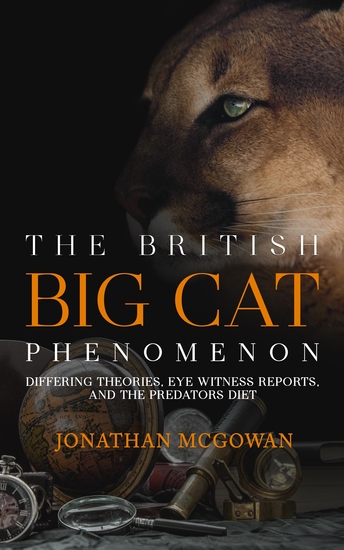
The British Big Cat Phenomenon - Differing Theories Eye Witness Reports and the Predators Diet - cover

The British Big Cat Phenomenon - Differing Theories Eye Witness Reports and the Predators Diet

Jonathan McGowan

Publisher: Hangar 1 Publishing

  • 0
  • 0
  • 0

Summary

A fascinating book by Jonathan McGowan that explores the many sightings of big cats in Britain.
 
In the book, Jonathan details his sightings, from the Badger Stalker to the Longham Puma, and delves into the various theories about these animals. He also examines reports from other witnesses, including those who have seen these creatures up close and personal, that are particularly compelling.
 
Written in an accessible and engaging writing style, this book brings those stories to life. Moreover, the book also looks at the predator's diet and how they could survive in the wild.
 
With so many sightings of big cats across Britain, this is a fascinating and insightful book that will leave you wondering whether these creatures really do exist.
Available since: 07/01/2022.
Print length: 198 pages.

Other books that might interest you

  • Homo Sapiens: A Captivating Guide to the History of Humans and Human Evolution - cover

    Homo Sapiens: A Captivating...

    Captivating History

    • 0
    • 0
    • 0
    Have you ever wanted to know how Homo sapiens became “human?” 
    In the beginning, Homo sapiens was just one of the human species in the world. After centuries of coexistence, it was the only survivor. How did that happen? 
    This captivating audiobook on Homo sapiens uncovers the secrets of our species and what made us human. From their humble beginnings in the dawn of prehistory, Homo sapiens rose to become one of the most resilient species in the world. 
    Unlike many other creatures, Homo sapiens lack the physical prowess of fierce predators. Yet, armed with an exceptional cognitive capacity, our species has defied the odds. How did we achieve that? 
    This audiobook uncovers the fascinating stories locked within our DNA, as well as our cultural legacy, tracing the history of our species since its very beginnings. Our cognitive capabilities and advanced communication skills have paved the way for our species’ success. From harnessing the power of fire to mastering the art of metalworking, our ancestors were relentless inventors who tamed the wild and conquered new frontiers. 
    Transporting readers back in time, this captivating exploration begins seven million years ago in Africa. Witness the remarkable moment when a group of primates started walking upright, setting in motion the extraordinary story of our species. 
    Scroll up and click the “add to cart” button to learn more about Homo sapiens today!
    Show book
  • The Weather Girls - cover

    The Weather Girls

    Sarah Webb

    • 0
    • 0
    • 0
    It's 1944. Twelve-year-old Grace Devine lives at Blacksod Lighthouse and weather station in County Mayo with her parents and little brother. When a German plane crashes nearby, she and her best friend Sibby risk their lives to save the young pilot. Grace's family take him in, but their neighbours are horrified at having an 'enemy' in their midst.
    Meanwhile, the Met Office in England suddenly asks Blacksod to send them weather reports every hour. But why? As the wind and rain howl outside, Grace begins to understand that something important is happening, something to do with the war – and she is right in the eye of the storm.
    A tale of bravery, adventure and a remarkable friendship, inspired by true events from World War 2.
    Show book
  • Empedocles - The Four Elements and Cosmic Cycles - cover

    Empedocles - The Four Elements...

    Hector Davidson

    • 0
    • 0
    • 0
    Empedocles, a philosopher and poet from the ancient Greek city of Acragas (modern-day Agrigento, Sicily), lived during the 5th century BCE and is often regarded as one of the most original thinkers of his time. His life and works remain an intriguing fusion of science, mysticism, and poetry. Though much of what we know about Empedocles comes from fragments of his writings, his ideas have had a profound and lasting influence on philosophy, science, and even religion. 
      
    Empedocles is best known for his theory of the four elements—earth, air, fire, and water—which he posited as the fundamental building blocks of the universe. Unlike his predecessors, who sought to explain the world through a singular substance (such as water for Thales or air for Anaximenes), Empedocles argued that these four elements combined and separated through two cosmic forces: Love (Philia) and Strife (Neikos). Love brings the elements together, fostering harmony and unity, while Strife pulls them apart, creating division and chaos. This cyclical process of combination and separation underlies the ongoing changes in the cosmos. 
      
    In addition to his materialistic philosophy, Empedocles incorporated spiritual and mystical elements into his worldview. He believed in the transmigration of souls, suggesting that human beings and other living creatures are bound to an endless cycle of reincarnation. According to Empedocles, the soul is trapped in a cycle of birth, death, and rebirth, and it can achieve liberation through purification and virtuous living. His philosophical system thus integrated both natural and ethical concerns, urging individuals to live in harmony with the forces of the cosmos and pursue a life of virtue.
    Show book
  • Archaeology of the Anunnaki Sumerians - Revealing Strange Artifacts and Mesopotamia Mysteries - cover

    Archaeology of the Anunnaki...

    Faruq Zamani

    • 0
    • 0
    • 0
    Leonard Woolley, an archaeologist from Britain, returned to Iraq in 1922, almost 4,000 years after the nuclear ancient catastrophe, to uncover ancient Mesopotamia.An imposing ziggurat standing out in the desert plain drew him to the nearby site of Tell el-Muqayyar, where he began excavating. As old walls, artifacts, and inscriptions were unearthed, he realized he was digging up ancient Ur-Ur of the Chaldees. 
    Twelve years of his work were conducted through a joint expedition between the British Museum in London and the University of Pennsylvania Museum in Philadelphia. For those institutions, Sir Leonard Woolley found some of the most dramatic objects and artifacts in Ur. However, what he discovered may well surpass anything ever exhibited before. 
    In the course of removing layers of soil deposited by desert sands, the elements, and time from the ruins, the ancient city began to take shape-here were the walls, there were the harbors and canals, the residential quarters, the palace, and the Tummal, the elevated sacred area. Woolley's discovery of a cemetery dated thousands of years ago included unique 'royal' tombs discovered by digging at its edge is the find of the century.
    Show book
  • Music and Globalization - Critical Encounters - cover

    Music and Globalization -...

    Bob W. White

    • 0
    • 1
    • 0
    "World music" emerged as a commercial and musical category in the 1980s, but in some sense music has always been global. Through the metaphor of encounters, Music and Globalization explores the dynamics that enable or hinder cross-cultural communication through music. In the stories told by the contributors, we meet well-known players such as David Byrne, Peter Gabriel, Sting, Ry Cooder, Fela Kuti, and Gilberto Gil, but also lesser-known characters such as the Senegalese Afro-Cuban singer Laba Sosseh and Raramuri fiddle players from northwest Mexico. This collection demonstrates that careful historical and ethnographic analysis of global music can show us how globalization operates and what, if anything, we as consumers have to do with it.
    Show book
  • Too Many - The Divine Impacts of Leaders Throughout Recent History - cover

    Too Many - The Divine Impacts of...

    James Syver

    • 0
    • 0
    • 0
    From John Paul II, to Frederick Douglas, Martin Luther King Jr. and others in between, Too Many, by author James Syver, shares the stories of twenty people who have impacted history and the lives of many. Each was moved to state their trust and belief in their Creator, and in large measures, credit Him for their work. 
    This collection of Christ-inspired histories explores the individuals’ lives and the impact they’ve had on society. Syver discusses each person’s background and character, what propelled them forward, how they inspired future generations, and how they were guided by their faith. 
    Offerings of lives well lived, ‘Too Many’ shares how each of these twenty people influenced the world because they, in their time, listened, and acted. From contemplations to inspiring actions and from many different pages of history, these vignettes underscore a personal belief and trust in the divine. 
    If you like your work and love your country then you will enjoy ‘Too Many’.
    Show book