Join us on a literary world trip!
Add this book to bookshelf
Grey
Write a new comment Default profile 50px
Grey
Subscribe to read the full book or read the first pages for free!
All characters reduced
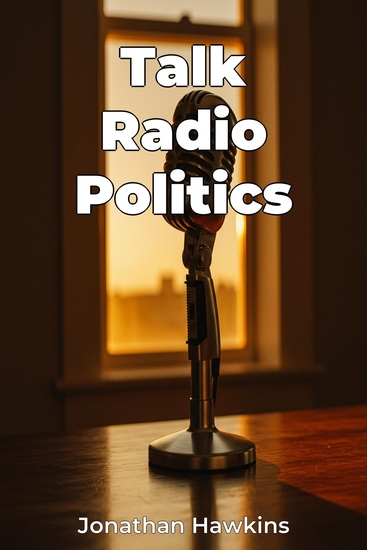
Talk Radio Politics - cover

Talk Radio Politics

Jonathan Hawkins

Translator A Ai

Publisher: Publifye

  • 0
  • 0
  • 0

Summary

"Talk Radio Politics" explores the significant impact of political talk radio on civic discourse and the political landscape, despite the rise of digital media. It examines how hosts craft narratives, mobilize audiences, and influence elections, revealing its enduring power in shaping public opinion, especially among politically engaged citizens. The book highlights the importance of understanding this medium's mechanics and rhetorical strategies in today's complex political communication environment.

 
The book charts the evolution of talk radio, noting the impact of the repeal of the Fairness Doctrine, and analyzes the core elements of the genre: the charismatic host, dedicated listener base, and emphasis on opinion. It argues that political talk radio, while often criticized for partisanship and potential misinformation, also provides space for alternative viewpoints and fosters community. Emotional appeals and framing techniques are key to the medium's persuasive power.

 
The book progresses through detailed portraits of influential hosts, explores the psychological and sociological factors contributing to its persuasive power, and examines its real-world implications in shaping political campaigns and contributing to political polarization. Utilizing content analysis, listener surveys, and interviews, it offers a balanced perspective on both the positive and negative aspects of political talk radio's influence, making it valuable for students, journalists, and anyone interested in contemporary politics.
Available since: 03/31/2025.
Print length: 70 pages.

Other books that might interest you

  • The Dragons and the Snakes - How the Rest Learned to Fight the West - cover

    The Dragons and the Snakes - How...

    David Kilcullen

    • 0
    • 0
    • 0
    Just a few years ago, people spoke of the US as a hyperpower—a titan stalking the world stage with more relative power than any empire in history. Yet as early as 1993, CIA director James Woolsey pointed out that although Western powers had "slain a large dragon" by defeating the Soviet Union in the Cold War, they now faced a "variety of poisonous snakes." 


    In The Dragons and the Snakes, the eminent soldier-scholar David Kilcullen asks how, and what, opponents of the West have learned during the last quarter-century of conflict. Applying a combination of evolutionary theory and detailed field observation, he explains what happened to the "snakes"-non-state threats including terrorists and guerrillas-and the "dragons"-state-based competitors such as Russia and China. He explores how enemies learn under conditions of conflict, and examines how Western dominance over a very particular form of warfare since the Cold War has created a fitness landscape that forces adversaries to adapt in ways that present serious new challenges to America and its allies. Within the world's contemporary conflict zones, Kilcullen argues, state and non-state threats have increasingly come to resemble each other, with states adopting non-state techniques and non-state actors now able to access levels of precision and lethal weapon systems once only available to governments.
    Show book
  • History of China - Specific Events Causes and Consequences - cover

    History of China - Specific...

    Kelly Mass

    • 0
    • 0
    • 0
    This is a combo of 5 titles with different topics related to Chinese history. The topics are the following: 
    Ancient China: It’s hard to cover all of China’s vast history in a short book, but for the sake of leaving out details, we will still give it a try. In this guide, you will be able to learn more about the most important turning events, eras, dynasties, leaders, wars, and cultural aspects of ancient China. 
    Chinese Mythology: Chinese folklore is mythology from the geographical area now called China that has been given orally or documented. Several myths from different local and cultural customs are included in Chinese folklore. Much of folklore includes thrilling stories including impressive characters and beings, the use of magic powers, and normally occurs in a mythologically unique area or time. 
    Confucius: Confucius was a Chinese thinker and political leader who was considered as the apotheosis of Chinese sages. Confucius' theories and philosophy, commonly seen as one of the most essential and prominent individuals in human history, created the structure of East Asian civilization and civilization, and stay appropriate across China and East Asia today. Confucianism, his philosophical theories, highlighted personal and governmental morality, social connection precision, justice, generosity, and genuineness. 
    Mao Zedong: Mao Zedong has had a tremendous impact on the Chinese nation. During his Great Leap Forward, he was responsible for more deaths than both Hitler and Stalin, making him the biggest mass murderer in history. What happened during the Great Leap Forward? Why did so many farmers starve to death? And what else did Mao Zedong do during his reign? 
    Portuguese Macau: Macau is known as the Las Vegas of China. It attracts many tourists every year, and it has a unique set of laws and history behind it. How did it become this way? Well, one of the reasons is that it used to be part of the Portuguese Empire.
    Show book
  • Operation Z - cover

    Operation Z

    Jacques Baud

    • 0
    • 0
    • 0
    Why did Putin launch Operation Z in Ukraine? Are Ukrainian forces using neo-Nazi volunteers? What are the forces involved and the reality of the military conflict for the past six months? What do we know about war crimes like Butcha? Have Western economic sanctions worked? Has the massive shipment of arms by the West had an effect on the conflict? After the best-seller Putin: Master of the Game, whose analysis has been praised worldwide, Jacques Baud returns in this book to the root causes of the war in Ukraine and the reasons that pushed Vladimir Putin to intervene on February 24, 2022. Using information from intelligence services and official reports, he analyzes the course of the military actions and the way they were interpreted in the West. He explains the political and economic upheaval of the world order, as well as the long-term consequences of Western sanctions on our daily lives. It reveals how the conflict could have been avoided and what avenues were deliberately left open by the United States and Europe. Colonel Jacques Baud is a former member of the Swiss Strategic Intelligence, a specialist in Eastern Europe and former head of Doctrine of the United Nations Peace Operations. Within NATO, he was involved in programs in Ukraine, including after the Maidan Revolution of 2014 and 2017. He is the author of several books on intelligence, war and terrorism, including Putin, Master of the Game? Governing by Fake News, and The Navalny Affair, all published by Max Milo. 
    This audiobook is read by a synthesized voice.
    Show book
  • Pirate Enlightenment or the Real Libertalia - cover

    Pirate Enlightenment or the Real...

    David Graeber

    • 0
    • 0
    • 0
    "Narrator Roger Davis, who earned first-class honors in media and anthropology, puts his training to good use to lead listeners through 17th- and 18th-century Malagasy history." - Library Journal The final posthumous work by the coauthor of the major New York Times bestseller The Dawn of Everything.Pirates have long lived in the realm of romance and fantasy, symbolizing risk, lawlessness, and radical visions of freedom. But at the root of this mythology is a rich history of pirate societies—vibrant, imaginative experiments in self-governance and alternative social formations at the edges of the European empire.In graduate school, David Graeber conducted ethnographic field research in Madagascar for his doctoral thesis on the island’s politics and history of slavery and magic. During this time, he encountered the Zana-Malata, an ethnic group of mixed descendants of the many pirates who settled on the island at the beginning of the eighteenth century. Pirate Enlightenment, or the Real Libertalia, Graeber’s final posthumous book, is the outgrowth of this early research and the culmination of ideas that he developed in his classic, bestselling works Debt and The Dawn of Everything (written with the archaeologist David Wengrow). In this lively, incisive exploration, Graeber considers how the protodemocratic, even libertarian practices of the Zana-Malata came to shape the Enlightenment project defined for too long as distinctly European. He illuminates the non-European origins of what we consider to be “Western” thought and endeavors to recover forgotten forms of social and political order that gesture toward new, hopeful possibilities for the future.A Macmillan Audio production from Farrar, Straus and Giroux.
    Show book
  • The Art of War - cover

    The Art of War

    Sun Tzu

    • 0
    • 0
    • 0
    The Art of War by Sun Tzu is the definitive ancient guide to military strategy, leadership, and psychological warfare — a masterpiece of timeless wisdom as relevant today as it was over 2,000 years ago. 
    Structured as a series of maxims, this foundational text offers insights into the nature of conflict, the value of preparation, and the dynamics of victory and defeat. In this authoritative English translation by Lionel Giles (first published in 1910), the text is presented with clarity, elegance, and scholarly precision. 
    From generals and CEOs to athletes and philosophers, The Art of War has been studied across disciplines for its profound understanding of power, discipline, and adaptability. This audiobook is essential listening for anyone interested in leadership, decision-making, and the strategy of life itself.
    Show book
  • Unchained Privacy: Blockchain Security and the Fight for Civil Liberties - cover

    Unchained Privacy: Blockchain...

    BLOCKCHAINS BLUEPRINT

    • 0
    • 0
    • 0
    This audiobook explores the crucial intersection of privacy, security, and civil liberties in the digital age. It discusses how increasing data collection and surveillance threaten individual autonomy and free expression. Blockchain technology is presented as a potential solution, offering decentralized and secure methods for managing personal data and financial transactions. The text examines the benefits of blockchain, like empowering individuals and enhancing financial inclusion, but it also acknowledges challenges such as regulatory hurdles and potential for misuse. Ultimately, it champions the need to balance privacy with security and to promote responsible development of blockchain technologies to safeguard fundamental freedoms.
    Show book