Join us on a literary world trip!
Add this book to bookshelf
Grey
Write a new comment Default profile 50px
Grey
Subscribe to read the full book or read the first pages for free!
All characters reduced
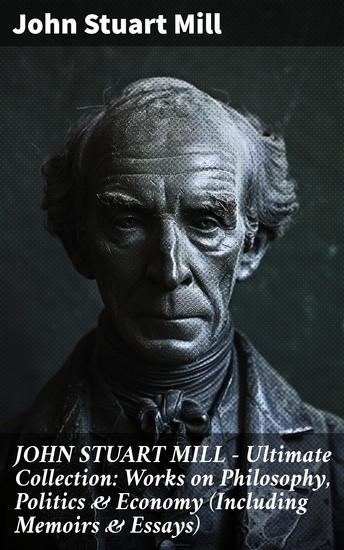
JOHN STUART MILL - Ultimate Collection: Works on Philosophy Politics & Economy (Including Memoirs & Essays) - A Comprehensive Compilation of Mill's Influential Works and Insights - cover

JOHN STUART MILL - Ultimate Collection: Works on Philosophy Politics & Economy (Including Memoirs & Essays) - A Comprehensive Compilation of Mill's Influential Works and Insights

John Stuart Mill

Publisher: Good Press

  • 0
  • 0
  • 0

Summary

John Stuart Mill's "Ultimate Collection: Works on Philosophy, Politics & Economy (Including Memoirs & Essays)" presents a comprehensive anthology of Mill's most influential writings. This extensive volume encapsulates Mill's profound contributions to utilitarianism, liberal thought, and economic theory, characterized by clear prose and rigorous argumentation. His works reflect the intellectual ferment of the 19th century, addressing vital issues such as individual liberty, social justice, and the dynamics of political economy, all while embracing a progressive and empirical approach to philosophical inquiry. John Stuart Mill, a polymath and son of noted philosopher James Mill, grew up immersed in an environment steeped in Enlightenment ideals. His early education, coupled with personal tragedies, shaped his humanistic outlook and advocacy for social reform. Mill'Äôs experiences in activism, particularly with the women'Äôs suffrage movement and labor rights, informed his philosophical positions, revealing a commitment to the enhancement of human well-being through rational discourse and ethical considerations. This volume is indispensable for readers seeking to understand the foundations of modern liberal democracy and economic thought. Mill'Äôs timeless essays encourage critical examination of personal and societal values, making the collection not only a historical artifact but also a profound commentary on contemporary issues. Ideal for students, scholars, and anyone passionate about philosophy, politics, or economics.
Available since: 01/17/2024.
Print length: 3191 pages.

Other books that might interest you

  • First Lesbian Experience Explicit Sex Stories - Older Woman Younger Woman Cougar Coming Out Girl On Girl First Time Lesbian - cover

    First Lesbian Experience...

    Laura Vixen

    • 0
    • 0
    • 0
    This 3 short story lesbian coming out collection includes:Coming Out to the Cougar Next DoorDreams of Puppy LoveComing Out to the Older Farm Volunteer 
    This book will give you all that you need to know to heat things up with your partner or yourself. So, what are you waiting for? Get ready to have your breath taken away and explore your deepest fantasies!
    Show book
  • Mishkât Al-Anwar (The Niche For Lights) - The classic work of Sufi mystical thinking - cover

    Mishkât Al-Anwar (The Niche For...

    Al- Ghazzali, WHT Gairdner

    • 0
    • 0
    • 0
    The classic work of Sufi mystical thinking from 1100CE, available in audiobook for the first time. It is also known as A Niche of Lamps. In the middle ages, Sufi scholars reconciled rationality and faith, both of which were ascendant in the empires of the time. This is one of the great philosophical and theological works from that period, and shows another side to Islam than the doctrinaire version that is more commonly spoken of. Al-Ghazali is often called "the proof of Islam" (hujjat al-islam), because he tried to bridge inquiry, legislation and mystical practice. One could call al-Ghazali the prototype Muslim intellectual.This translation was done in 1823 by WHT Gairdner, who also includes a commentary upon the ideas that Al-Ghazzali presents.The Niche of Lights, written near the end of his life, is about the need for balance between the authority of the divine and reason, seeing both as essential to real spiritual development.
    Show book
  • Physics - cover

    Physics

    Aristotle

    • 0
    • 0
    • 0
    This seminal work delves into the essence of change, motion, and the purposes of natural phenomena, exploring the interplay of matter and form. Aristotle's methodical inquiries lay the groundwork for centuries of scientific thought, dissecting the laws that govern the universe. A must-read for anyone seeking to understand the origins of natural philosophy and the roots of modern science.
    Show book
  • German Invasions of France during the World Wars The: The History of Germany’s Campaigns in World War I and World War II - cover

    German Invasions of France...

    Editors Charles River

    • 0
    • 0
    • 0
    If trench warfare was an inevitability during the war, it is only because the events leading up to the First Battle of the Marne were quite different. The armies at the beginning of the war moved quickly through the land, but the First Battle of the Marne devolved into a bloody pitched battle that led to the construction of trenches after the Germans retreated, blocked in their pursuit of Paris. When the aftermath disintegrated into a war between trenches, some Germans thought they had the upper hand since they were occupying French territory, but with fewer soldiers than the combined Allied nations and fewer resources and supplies, it was possibly only a matter of time before they were ultimately defeated. The commander of the German armies, General Helmuth von Moltke, allegedly said to Kaiser Wilhelm II immediately after the First Battle of the Marne, "Your Majesty, we have lost the war." 
    One of the most famous people in the world came to tour the city of Paris for the first time on June 28, 1940. Over the next three hours, he rode through the city’s streets, stopping to tour L’Opéra Paris. He rode down the Champs-Élysées toward the Trocadero and the Eiffel Tower, where he had his picture taken. After passing through the Arc de Triomphe, he toured the Pantheon and old medieval churches, though he did not manage to see the Louvre or the Palace of Justice. Heading back to the airport, he told his staff, “It was the dream of my life to be permitted to see Paris. I cannot say how happy I am to have that dream fulfilled today.” Four years after his tour, Adolf Hitler would order the city’s garrison commander, General Dietrich von Choltitz, to destroy Paris, warning his subordinate that the city "must not fall into the enemy's hand except lying in complete debris." 
    Show book
  • Debunking 20 Bitcoin Myths: Unlocking America's Crypto Future - Shatter Illusions on Volatility Regulation and Power – Invest Smarter in the US Digital Gold Rush - cover

    Debunking 20 Bitcoin Myths:...

    Anonymous

    • 0
    • 0
    • 0
    This audiobook is narrated by an AI Voice.   
    Debunking 20 Bitcoin Myths: Unlocking America's Crypto Future cuts through bubble headlines and doomsday climate takes to ask what this code actually does for US money, power and policy. From "it's a Ponzi" and "has no real use" to "will be banned" and "kills the planet", Miguel Thornton tests each viral claim against SEC filings, Fed speeches, ETF flows, mining data and real world case studies of savers, migrants and miners. In twenty sharp, tightly sourced chapters he explains how Wall Street, regulators and media built comforting myths that protect the old system, and what the numbers really say about volatility, regulation, inequality and national security. If you want to argue or invest in Bitcoin with factsinstead of memes, start here.
    Show book
  • The Afterlife of Byzantium - cover

    The Afterlife of Byzantium

    Santiago Machain

    • 0
    • 0
    • 0
    The Afterlife of Byzantium traces the final centuries of the Byzantine Empire from the Palaiologan restoration to the fall of Constantinople—and follows its astonishing afterlife far beyond 1453. Through nine richly detailed chapters culminating in a study of legacy and memory, this volume reveals how an empire under pressure reinvented itself through faith, diplomacy, art, scholarship, and everyday resilience. Readers encounter the return to Constantinople in 1261, the fraying frontiers of the Balkans and Anatolia, the mystical power of Hesychasm, the resourceful brilliance of Palaiologan art, the hard math of a late economy, and the fine-edged craft of survival diplomacy. The ascent of the Ottomans and the last defense of 1453 are narrated alongside the intimate human experiences of merchants, monks, mothers, and envoys. 
    Beyond the walls, the book follows Byzantium’s legacy into Ottoman institutions, Orthodox worship, Venetian print shops, Cretan ateliers, Muscovite courts, and the domestic rituals that carried memory forward. It shows how Byzantine law, liturgy, education, iconography, and political imagination shaped communities for centuries, from the Phanar’s salons to Athonite scriptoria, from market stalls to imperial chancelleries. Written in an informative, humanized, and professional voice, this is a story of continuity through change—a portrait of how an empire’s culture outlived its sovereignty and continued to teach the world how to endure with dignity.
    Show book