Join us on a literary world trip!
Add this book to bookshelf
Grey
Write a new comment Default profile 50px
Grey
Subscribe to read the full book or read the first pages for free!
All characters reduced
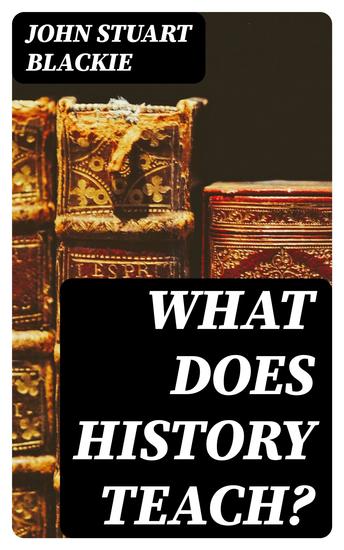
What Does History Teach? - Two Edinburgh Lectures - cover

What Does History Teach? - Two Edinburgh Lectures

John Stuart Blackie

Publisher: DigiCat

  • 0
  • 0
  • 0

Summary

John Stuart Blackie's "What Does History Teach?" serves as a thoughtful examination of the lessons embedded within historical narratives, emphasizing the interconnectedness of past events and contemporary thought. This philosophical treatise adopts a reflective literary style, engaging readers through eloquent prose that marries anecdotal evidence with rigorous analysis. Blackie draws on a wide array of historical sources, from ancient civilizations to recent histories, to elucidate how these lessons shape moral understanding, citizenship, and civilization itself within the broader context of 19th-century intellectual thought, an era marked by fervent inquiries into human experience and identity. John Stuart Blackie (1809-1895) was a Scottish scholar, poet, and educator whose diverse academic pursuits greatly informed his writing. Educated at the University of Edinburgh, he traveled extensively across Europe, where exposure to different cultures and philosophical ideas nourished his belief in the importance of history as a moral guide. His passion for learning and ability to synthesize knowledge from various disciplines led him to create this compelling work, which reflects his own experiences and insights into the role of history in shaping human character and societal values. This book is highly recommended for readers interested in the intersection of history, philosophy, and moral education. Blackie's insightful synthesis encourages critical reflection and will appeal to historians, educators, and anyone seeking to understand how historical precedents inform modern-day dilemmas. His engaging style and profound insights make "What Does History Teach?" a valuable addition to the library of any thoughtful scholar.
Available since: 09/16/2022.
Print length: 56 pages.
Other books that might interest you

  • Can Human Problems Be Solved? - Brockwood Park 1980 - Dialogue 15 - cover

    Can Human Problems Be Solved? -...

    Jiddu Krishnamurti

    • 0
    • 0
    • 0
    "Can human problems be solved? - 27 September 1980 
    • Why have human beings throughout the world not been able to resolve human, 
    daily problems of life? What are the things that prevent the solution of these 
    problems completely? 
    • When there is attention there is no centre from which I attend. 
    • A poor man wants to be rich and a rich man wants to be richer. It is a movement 
    of becoming, becoming, both outwardly and inwardly. Though it brings a great deal of pain and sometimes pleasure, this sense of becoming, fulfilling, achieving psychologically has made my life into all that it is. 
    • Is love something that is common to all of us? 
    • From the particular move to the general, from the general move away still 
    deeper, and there perhaps is this purity of that thing called compassion, love and intelligence. But that means giving your mind and heart to this. Your whole being must be involved in this."
    Show book
  • Sevastopol Sketches - A Gripping Account of War Courage and the Human Spirit - cover

    Sevastopol Sketches - A Gripping...

    Leo Tolstoy, Tim Zengerink

    • 0
    • 0
    • 0
    What if the real story of war lies not in glory—but in the hearts of those who endure it? 
    Sevastopol Sketches offers an unfiltered look into the Crimean War through the eyes of a young officer who would become one of the world’s greatest authors—Leo Tolstoy.  
    In this gripping trilogy of war vignettes—Sevastopol in December, Sevastopol in May, and Sevastopol in August—Tolstoy reveals the raw and often tragic reality of conflict.  
    From the trenches and hospitals to the fleeting moments of human compassion, this audiobook delivers a profound meditation on war’s cost, captured with rare honesty and literary brilliance. 
    What you'll discover inside: 
    ●	A Realistic Portrait of Warfare – The brutal, everyday truth of combat without romanticism. 
    ●	Three Powerful Sketches – Each offering a unique window into different phases of the siege. 
    ●	Reflections on Courage and Humanity – A deep exploration of morality in the face of death. 
    ●	Tolstoy’s Early Masterpiece – The foundation of his literary voice and philosophical depth. 
    Start listening today and experience the war that shaped one of literature’s greatest minds—and see the battlefield through the eyes of conscience.
    Show book
  • Chip War: Book Summary & Analysis - cover

    Chip War: Book Summary & Analysis

    Briefly Summaries

    • 0
    • 0
    • 0
    This is a concise summary and analysis of Chip War , by Chris Miller.
     
    It is not the original book and is not affiliated with or endorsed by Chris Miller.
     
    Ideal those seeking a quick and insightful overview.
    
     
    Chip War explores the global race for dominance in semiconductor technology, a field that underpins modern economies and national security. The book delves into the history, politics, and economic strategies behind the production of microchips, highlighting how this seemingly invisible technology has shaped global power dynamics. It examines the geopolitical struggle for control over semiconductor supply chains and its implications for future conflicts in the tech world.
    Show book
  • Anger Management for Parents - Ultimate Guide to Manage Your Anger into Positive and Become More Patient with Your Children Effective Strategies for Women and Men That Will Help to Manage Your Emotions - cover

    Anger Management for Parents -...

    Jennie Garcia

    • 0
    • 0
    • 0
    All I ever seem to do is shout at my kids. Why can’t I get this right? 
    As parents, we can get exhausted caring for our children. We've tried all sorts of methods. In our frustration, we end up yelling, screaming, and hitting them to follow our commands. And they still refuse to listen. 
    This book was written to help parents like you. 
    I’ve put together a lot of practical advice and psychological insights so you can begin changing the way you relate to your child or children. You may be feeling trapped, and a little hopeless, but I assure you that it is possible to calm yourself, get your child to hear and understand you, and to start building better family relationships. Yes, you can! 
    There is a way to raise children to be calmer, respectful, warm-hearted, and happy. You'd be surprised that your children will be beyond just obedient and agreeable after you have listened to this book. 
    What are you waiting for? 
    Scroll to the top of the page and click the “buy now” button.
    Show book
  • The Complete Strategy Collection - The Art of War The Prince The Book of Five Rings Tao Te Ching Arthashastra On War & More - cover

    The Complete Strategy Collection...

    Sun Tzu, Niccolo Machiavelli,...

    • 0
    • 0
    • 0
    Unlock the minds of history’s greatest leaders and tacticians with The Complete Strategy Collection.  
    This modern audiobook adaptation brings together the world’s most influential writings on power, warfare, diplomacy, and leadership—translated and adapted for clarity, comprehension, and immediate application. 
    Perfect for business leaders, political thinkers, strategists, and students of philosophy, this collection reveals the principles that shaped empires and still define success today. 
    This audiobook includes: 
    - The Art of War by Sun Tzu – The foundation of strategic thinking and tactical foresight 
    - The Prince and The Art of War by Niccolò Machiavelli – Political leadership, military strength, and real-world power 
    - The Book of Five Rings by Miyamoto Musashi – Mental mastery and victory through discipline and rhythm 
    - Tao Te Ching by Lao Tzu – Leading through balance, stillness, and non-resistance 
    - The Analects by Confucius – Leadership through ethics, respect, and virtue 
    - Arthashastra by Kautilya – Statecraft, economics, espionage, and war from ancient India 
    - The Maxims of War by Napoleon Bonaparte – Battlefield-tested wisdom from a military legend 
    - Instructions to His Generals by Frederick the Great – Insights into leadership and training 
    - On War by Carl von Clausewitz – A theory of war, politics, and human nature 
    - The Commentaries by Julius Caesar – Firsthand accounts of strategic brilliance and tactical planning 
    - History of the Peloponnesian War by Thucydides – A historical study of war, human behavior, and the cost of ambition 
    Each work is introduced with background and context, then presented in a fresh, accessible voice for today’s listeners.  
    Whether you’re seeking to lead, win, or understand the heart of conflict—this audiobook will give you the edge.
    Show book
  • Nato's Role - An International Coalition During the War in Afghanistan - cover

    Nato's Role - An International...

    Vince Bywaters

    • 0
    • 0
    • 0
    NATO, or the North Atlantic Treaty Organization, is a military alliance formed in 1949 to provide collective defense against aggression, primarily focused on safeguarding the democratic values and security of its member nations. Over time, its role has expanded from traditional defense to addressing global security challenges, including the fight against terrorism and the stabilization of conflict zones. The War in Afghanistan became a key test for NATO's evolving mission, showcasing its capabilities in out-of-area operations far beyond the traditional borders of its members. 
    The decision to involve NATO in Afghanistan followed the September 11, 2001, terrorist attacks on the United States, which were planned and orchestrated by al-Qaeda, a terrorist group harbored by Afghanistan's Taliban regime. In response, NATO invoked Article 5 of its founding treaty for the first time in its history, declaring an attack on one member as an attack on all. The alliance's commitment to fighting terrorism led to the deployment of NATO forces in Afghanistan, initially through Operation Enduring Freedom, and later through the more expansive International Security Assistance Force (ISAF) mission. 
    NATO’s intervention was multi-faceted, aiming not only to eliminate terrorist threats but also to assist in rebuilding a war-torn nation. The alliance’s involvement extended beyond military operations, focusing on stabilizing Afghanistan by promoting security, governance, and economic development. This commitment was based on the understanding that military force alone would not bring lasting peace. NATO recognized that its mission required close collaboration with local Afghan forces, international organizations, and governments, all working together to achieve a stable and secure Afghanistan.
    Show book