¡Acompáñanos a viajar por el mundo de los libros!
Añadir este libro a la estantería
Grey
Escribe un nuevo comentario Default profile 50px
Grey
Suscríbete para leer el libro completo o lee las primeras páginas gratis.
All characters reduced
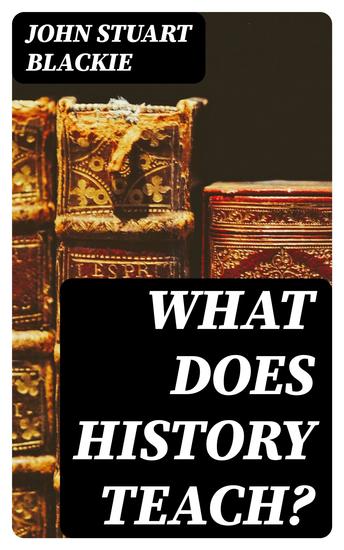
What Does History Teach? - Two Edinburgh Lectures - cover

What Does History Teach? - Two Edinburgh Lectures

John Stuart Blackie

Editorial: DigiCat

  • 0
  • 0
  • 0

Sinopsis

John Stuart Blackie's "What Does History Teach?" serves as a thoughtful examination of the lessons embedded within historical narratives, emphasizing the interconnectedness of past events and contemporary thought. This philosophical treatise adopts a reflective literary style, engaging readers through eloquent prose that marries anecdotal evidence with rigorous analysis. Blackie draws on a wide array of historical sources, from ancient civilizations to recent histories, to elucidate how these lessons shape moral understanding, citizenship, and civilization itself within the broader context of 19th-century intellectual thought, an era marked by fervent inquiries into human experience and identity. John Stuart Blackie (1809-1895) was a Scottish scholar, poet, and educator whose diverse academic pursuits greatly informed his writing. Educated at the University of Edinburgh, he traveled extensively across Europe, where exposure to different cultures and philosophical ideas nourished his belief in the importance of history as a moral guide. His passion for learning and ability to synthesize knowledge from various disciplines led him to create this compelling work, which reflects his own experiences and insights into the role of history in shaping human character and societal values. This book is highly recommended for readers interested in the intersection of history, philosophy, and moral education. Blackie's insightful synthesis encourages critical reflection and will appeal to historians, educators, and anyone seeking to understand how historical precedents inform modern-day dilemmas. His engaging style and profound insights make "What Does History Teach?" a valuable addition to the library of any thoughtful scholar.
Disponible desde: 16/09/2022.
Longitud de impresión: 56 páginas.

Otros libros que te pueden interesar

  • Exploitation - How Inequality and the Income Gap Is Shaping the Future of Our Societies - cover

    Exploitation - How Inequality...

    Marcus Klein

    • 0
    • 0
    • 0
    Economic inequality has become one of the defining challenges of our era, shaping the trajectory of societies across the globe. The income gap between the wealthiest and the poorest continues to widen, creating a stark divide that influences not only financial security but also access to education, healthcare, and opportunities. This growing disparity raises questions about the fairness of our systems and the sustainability of our futures.  
      
    The roots of inequality are complex, intertwining historical legacies with contemporary policies and practices. In many nations, the transition from agrarian economies to industrialized and globalized markets created unprecedented wealth. However, this wealth was not evenly distributed. The rise of capitalism, technological advancements, and shifts in labor dynamics often concentrated power and resources in the hands of a few, leaving vast populations struggling to make ends meet.  
      
    The income gap is more than just an economic issue; it has profound social, political, and cultural implications. At the societal level, inequality fosters divisions, creating barriers between different classes and perpetuating cycles of poverty. Social trust diminishes as communities perceive disparities as injustices, leading to increased tension and reduced cohesion. Politically, the influence of wealth on decision-making undermines democratic ideals, allowing a small elite to shape policies that serve their interests rather than those of the broader population. 
    Ver libro
  • Mexican History - Drug Cartels Wars and Heroes (3 in 1) - cover

    Mexican History - Drug Cartels...

    Kelly Mass

    • 0
    • 0
    • 0
    This book includes three titles about Mexico's history: 
    Cristero War - The Cristero War, also known as the Cristero Rebellion or La Cristiada [la kistjaa], was a widespread and deeply significant conflict that unfolded in central and western Mexico during the late 1920s. It was primarily driven by a violent response to the secularist and anti-clerical provisions of the 1917 Mexican Constitution, which sought to curtail the influence of the Catholic Church over the country's political and social life. The Constitution introduced sweeping reforms, including the restriction of church property rights and the severe limitations placed on the clergy’s ability to engage in public life. 
    Mexican Drug Cartels - The Mexican drug war, also known as the Guerra contra el narcotráfico en México, is the Mexican theater of the global war on drugs, a campaign led by the United States federal government. This war has resulted in a protracted, asymmetric low-intensity conflict between the Mexican government and various drug trafficking organizations. The Mexican government’s main objective when it intervened militarily in 2006 was to curb drug-related violence, which had escalated in the preceding years. The government’s stated aim, in collaboration with U.S. officials, was to eliminate the cartels and reduce the demand for drugs trafficking. 
    Pancho Villa - Francisco Villa, better known as Pancho Villa, was a key figure in the Mexican Revolution, known for his transformation from a bandit to one of the revolution’s most influential commanders. Villa’s rise to prominence in the early 20th century marked him as a central player in the violent upheavals that reshaped Mexico’s political landscape. In 1911, Villa became a significant actor in the revolutionary violence that led to the overthrow of President Porfirio Díaz, ushering in Francisco I. Madero’s government.
    Ver libro
  • Aga Khan Britain's counterweight to the Ottoman Hegemony - cover

    Aga Khan Britain's counterweight...

    Amit Schandillia

    • 0
    • 0
    • 0
    Long, long ago in the deserts of Egypt, emerged a new Islamic sect that experienced a mortal threat from mainstream Islam right since inception. The sect invented the art of assassination as a defence strategy, participated in the crusades, and eventually entered India as an ally of the British. Aga Khan, the leader of this sect was once among the most influential figures in the Indian subcontinent and Europe. So influential, the Germans made bids for his life in the thick of the First World War. Have you ever wondered that how did the leader of one of the smallest Islamic sects end up with so much power and clout?
    Ver libro
  • The Rooster Diaries - Coop Chronicles from a Hen-Keeper's Home-Based Egg Venture - cover

    The Rooster Diaries - Coop...

    Caroline Hurry

    • 0
    • 0
    • 0
    Wisdom, Wisecracks, and Well-grounded Advice 
    Smart Alec, King of the Heap, offers fresh and hilarious perspectives on coop tribulations and human complexities. His sharp insights on life, mortality, and the natural order as he bridges chicken-keeping with suburban folklore will enlighten and amuse you. 
    Whether you’re looking to keep hens for fresh, delicious eggs or to become more conscious about what you eat, Smart Alec has the inside scoops on coops, food, and egg production. 
    His captivating witty observations will resonate with your aspirations of self-sufficiency.. 
    Add The Rooster Diaries to your cart and change your outlook on life, love, and homesteading harmony.
    Ver libro
  • Modern Man in Search of a Soul - cover

    Modern Man in Search of a Soul

    Carl Jung

    • 0
    • 0
    • 0
    *Modern Man in Search of a Soul* by Carl Jung is a well-known book in psychology that introduces readers to his key ideas.  
    Jung explores many topics, including dream analysis, the purpose of psychotherapy, and his theory of personality types. He also discusses different stages of life, compares his ideas with Freud’s, and reflects on psychology’s connection to literature. Towards the end, Jung addresses the spiritual struggles of modern life after World War I, comparing it to ancient beliefs like gnosticism. He even touches on the role of therapists and their similarities to spiritual guides. 
    This special edition is thoughtfully designed with large, easy-to-read fonts, ensuring a comfortable reading experience for everyone, especially those who prefer larger text.  
    Ver libro
  • King John Henry III and England’s Lost Civil War - cover

    King John Henry III and...

    John Paul Davis

    • 0
    • 0
    • 0
    This sweeping history of thirteenth century England examines how the successive reigns of two very different kings established the English way of life. 


    In 1204, the great Angevin Empire was fragmenting under King John's rule. Unable to withstand France's invasion of Normandy, John also faced difficult relations with the papacy, and rising dissent among his barons. By the time John died in 1216, the failed Magna Carta gave way to civil conflict, and more than half of the country had fallen to the dauphin of France. These troubles were then passed, along with the crown, to John's nine-year-old son, Henry III. 


    Even with a regency government commanding the ship of state, Henry faced a dire threat to his royal authority. But the First Baron's War came to an end as Henry aligned himself with the pope and offered a revised Magna Carta. While this may have ensured short-term survival, living up to the promises of this foundational contract would create a more significant challenge—and lay the groundwork for the Second Baron's War.
    Ver libro