Join us on a literary world trip!
Add this book to bookshelf
Grey
Write a new comment Default profile 50px
Grey
Subscribe to read the full book or read the first pages for free!
All characters reduced
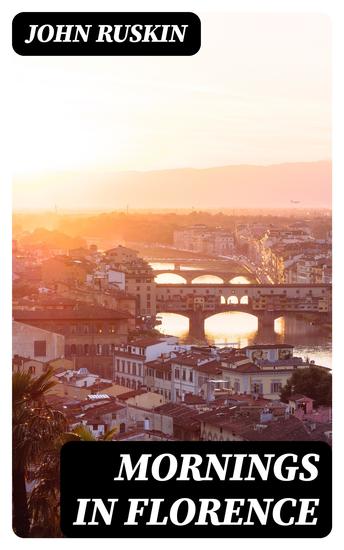
Mornings in Florence - cover

Mornings in Florence

John Ruskin

Publisher: DigiCat

  • 0
  • 0
  • 0

Summary

In "Mornings in Florence," John Ruskin artfully merges his profound appreciation for art, architecture, and the beauty of the natural world with a personal narrative that captures the essence of his experiences in the Italian city. Written in a lyrical yet accessible style, Ruskin's prose reflects the Gothic revival movement and the burgeoning fascination with the Pre-Raphaelites, seamlessly weaving together observations on Florentine landmarks, such as the Duomo and Ponte Vecchio, alongside philosophical musings on art and beauty. This work serves not only as a travelogue but also as a meditation on the profound relationship between art and the human experience, illustrating how the cultural heritage of Florence has been a recurring inspiration throughout history. John Ruskin, a prominent Victorian art critic, social thinker, and philanthropist, found himself profoundly influenced by his travels in Italy, particularly Florence. His engagement with the city's historical context and artistic legacy deeply resonated with Ruskin's advocacy for the Gothic style in opposition to the industrial age's mechanistic tendencies. His background in art education and his position as a critic provide a lens through which he interprets Florence, transforming his personal journey into an intellectual exploration of culture and morality. "Mornings in Florence" is highly recommended for readers interested in the intersections of art, philosophy, and travel literature. Spanning beyond mere descriptions, Ruskin's reflections offer valuable insights into how art shapes and enriches life. As both a guide and a philosophical companion, this book invites readers to immerse themselves in the beauty of Florence while pondering the broader implications of aesthetic experience.
Available since: 05/28/2022.
Print length: 107 pages.

Other books that might interest you

  • A Rare Recording of Artist Andy Warhol - cover

    A Rare Recording of Artist Andy...

    Andy Warhol

    • 0
    • 0
    • 0
    Andy Warhol (August 6, 1928 - February 22, 1987), born Andrew Warhola Jr., was an American visual artist, film director and producer. A leading figure in the pop art movement, Warhol is considered one of the most important American artists of the second half of the 20th century. His works explore the relationship between artistic expression, advertising, and celebrity culture that flourished by the 1960s, and span a variety of media, including painting, sculpture, photography, and filmmaking. The following recordings are from interviews in 1966 and 1981.
    Show book
  • Threading the Needle - A Fashion Designer's Guide to Successfully Launching Your Collection - cover

    Threading the Needle - A Fashion...

    Kadeem Alphanso Fyffe

    • 0
    • 0
    • 0
    Threading the Needle: A Fashion Designer’s Guide to Successfully Launching Your First Collection is the new go-to back-pocket resource for aspiring designers, with everything you need to know about building a successful clothing company before launching your first collection. While there is a wealth of information on this topic, this book takes all the information and compiles it into an easy-to-listen, direct, concise format. This book will provide valuable insights and practical advice for aspiring fashion designers looking to break into the industry. The author, an experienced fashion designer with a decade of international experience, will cover a range of topics, such as market research and analysis, design principles, manufacturing and production, supply chain management, branding and marketing, and sales strategies.  
    Threading the Needle: A Fashion Designer’s Guide to Successfully Launching Your First Collection will also provide guidance on how to establish relationships with suppliers, manufacturers, and retailers, as well as tips for managing finances and budgeting effectively. The goal is to help you avoid common pitfalls and overcome obstacles as you launch your first collection—this book will hopefully serve as your main point of reference on your journey as you continue to make an impact on the world.
    Show book
  • Vasily Surikov - cover

    Vasily Surikov

    Vladimir Kemenov

    • 0
    • 0
    • 0
    Born in Krasnoiarsk in 1848, Surikov died in Moscow in 1916. He is one of the great masters of history painting, and he occupies a special place in Russian culture. Like Delacroix, he believed that history was not a pretext for nice painting but an inexorable drama with neither culprits nor innocents but rather people driven by invisible forces. He was very knowledgeable about Russian history, and his paintings deal with crucial moments. He sought in historical events the answers to pressing problems of his time. Here is a book about a painter little-known in the West, analysed with understanding by one of the greatest Russian art critics.
    Show book
  • That's not how I remember it - glimpses of the Packington Estate from those who were there - cover

    That's not how I remember it -...

    Pack*Art Panel (eds)

    • 0
    • 0
    • 0
    Interwoven memories of wallpaper, sugar sandwiches, violence and unwritten rules of community offer an insider history of the Pack, a now demolished London council estate.
    Show book
  • Vijayanagara Empire - Hampi's Glorious Past and the Last Hindu Kingdom - cover

    Vijayanagara Empire - Hampi's...

    Rolf Hedger

    • 0
    • 0
    • 0
    The Vijayanagara Empire emerged as one of the most significant and powerful dynasties in Indian history, rising at a time when the Indian subcontinent was fragmented and facing threats from expanding Islamic sultanates. Its foundation in the 14th century was a turning point that not only established a strong Hindu kingdom in southern India but also laid the groundwork for a cultural and economic renaissance. 
    The origins of Vijayanagara trace back to the political instability of the Deccan region. The Delhi Sultanate had extended its influence into the south, leading to the weakening of older Hindu kingdoms such as the Kakatiyas, Hoysalas, and Pandyas. Amid this turmoil, two brothers, Harihara and Bukka, originally serving under the Kakatiya rulers, rose to prominence. After being captured and later released by the Delhi Sultanate, they sought guidance from the sage Vidyaranya, who inspired them to establish a strong Hindu kingdom to resist further invasions. In 1336, they founded the city of Vijayanagara on the banks of the Tungabhadra River, marking the birth of the empire. 
    From its inception, the Vijayanagara Empire was strategically positioned to thrive. The Tungabhadra River provided a natural defensive barrier, while the rocky terrain of Hampi served as a formidable protection against enemy invasions. The early rulers focused on consolidating power, expanding their territories, and strengthening their military capabilities. Under Harihara I, the empire extended its control over parts of Karnataka and Andhra Pradesh, securing key trade routes and fortifying its defenses.
    Show book
  • See What You're Missing - New Ways of Looking at the World Through Art - cover

    See What You're Missing - New...

    Will Gompertz

    • 0
    • 0
    • 0
    Taking us into the minds of artists—from contemporary stars to old masters—See What You're Missing shows us how to look and experience the world with their heightened awareness. 


    Artists are expert lookers: they have learned to pay attention. The rest of us spend most of our time on autopilot, rushing from place to place, our overfamiliarity blinding us to the marvelous, life-affirming phenomena of our world. But that doesn't have to be the case. 


    In his inimitable engaging style, Will Gompertz takes us into the minds of artists—from contemporary stars to old masters, the well-known to the lesser-so, and from around the world—to show us how to look and experience the world with their heightened awareness. 


    In See What You're Missing we learn, for example, how Hasegawa Tohaku can help us to see beauty, how David Hockney helps us to see color, and how Frida Kahlo can help us see pain. In doing so we come to know the exhilarating feeling of being truly alive. See What You're Missing is at once entertaining and enlightening art history while delivering empowering new insights to its listener.
    Show book