Join us on a literary world trip!
Add this book to bookshelf
Grey
Write a new comment Default profile 50px
Grey
Subscribe to read the full book or read the first pages for free!
All characters reduced
Traditions of Lancashire (Vol 1&2) - Enriched edition Complete Edition - cover

Traditions of Lancashire (Vol 1&2) - Enriched edition Complete Edition

John Roby

Publisher: DigiCat

  • 0
  • 0
  • 0

Summary

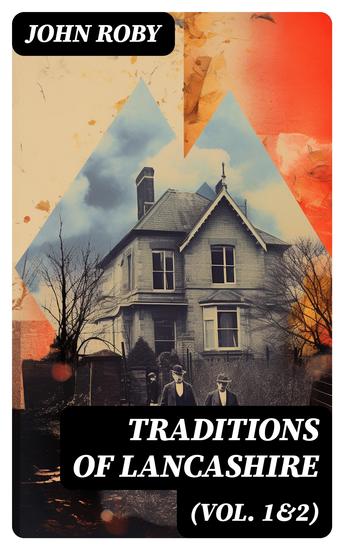
In "Traditions of Lancashire (Vol. 1&2)," John Roby meticulously explores the rich folklore, customs, and historical narratives of Lancashire, interweaving local legends with thorough historical analysis. Roby's literary style blends vivid storytelling with rigorous scholarship, creating a tapestry of the region's cultural identity. Written in the early 19th century, this work stands as both a chronicle and a critique of societal changes during the Industrial Revolution, capturing the tensions between tradition and modernity that characterize this vibrant English region. John Roby, a native of Lancashire, exemplifies the synergy of personal experience and academic inquiry in his writing. His deep-rooted interest in local history and folklore, coupled with an awareness of the transformative social landscape of his time, fuels his desire to preserve Lancashire's oral traditions before they succumb to the relentless tide of modernization. As a historian, Roby's insights are not merely observational but deeply empathetic, lending a voice to the common people whose stories might otherwise be lost. "Traditions of Lancashire" is not only a vital resource for historians and folklorists but also a compelling read for anyone who values the intersections of culture and history. Roby's engaging prose invites readers to immerse themselves in the narratives that shape regional identity, making this collection essential for both academic study and leisurely exploration.

In this enriched edition, we have carefully created added value for your reading experience:
- Lastly, our hand‐picked Memorable Quotes distill pivotal lines and turning points, serving as touchstones for the collection's central themes.
Available since: 11/16/2023.
Print length: 953 pages.
Other books that might interest you

  • The Most Famous Slave Rebellions in the Americas - The History of Important Uprisings across the Western Hemisphere - cover

    The Most Famous Slave Rebellions...

    Editors Charles River

    • 0
    • 0
    • 0
    By the 16th century, slaves were being imported to Hispaniola, and over the next few centuries, the population of African slaves came to represent a sizable majority of the population there. This would set the stage for one of history’s most unique revolutions in Haiti.  
    As the issue of slavery roiled the U.S., few people became as controversial or consequential as Nat Turner, who was one of millions of slaves in the South before the Civil War but ultimately led the nation’s most notorious slave uprising. In August 1831, Turner led a rebellion that terrorized Virginia for several days, killing dozens of whites and freeing slaves as his band moved from plantation to plantation. The Richmond Enquirer reported, “A fanatic preacher by the name of Nat Turner (Gen. Nat Turner) who had been taught to read and write, and permitted to go about preaching in the country, was at the bottom of this infernal brigandage. He was artful, impudent and vindicative, without any cause or provocation, that could be assigned.” Even after the uprising was put down, Turner evaded capture for a few months, and after he was captured, his “confessions” were taken down and published before he was executed. Virginia would put a total of 56 slaves to death for the uprising. 
    	While Turner’s rebellion remains famous today, a far larger uprising took place a generation earlier. In January 1811, hundreds of slaves in Louisiana attempted to make a new beginning for themselves or die trying. Armed with muskets, cane knives, and axes, and wearing stolen United States militia uniforms, they set out to conquer the city of New Orleans. The goal was to establish a free republic where slavery was outlawed and blacks had control over their own lives. Understandably discontented with their status and no longer willing to accept it, they were ready to engage in extreme violence to win their freedom, fully aware that death would be the only alternative. 
    Show book
  • Swami Satchidananda - Perfect Master Perfect Answers - cover

    Swami Satchidananda - Perfect...

    Radha Krsna Das

    • 0
    • 0
    • 0
    “God knows your breaking point. You simply don’t know your own strength.” 
     
    “Everything begins in the mind. If you want to see clearly, you need clear vision.” 
     
    Swami Satchidananda was the founder of Integral Yoga International. He taught the birthright of all is to realize the spiritual unity behind the diversity throughout creation and live harmoniously as members of “one universal family”. Swami was born into a loving spiritual family on December 22nd in 1914 during the month known as Margali, the Dawn of the Devas. From an early age, Swami (or Ramaswamy as he was known at the time) displayed many spiritual tendencies and a deep dedication to the truth. 
     
    Thus at the age of 28, he decided to devote himself full time to his spiritual practice. There then followed a period of seeking the wisdom and blessing of various saints and sages. Although a sannyasin Satchidananda was active in serving others and was happy to use modern technology to disseminate the teachings of yoga. Like many great Saints, Satchidananda believed all religions could lead seekers to the same goal. His interfaith motto was “Truth Is One, Paths Are Many.”
    Show book
  • History of Marathas EP05 - Attack on Shaista Khan - cover

    History of Marathas EP05 -...

    Vikrant Pande

    • 0
    • 0
    • 0
    It was late in the night when the group reached Pune. The soft diffused light of the ashtami moon spread over the ground. The guards at the gate came out adjusting their guns hearing the horses. One of the guards challenged,
    'Kaun hai?'
    One of Ibrahim's men stepped forward and slapped the guard hard shouting, 'Badtameez! Khansahab ko pehchanta nahin?'
    The other guards hastily bent in mujras and salaams. The route was now clear. Ibrahim moved forward in a casual yet dignified manner as if nothing had happened. It was silence all over sans the intermittent warning shouts of the guards parading the area. Most of the Mughal troops were tired of the day long Ramzan fast and were fast asleep after a heavy meal.
    Show book
  • Colony of Virginia The: The History of the British Empire’s Largest Colony Before the American Revolution - cover

    Colony of Virginia The: The...

    Editors Charles River

    • 0
    • 0
    • 0
    Nearly 20 years before Jamestown was settled, the English established one of the earliest colonies in North America around the Chesapeake Bay region, until the colony had over 100 inhabitants. Like other early settlements, Roanoke struggled to survive in its infancy, to the extent that the colony’s leader, John White, sailed back to England in 1587 in an effort to bring more supplies and help. However, the attempts to bring back supplies were thwarted by the Spanish in the midst of the Anglo-Spanish War going on at the time, and it was not until 1590 that White reached Roanoke again.  
    What White found when he came back to Roanoke led to one of the most enduring mysteries in American history. Despite the fact he had left over 100 people in Roanoke in 1587, White returned to literally nothing, with all traces of the settlement gone and no evidence of fighting or anything else that might have explained the disappearance of the inhabitants. The fate of Roanoke has fascinated people for over 400 years, and there is no shortage of theories regarding the disappearance of the colony. In addition to the possibility that the settlers moved to Croatoan Island, most theories speculate that they were either wiped out by nearby Native Americans or assimilated among a tribe. 
    Jamestown is remembered today because the settlement did survive through the hardships and go on to serve as the capital of the English colony for much of the 17th century. At the same time, one of the biggest reasons for its survival and fame today can be attributed to the local Native Americans, particularly Pocahontas, who has added both a human and romanticized, mythological element to Jamestown. She was the daughter of the paramount chief (mamanatowick) Powhatan, leader of an Algonquian-speaking native group in eastern Virginia.
    Show book
  • Happy Ending At Pearl’s Parlor - Lesbian Short Story - cover

    Happy Ending At Pearl’s Parlor -...

    Monique Rose

    • 0
    • 0
    • 0
    She lingers on Ginny’s shoulders for a few moments and then works her way even further down, pressing her palms into the muscles just beneath Ginny’s shoulder blades and then sliding over to the center of her spine. Yue is an expert at the art of massage, and she works over each muscle, each knot, and each joint that has Ginny turning into a melted soap bar. 
    Show book
  • Sins Of Love - cover

    Sins Of Love

    Fay Leta Crawford

    • 0
    • 0
    • 0
    Sins of Love is a collection of poems written solely by myself. Sins of Love is my interpretation of love and heartbreak in correlation with the stages of death and dying. I have taken my experiences and the experiences of others and categorized them into five stages. This book is a walk through the side of love most people don’t want to talk about. This conversation is necessary in order to heal, grow and find the love meant for you. 
    Follow me as we trail through my denial, my anger, my bargaining, my depression and my acceptance in my Sins of Love. 
    Special thanks to my amazing Producer & Engineer Extraordinaire, Kenechi Ubani 
    Special thanks to my Cover Art Designer, Emmanuel Baligad
    Show book