¡Acompáñanos a viajar por el mundo de los libros!
Añadir este libro a la estantería
Grey
Escribe un nuevo comentario Default profile 50px
Grey
Suscríbete para leer el libro completo o lee las primeras páginas gratis.
All characters reduced
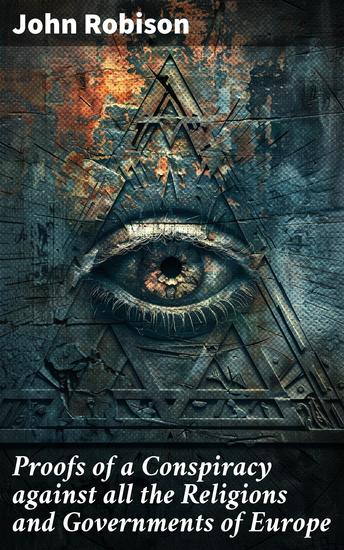
Proofs of a Conspiracy against all the Religions and Governments of Europe - Carried on in the secret meetings of Free Masons Illuminati and reading societies - cover

Proofs of a Conspiracy against all the Religions and Governments of Europe - Carried on in the secret meetings of Free Masons Illuminati and reading societies

John Robison

Editorial: Good Press

  • 0
  • 0
  • 0

Sinopsis

In "Proofs of a Conspiracy against all the Religions and Governments of Europe," John Robison meticulously unravels the intricate web of Enlightenment thought and its perceived threats to established institutions. Through a methodical and analytical approach, Robison critiques the rise of radical philosophies that, according to him, conspire to undermine religious and political authority across the continent. His literary style reflects the post-Enlightenment context in which he writes'Äîmarked by a profound concern for societal stability and Christian values'Äîculminating in a text that serves as both a historical account and a warning against subversive ideologies. John Robison, a Scottish physicist and member of the Scottish Enlightenment, held a multifaceted career as an educator, inventor, and commentator on the socio-political climate of his time. His professional affiliations and personal investigations into the revolutionary movements of the late 18th century led him to express his alarm through this seminal work, reflecting a complex interplay of enlightenment ideals and an exigent call for preservation of tradition and order in the face of burgeoning secularism. "Proofs of a Conspiracy" is an essential read for historians and political theorists alike, as it offers not just a glimpse into the fears that characterized the post-revolutionary era, but also a profound commentary on the balance of reason and faith in societal governance. Robison's compelling arguments and rich historical context compel us to consider the enduring implications of his warnings in today's global landscape.
Disponible desde: 12/10/2023.
Longitud de impresión: 306 páginas.

Otros libros que te pueden interesar

  • Goodbye Anxiety Hello Happiness - A practical guide with proven and easy to apply methods to finally overcome anxiety - cover

    Goodbye Anxiety Hello Happiness...

    Gavin Moore

    • 0
    • 0
    • 0
    Almost one factor in our lives causes us pain or overwhelming emotions. One such factor 
    can be hard to determine and can be seen as inconceivable, among many others. These 
    emotions may be hard to identify, harder to grasp, and could lead to various unfavorable 
    events in our lives. Unless they are recognized for the problems they cause, and 
    appropriate care is offered as soon as they are conceived. 
    Anxiety, also termed by the common notion of concern, is one such thing in our lives that 
    affects us, daily or temporarily. It is that one factor that people need to be cautious of and 
    should make no fault in determining the cause of. The solutions that come forth after 
    conceiving the cause are also to be given crucial importance. 
    Some common questions that many people wonder: What is anxiety? What is the cure for 
    anxiety? Are there any symptoms to determine it? There are a lot of questions, but there 
    appear to be fewer solutions. Although these solutions can be determined over time and 
    implemented in our daily lives, doing so requires perseverance. The constant motivation 
    and drive are what makes it seem real in the end, but knowing the solutions that can aid 
    when implemented is one vital step towards happiness. 
    “Goodbye Anxiety, Hello Happiness” helps determine the different causes of anxiety in its 
    various forms, comparing it to other well-known notions and seeking out the differences. 
    It also aims at posing the necessary solutions to combat anxiety using the right practical 
    knowledge and methods.
    Ver libro
  • Dakota War of 1862 The: The History and Legacy of the Sioux Uprising during the American Civil War - cover

    Dakota War of 1862 The: The...

    Editors Charles River

    • 0
    • 0
    • 0
    Despite being one of the most erstwhile foes the U.S. government faced during the Indian Wars, the Sioux and their most famous leaders were grudgingly admired and eventually immortalized by the very people they fought. Sitting Bull and Crazy Horse remain household names due to their leadership of the Sioux at the fateful Battle of the Little Bighorn, where the native warriors wiped out much of George Custer’s 7th Cavalry and inflicted the worst defeat of the Indian Wars upon the U.S. Army. Red Cloud remains a symbol of both defiance and conciliation, resisting the Americans during Red Cloud’s War but also transitioning into a more peaceful life for decades on reservation.  
    	However, one of the more overlooked conflicts the U.S. Army had with the Sioux took place during the American Civil War. It is known by various names, including the Dakota War, the US-Dakota War, the Dakota Uprising, the Sioux Outbreak, and Little Crow’s War (after the principal Dakota leader), but the current most commonly used name for the war is the “Dakota War.” Two of the four Dakota tribes in the state unleashed their anger and frustration on largely immigrant communities that were heavily German or Norwegian, and the massacres took a heavy toll. In the process, the conflict featured the largest Indian siege of an Army fort in American history, and the end of the conflict brought the largest mass execution in American history.  
    	Indeed, the total loss of life during the Dakota War was perhaps the second largest of all the Indian Wars in North America, second only to the bloody King Philip’s War in colonial New England in the late 17th century, during which more than 1,000 settlers were killed. Throughout the Dakota War, as many as 800 whites were killed, although no one knows the total, and many of the victims were buried in anonymous mass graves.
    Ver libro
  • Integrating the Inner City - The Promise and Perils of Mixed-Income Public Housing Transformation - cover

    Integrating the Inner City - The...

    Robert J. Chaskin, Mark L. Joseph

    • 0
    • 0
    • 0
    For many years Chicago’s looming large-scale housing projects defined the city, and their demolition and redevelopment—via the Chicago Housing Authority’s Plan for Transformation—has been perhaps the most startling change in the city’s urban landscape in the last twenty years. The Plan, which reflects a broader policy effort to remake public housing in cities across the country, seeks to deconcentrate poverty by transforming high-poverty public housing complexes into mixed-income developments and thereby integrating once-isolated public housing residents into the social and economic fabric of the city. But is the Plan an ambitious example of urban regeneration or a not-so-veiled effort at gentrification? In the most thorough examination of mixed-income public housing redevelopment to date, Robert J. Chaskin and Mark L. Joseph draw on five years of field research, in-depth interviews, and volumes of data to demonstrate that while considerable progress has been made in transforming the complexes physically, the integrationist goals of the policy have not been met. They provide a highly textured investigation into what it takes to design, finance, build, and populate a mixed-income development, and they illuminate the many challenges and limitations of the policy as a solution to urban poverty. Timely and relevant, Chaskin and Joseph’s findings raise concerns about the increased privatization of housing for the poor while providing a wide range of recommendations for a better way forward.
    Ver libro
  • Anunnaki Lands in the Ancient Near East - How Sumer Nibiru and Iraq Formed the Birthplace of Civilization - cover

    Anunnaki Lands in the Ancient...

    Faruq Zamani

    • 0
    • 0
    • 0
    There were talented and dexterous people living in what is now southern Iraq during the time of Sumer. Humankind's first known civilization arose in the fertile plain irrigated by the Euphrates and Tigris rivers some 6,000 years ago "suddenly," "unexpectedly," and "with stunning abruptness," according to researchers.  
    It was a society to which we owe virtually every 'First' of what we consider essential to an advanced society:  
    For example, the wheel and wheeled transportation; brick, which made (and still makes) high-rise buildings; furnaces and kilns, which are vital to industries from baking to metallurgy. 
     In Sumer, astronomy, mathematics, cities and urban societies, kingships and laws, temples and priesthoods, calendars, festivals, recipes, art, artifacts, and, above all, writing and record-keeping are all firsts. They were the first to record and describe past events and tell tales of their gods through artful statues and statuettes depicted in a devotional stance. 
    Many landmarks along the road that brought ancient Sumer from complete obscurity to awe-inspiring appreciation of its grandeur bear the names of scholars who made the journey possible. We will mention some of those who worked at the various sites. Many others have assembled and classified fragmented artifacts over the last century and a half of Mesopotamian archaeology to list them all. We now know all this thanks to archaeology and decipherment of ancient languages during the past century and a half. 
    Epigraphers also worked in crowded museums and libraries to turn clay tablets inscribed with odd 'cuneates' into readable cultural, academic, and historical treasures by converting their persistence, devotion, and abilities. 
    Ver libro
  • Addiction Becomes Normal - On the Late-Modern American Subject - cover

    Addiction Becomes Normal - On...

    Jaeyoon Park

    • 0
    • 0
    • 0
    Addiction is now seen as an ordinary feature of human nature, an idea that introduces new doubts about the meaning of our desires. 
      
    Over the last forty years, a variety of developments in American science, politics, and culture have reimagined addiction in their own ways, but they share an important understanding: increasingly, addiction is described as normal, the natural result of a body that has been exposed to potent stimuli. This shift in thinking suggests that addiction is a condition latent in all of us, a common response to a society rich in thrills. 
      
    In Addiction Becomes Normal, Jaeyoon Park provides a history and critical analysis of the normalization of addiction in late-modern American society. By exploring addiction science, diagnostic manuals, judicial reform, and public health policy, he shows how seeing addiction as normal has flourished in recent decades and is supported throughout cultural life in the United States by the language of wellness, psychotherapy, and more. Building on Michel Foucault’s depiction of the human figure, Park argues that this shift reflects the emergence of a new American subject, one formed by the accretion of experiences. This view of the human subject challenges the idea that our compulsions reflect our characters, wills, or spirits. For if addiction is an extreme but ordinary attachment, and if compulsive consumption resembles healthy behavior, then desire is no longer an expression of the soul so much as the pursuit of a past reward. A perceptive work of recent history and political theory, Addiction Becomes Normal raises new questions about what it means to be human in America today.
    Ver libro
  • Norse Mythology: Ultimate Guide Into Norse Gods and Goddesses Viking Warriors and Magical Creatures (Engaging Stories of the War of Gods That Shaped the Norse Pantheon) - cover

    Norse Mythology: Ultimate Guide...

    Sophia Ramirez

    • 0
    • 0
    • 0
    Dive deep into the stormy, spellbinding world of Norse mythology, where the lines between myth, magic, and history blur. This comprehensive guide brings together the most iconic legends, godly conflicts, and mystical beings of the Norse cosmos—crafted to educate, entertain, and inspire. 
    Whether you're a casual reader, student of mythology, or a fantasy enthusiast seeking the roots of modern epic storytelling, this book offers an accessible yet rich exploration of the Norse belief system and the unforgettable tales that shaped Viking culture. 
    Inside this ultimate guide, you'll discover:The Origins of the Nine Worlds – Learn how Yggdrasil, the World Tree, connects realms like Asgard, Midgard, and Helheim.Legendary Gods and Goddesses – Explore the complex personalities and powers of Odin, Thor, Loki, Freyja, Frigg, and others.Magical Creatures & Beings – Meet fearsome giants, cunning dwarves, Valkyries, elves, dragons, and the monstrous wolf Fenrir.Epic Battles and the War of the Gods – Relive the cosmic conflicts between the Aesir and Vanir, and the events that lead to Ragnarök.Symbolism and Themes – Uncover the deeper meaning behind recurring themes like fate, sacrifice, honor, and rebirth.The Viking Connection – Understand how these myths influenced Viking culture, warfare, rituals, and worldview. 
    Why This Book?Beginner-friendly yet detailed enough for mythology enthusiasts.Perfect for readers of Rick Riordan, Neil Gaiman, or anyone interested in ancient religions and folklore.Includes historical insights to connect myth with real-world Viking beliefs and practices. 
    Are you ready to step into the world of thunder and frost?
    Ver libro