¡Acompáñanos a viajar por el mundo de los libros!
Añadir este libro a la estantería
Grey
Escribe un nuevo comentario Default profile 50px
Grey
Suscríbete para leer el libro completo o lee las primeras páginas gratis.
All characters reduced
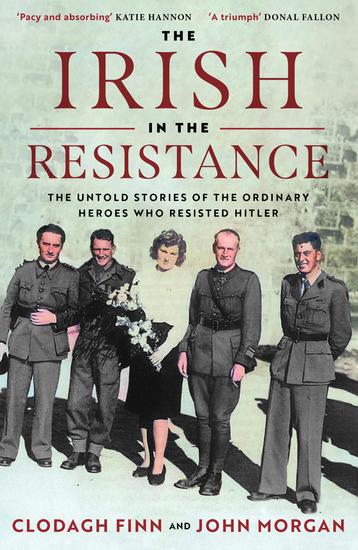
The Irish in the Resistance - The Untold Stories of the Ordinary Heroes Who Resisted Hitler - cover

The Irish in the Resistance - The Untold Stories of the Ordinary Heroes Who Resisted Hitler

John Morgan, Clodagh Finn

Editorial: Gill Books

  • 0
  • 0
  • 0

Sinopsis

'You simply couldn't stand by with your arms folded.'
These were the words of Samuel Beckett who famously returned to France from a holiday in Ireland when World War II broke out. His clandestine work against the Nazi occupation of Europe is well documented, but there were many other ordinary Irish people who joined the underground network.
Some took up arms. Others gathered intelligence, sheltered fugitives, committed acts of sabotage or broke codes. This new history tells the stories of those forgotten Irish men and women.
Discover Captain John Keany from Cork, who parachuted into occupied Italy to help the local Resistance; Margaret Kelly, the Dublin founder of the world-famous Bluebell Girls cabaret troupe in Paris, who hid her Jewish husband; and Catherine Crean, the Irish governess born on Moore Street, Dublin, who was sent to a concentration camp for helping Allied airmen in Belgium.
These, and many more stories, span the course of World War II and remind us of the power of individuals to make a difference.
'An eye-opening account of how ordinary people caught up in extraordinary situations helped to fight the Nazis' David McCullagh
'A truly important and groundbreaking book' Mary Kenny
Disponible desde: 29/08/2024.
Longitud de impresión: 368 páginas.

Otros libros que te pueden interesar

  • Most Important Capitals of Ancient Egypt The: The History of Memphis Thebes and Alexandria - cover

    Most Important Capitals of...

    Editors Charles River

    • 0
    • 0
    • 0
    Africa may have given rise to the first humans, and Egypt probably gave rise to the first great civilizations, which continue to fascinate modern societies across the globe nearly 5,000 years later. From the Library and Lighthouse of Alexandria to the Great Pyramid at Giza, the Ancient Egyptians produced several wonders of the world, revolutionized architecture and construction, created some of the world’s first systems of mathematics and medicine, and established language and art that spread across the known world. With world-famous leaders like King Tut and Cleopatra, it’s no wonder that today’s world has so many Egyptologists. 
    	For almost four millennia, the Great Pyramids of Ancient Egypt have been widely hailed as the single greatest archeological feat man has ever accomplished. The Great Pyramid at Giza is the only one of the seven wonders of the ancient world to have survived into the modern age. Unlike so many pieces of the historical record which have been “re-discovered,” relatively recently (in the grand scheme of things,” in their four thousand years of existence, the Great Pyramids have never allowed themselves to be truly forgotten by the human civilization which has never ceased to regard them with wonder and awe.  
    	This audiobook examines the history of the cities that served as capitals for Egypt for millennia, including their architectural, religious, cultural, and historical characteristics.
    Ver libro
  • What We Owe the Future - cover

    What We Owe the Future

    William MacAskill

    • 0
    • 0
    • 0
    An Oxford philosopher makes the case for “longtermism”—that positively influencing the long-term future is a key moral priority of our time 
     
    The fate of the world is in our hands. Humanity’s written history spans only five thousand years. Our yet-unwritten future could last for millions more—or it could end tomorrow. Astonishing numbers of people could lead lives of great happiness or unimaginable suffering, or never live at all, depending on what we choose to do today. 
      
    In What We Owe The Future, philosopher William MacAskill argues for longtermism, that idea that positively influencing the distant future is a key moral priority of our time. From this perspective, it’s not enough to reverse climate change or avert the next pandemic. We must ensure that civilization would rebound if it collapsed; counter the end of moral progress; and prepare for a planet where the smartest beings are digital, not human. 
      
    If we put humanity’s course to right, our grandchildren’s grandchildren will thrive, knowing we did everything we could to give them a world full of justice, hope, and beauty.
    Ver libro
  • Ivan the Terrible - cover

    Ivan the Terrible

    Kelly Mass

    • 0
    • 0
    • 0
    Ivan IV Vasilyevich, referred to as Ivan the Terrible in English, was the Grand Prince of Moscow from 1533 to 1547 and the very first Moscow ruler to announce himself Tsar of Russia from 1547 to 1584.Ivan was the first ruler of Moscow after the city's independence and state of freedom. After the death of his dad, Vasili III, the Rurikid ruler of the Grand Duchy of Moscow, he was declared supreme prince when he was three years of age. The "Chosen Council," a group of reformers, rallied around the young Ivan in the year 1547, announcing him tsar (emperor) of All Rus' and developed the Tsardom of Russia, with Moscow as the primary state. Ivan's rule was marked by Russia's change from a middle ages state to an empire under the control of the tsar, but at a big cost to the people and the nation's long-lasting economy.Let’s talk about his life, his legacy, his evil deeds, and the way things occurred in history.
    Ver libro
  • The History of England Volume 3 - From Henry VII to Mary - cover

    The History of England Volume 3...

    David Hume

    • 0
    • 0
    • 0
    The accession of Henry VII (reigned 1485-1509) to the throne of England, leading to the end of the Wars of the Roses, opened the door to Tudor rule, setting a different character to the monarchy. In Volume 3 of The History of England, Hume traces the story through turbulent and unpredictable times, the reigns of Henry VII, Henry VIII, Edward VI, the brief period of Jane Grey; and concluding with the brutal religious persecutions of Mary I.  
    Initially, Henry VII had to establish royal control and legitimacy. With his customary clarity and natural story-telling style, Hume tells how Henry established his authority with a firm, ruthless but sure hand. He suppressed insurrections, faced French incursions into Brittany, instability in Scotland, and other fractious relationships with Spain and Flanders. Just as important was his commitment to improving the monetary state of the country after the turmoil of the Wars of the Roses. As a result, he was able to pass on a wealthier England to his successor. 
    Henry VIII (reigned 1509-1547) was welcomed as a huge contrast, from the ‘jealous, severe and avaricious’ character of his father. The bold, youthful and courageous prince of just 18 years engendered much hope in the populace. But his character resulted in a reign of much turbulence, from his marital profligacy as he searched for an heir, to his departure from the religious overlordship of the Pope.  Under his flamboyant rule the country was to experience huge uncertainties, with expeditionary failures abroad, introduction of the new religion, the dissolution of monasteries and constant financial challenges. 
    His son, Edward VI (reigned 1547-1553) raised hopes as he was known to be a committed Protestant. But his early death at the age of 15, (apart from the short, disputed reign of Lady Jane Grey), saw the fiercely Catholic Mary (1553-1558) accede to the throne. Predictably, the five years of her monarchy was dominated by religious persecution as an increasingly embittered sovereign sought to impose Catholicism on the nation. Her death after only five years left England in a parlous state. 
    As always, Hume’s characterful but well-informed view of events brings the launch of the Tudor monarchy to life. He deals not only with the major events and personalities, but by introducing many less well-known individuals and their actions, brings a vivid quality to the story of England as it unfolds.
    Ver libro
  • Odin - An Illustrated Guide to the Allfather - cover

    Odin - An Illustrated Guide to...

    L. Dean Lee

    • 0
    • 0
    • 0
    Odin: wanderer, rune-carver, and chief of the Æsir. Explore the revered god of Norse mythology in this richly illustrated guide.   This authentic introduction to the Norse god Odin Borson, revered in Norse paganism as a warrior, a wanderer, and a leader, delves into his history, impact on the Norse pantheon, and enduring legacy. Portrayed as a poet, magician, mad man and, most distinctively, as an old man, Odin’s most famous role is as the keeper of Valhalla, a glittering afterlife reserved for chosen warriors who died bravely in the heat of battle.  Odin: An Illustrated Guide to the Allfather provides an overview of Odin’s origins, personality, significance, powers, and associations in this comprehensive, accessible, and beautifully designed hardcover. Included are the most important folklore and mythological tales involving Odin, such as the creation of the world, the Æsir-Vanir war, an eye for wisdom, Graybeard the ferryman, the death of Balder, and Ragnarök. This guide covers Odin not only in ancient times, but through the ages, sharing how he became an icon around the world.   With Odin: An Illustrated Guide to the Allfather you will delve into the depths of Norse mythology and understand the true nature of Odin. Expert practicing Norse heathen L. Dean Lee shares how to properly venerate and incorporate Loki into your spiritual practice.
    Ver libro
  • Anatolia and the Bronze Age: The History of the Earliest Kingdoms and Cities that Dominated the Region - cover

    Anatolia and the Bronze Age: The...

    Editors Charles River

    • 0
    • 0
    • 0
    While the Bronze Age is recognized as one of history’s most important phases, it’s been hard for historians to precisely date. The idea of the Bronze Age comes from a three-age system developed in the 19th century through which archaeologists and historians believe cultures evolve. These three ages are the Stone Age, the Bronze Age, and the Iron Age, and the concept of the system stems from the simultaneous development of museums in Europe during that time. In the Royal Museum of Nordic Antiquities in Denmark, Christian Jürgensen Thomsen, the director of the museum, began classifying objects of stone, bronze, or iron to better categorize and exhibit them. Each archaeological artifact was thus sorted according to their materials and further organized by shape and style. Through such methodology, working alongside archaeological reports, he was able to show how certain objects changed over time. 
    	During the Late Bronze Age, from about 1500-1200 BCE, the Near East was a time and place where great kingdoms and empires vied for land and influence, playing high stakes diplomatic games, trading, and occasionally going to war with each other in the process. The Egyptians, Hittites, Babylonians, Assyrians, and several smaller Canaanite kingdoms were all part of this system, which was one of the first true “global” systems in world history and also one of the most materially prosperous eras in antiquity. The major kingdoms are well-known to most people, but among them were powerful neighbors, many of whom have been mostly overlooked.  
    The transition from the Bronze to the Iron Age during the late 13th and early 12th centuries BCE arguably changed the structure and course of world history more fundamentally than any period before or since, and at the center of this period of turmoil was a group of people known today as the Sea Peoples, the English translation of the name given to them by the Egyptians.
    Ver libro