

Join us on a literary world trip!
Add this book to bookshelf
Grey
Write a new comment Default profile 50px
Grey
Subscribe to read the full book or read the first pages for free!
All characters reduced
Paradise Lost: Embark on Milton's Epic of Sin and Redemption - eBook Edition - cover

Paradise Lost: Embark on Milton's Epic of Sin and Redemption - eBook Edition

John Milton, Bluefire Books

Publisher: Bluefire Books

  • 0
  • 0
  • 0

Summary

Engage with the grandeur of John Milton's epic masterpiece with "Paradise Lost: Milton's Epic of Sin and Redemption - eBook Edition." This celebrated epic poem has enchanted millions of readers worldwide with its poetic brilliance and poignant narrative.
Unravel the layers of allegory and symbolism as you journey through the narrative of humanity's first sin, and the profound consequences that ensue. Experience the heights of Heaven and the depths of Hell, arousing emotions of awe, empathy, and introspection. Our brief synopsis offers only a glimpse into the magnificence that awaits you in Paradise Lost.
Our eBook version is meticulously designed to offer a seamless reading experience, ensuring that the rhythm and grandeur of Milton's blank verse remain untouched. Esteemed by critics and embraced by readers, our eBook edition boasts an impressive array of 5-star ratings.
Don't miss out on this journey of epic proportions! Download your copy of 'Paradise Lost' now and embark on Milton's magnificent exploration of sin, redemption, and human nature.
Available since: 07/09/2023.
Print length: 146 pages.
Other books that might interest you

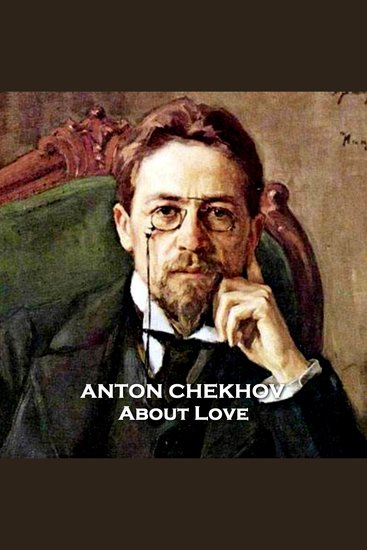
  • About Love - From their pens to your ears genius in every story - cover

    About Love - From their pens to...

    Anton Chekhov

    • 0
    • 0
    • 0
    Anton Pavlovich Chekhov was born on 29th January 1860 in Taganrog, on the south coast of Russia.  
    His family life was difficult; his father was strict and over-bearing but his mother was a passionate story-teller, a subject Chekhov warmed to. As he later said; ‘our talents we got from our father, but our soul from our mother’.  
    At school Chekhov was distinctly average. At 16 his father mis-managed his finances and was declared bankrupt. His family fled to Moscow. Chekhov remained and eked out a living by various means, including writing and selling short sketches to newspapers, to finish his schooling. That completed and with a scholarship to Moscow University obtained he rejoined his family. 
    He was able to help support them by selling satirical sketches and vignettes of Russian lifestyles and gradually obtained further commissions. In 1884, he qualified as a physician and, although it earned him little, he often treated the poor for free, he was fond of saying ‘Medicine is my lawful wife, and literature is my mistress.’ 
    His own health was now an issue as he began to cough up blood, a symptom of tuberculosis.  Despite this his writing success enabled him to move the family into more comfortable accommodation.  
    Chekhov wrote over 500 short stories which included many, many classics including ‘The Kiss’ and ‘The Lady with a Dog’.  His collection ‘At Dusk’ won him the coveted Pushkin Prize when was only 26.  
    He was also a major playwright beginning with the huge success of ‘Ivanov’ in 1887.   
    In 1892 Chekhov bought a country estate north of Moscow. Here his medical skills and money helped the peasants tackle outbreaks of cholera and bouts of famine. He also built three schools, a fire station and a clinic.  It left him with less time for writing but the interactions with real people gained him detailed knowledge about the peasantry and their living conditions for his stories.  
    His most famous work, ‘The Seagull’ was received disastrously at its premiere in St Petersburg. It was later restaged in Moscow to highlight its psychological aspects and was a huge success. It led to ‘Uncle Vanya’, ‘The Three Sisters’ and ‘The Cherry Orchard’.  
    Chekhov suffered a major lung hemorrhage in 1897 while visiting Moscow. A formal diagnosis confirmed tuberculosis and the doctors ordered changes to his lifestyle.  
    Despite a dread of weddings the elusive literary bachelor quietly married the actress Olga Knipper, whom he had met at rehearsals for ‘The Seagull’, on 25th May 1901. 
    By May 1904 with his tuberculosis worsening and death imminent he set off for the German town of Badenweiler writing cheerful, witty letters to his family and assuring them his health was improving.  
    On 15th July 1904 Anton Chekhov died at Badenweiler.  He was 44.
    Show book
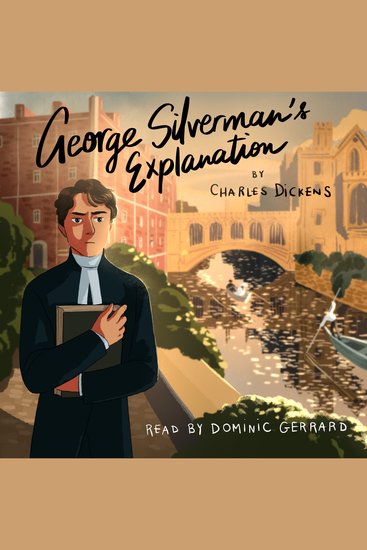
  • George Silverman's Explanation - cover

    George Silverman's Explanation

    Charles Dickens, Dominic Gerrard

    • 0
    • 0
    • 0
    George Silverman’s Explanation (published in The Atlantic in 1868) is one of Charles Dickens’ rarer short stories. Here the author immerses himself entirely in his character of George Silverman: addressing the reader in a dramatic monologue in which he is reticent, perhaps even unwilling to open up to us, but at the same time compelled to unburden his heart.  
    So deeply does Dickens embody the role of Silverman that in a letter to an editor he writes that: 'I feel as if I had read something (by somebody else) which I should never get out of my head …’ 
    This tale is an indictment against poverty as powerful as you will find in any of Dickens’ larger works. It is also a biting satire against the 'daring ignorance' and little 'meannesses' found in many non-conformist movements. Above all it is a deeply affecting examination of how far a childhood of of both want and punishing religious control can impact a man’s self-worth and future happiness. 
    Narrated by Dominic Gerrard 
    Cover Art by Léna Gibert
    Show book
  • The Model Millionaire - cover

    The Model Millionaire

    Oscar Wilde

    • 0
    • 0
    • 0
    "The Model Millionaire" is a short story by the Irish author Oscar Wilde. It first appeared in print in the newspaper The World in June 1887. It was published again in 1891 as part of the anthology Lord Arthur Savile's Crime and Other Stories.
    The story concerns a young man who, although he does not have much money himself, is moved to pity by the sight of an elderly beggar who is posing as a model for his artist friend. Although he can barely afford to do so, the young man gives the beggar the largest denomination coin that he has in his pocket. The young man's act of kindness has unexpected positive consequences for him.
    Show book
  • Of Conversation and the Anatomy of Fashion (Unabridged) - cover

    Of Conversation and the Anatomy...

    H. G. Wells

    • 0
    • 0
    • 0
    Herbert George "H. G." Wells (1866 - 1946) was an English writer.
    He was prolific in many genres, including the novel, history, politics, social commentary, and textbooks and rules for war games. Wells is now best remembered for his science fiction novels and is called a "father of science fiction"
    OF CONVERSATION AND THE ANATOMY OF FASHION: This uncle of mine, you must understand, having attained by the purest accident some trifles of distinction and a certain affluence in South Africa, came over at the earliest opportunity to London to be photographed and lionised.
    Show book
  • Horror - cover

    Horror

    Alexander Kuprin

    • 0
    • 0
    • 0
    A reminder from the master storyteller Alexander Kuprin - sometimes, there are but a few steps between your own front door and unimaginable horror.
    Show book
  • London Models (Unabridged) - cover

    London Models (Unabridged)

    Oscar Wilde

    • 0
    • 0
    • 0
    Oscar Wilde (16 October 1854 - 30 November 1900) was an Irish poet and playwright. After writing in different forms throughout the 1880s, he became one of the most popular playwrights in London in the early 1890s.
    LONDON MODELS: Professional models are a purely modern invention. To the Greeks, for instance, they were quite unknown. Mr. Mahaffy, it is true, tells us that Pericles used to present peacocks to the great ladies of Athenian society in order to induce them to sit to his friend Phidias, and we know that Polygnotus introduced into his picture of the Trojan women the face of Elpinice, the celebrated sister of the great Conservative leader of the day.
    Show book
