Join us on a literary world trip!
Add this book to bookshelf
Grey
Write a new comment Default profile 50px
Grey
Subscribe to read the full book or read the first pages for free!
All characters reduced
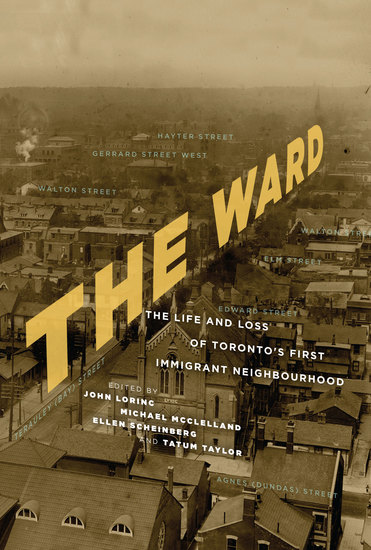
The Ward - The Life and Loss of Toronto’s First Immigrant Neighbourhood - cover

The Ward - The Life and Loss of Toronto’s First Immigrant Neighbourhood

John Lorinc, Michael McClelland, Ellen Scheinberg

Publisher: Coach House Books

  • 0
  • 0
  • 0

Summary

The story of the growth and destruction of Toronto's first 'priority neighbourhood.'
   
From the 1840s until the Second World War, waves of newcomers who migrated to Toronto – Irish, Jewish, Italian, African American and Chinese, among others – landed in 'The Ward.' Crammed with rundown housing and immigrant-owned businesses, this area, bordered by College and Queen, University and Yonge streets, was home to bootleggers, Chinese bachelors, workers from the nearby Eaton';s garment factories and hard-working peddlers. But the City considered it a slum, and bulldozed the area in the late 1950s to make way for a new civic square.
   
The Ward finally tells the diverse stories of this extraordinary and resilient neighbourhood through archival photos and contributions from a wide array of voices, including historians, politicians, architects, story-tellers, journalists and descendants of Ward residents. Their perspectives on playgrounds, tuberculosis, sex workers, newsies and even bathing bring The Ward to life and, in the process, raise important questions about how contemporary cities handle immigration, poverty and the geography of difference.
   
‘The Ward shines a light on one of Toronto's most historically significant and most forgotten neighbourhoods. Instead of a straight history, the book's editors opted to present the Ward through multiple short essays, each with its own unique point of view. The result is a fascinating and varied look at an area that once concurrently defined the city and acted as its biggest shame. As a result of the Ward's eventual razing, there are few artifacts left to teach newer generations about this important part of Toronto's history. This book helps correct that.’
   
– 2016 Toronto Book Awards Jury Citation
   
'[The Ward] should be of interest to Canadians anywhere, reminding us that we all came from some place else.'
   
– Michael Enright, CBC Sunday Edition
   
Contents & Contributors
   
Introduction – John Lorinc
   
Searching for the Old Ward – Shawn Micallef
   
No Place Like Home – Howard Akler
   
Beforethe Ward: Macauleytown – Stephen A. Otto
   
My Grandmother the Bootlegger – Howard Moscoe
   
Against All Odds: The Chinese Laundry – Arlene Chan
   
VJ Day – Arlene Chan
   
Merle Foster's Studio: 'A Spot Of Enchantment' – Terry Murray
   
Missionary Work: The Fight for Jewish Souls – Ellen Scheinberg
   
King of the Ward – Myer Siemiatycki
   
Where the Rich Went for Vice – Michael Redhill
   
A Fresh Start: Black Toronto in the 19th Century – Karolyn Smardz Frost
   
Policing the Lord’s Day – Mariana Valverde
   
'The Maniac Chinaman' – Edward Keenan
   
Elsie's Story – Patte Roseban
   
Lawren Harris's Ward Period – Jim Burant
   
'Fool's Paradise': Hastings' Anti-Slum Crusade – John Lorinc
   
Strange Brew: The Underground Economy of Blind Pigs – Ellen Scheinberg
   
The Consulate, the Padroni and the Labourers – Andrea Addario
   
Excerpt: The Italians in Toronto – Emily P. Weaver
   
Arthur Goss: Documenting Hardship– Stephen Bulger
   
Fresh Air: The Fight Against TB – Cathy Crowe
   
The Stone Yard – Gaetan Heroux
   
William James: Toronto's First Photojournalist – Vincenzo Pietropaolo
   
The Avenue Not Taken – Michael McClelland
   
Timothy Eaton’s Stern Fortifications – Michael Valpy
   
Settling In: Central Neighbourhood House – Ratna Omidvar & Ranjit Bhaskar
   
Toronto’s Girl with the Curls – Ellen Scheinberg
   
Chinese Cafés: Survival and Danger – Ellen Scheinberg & Paul Yee
   
Defiance and Divisions: The Great Eaton's Strike – Ruth A. Frager
   
Elizabeth Street: What the City Directories Reveal – Denise Balkissoon
   
Growing Up on Walton Street – Cynthia MacDougall
   
Revitalizing George Street: The Ward's Lessons – Alina Chatterjee & Derek Ballantyne
   
Taking Care of Business in the Ward &ndash Ellen Scheinberg
   
'A Magnificent Dome': The Great University Avenue Synagogue – Jack Lipinsky
   
Reading the Ward: The Inevitability of Loss – Kim Storey & James Brown
   
Toronto’s First Little Italy – John Lorinc
   
The Elizabeth Street Playground, Revisited – Bruce Kidd
   
Divided Loyalties – Sandra Shaul
   
Crowded by Any Measure – John Lorinc
   
A Peddler and His Cart: TheWard’s Rag Trade – Deena Nathanson
   
Toronto's Original Tenement: Wineberg Apartments – Richard Dennis
   
Excerpt: Tom Thomson's Diary – Tom Thomson
   
An Untimely Death – Brian Banks
   
Paper Pushers – Ellen Scheinberg 
   
The BMR's Wake-Up Call – Laurie Monsebraaten
   
Excerpt: Report of the Medical Health Officer … – Charles J. Hastings
   
Dr. Clarke's Clinic – Thelma Wheatley
   
Slum-Free: The Suburban Ideal – Richard Harris
   
The Glionna Clan and Toronto's First Little Italy – John E. Zucchi
   
'The Hipp' – Michael Posner
   
Before Yorkville– John Lorinc
   
Sex Work and the Ward’s Bachelor Society – Elise Chenier
   
Public Baths: Schvitzing on Centre Avenue – Ellen Scheinberg
   
The Health Advocates: McKeown on Hastings – John Lorinc
   
Remembering Toronto's First Chinatown – Kristyn Wong-Tam
   
Tabula Rasa – Mark Kingwell
   
Unrealized Renewal  – J. David Hulchanski
   
A Short History of the 'Civic Square' Expropriation – John Lorinc
   
Storytelling is Part of the Story – Tatum Taylor
   
How We Think About What (Little) Survives – Patrick Cummins
   
Institutional Memory – Scott James & Victor Russell
   
Alternative Histories – MichaelMcClelland
Available since: 06/01/2015.
Print length: 320 pages.

Other books that might interest you

  • World War III: Humanity Sacrificed - The Hidden Architecture of Global Collapse - cover

    World War III: Humanity...

    Murat Aibassov

    • 0
    • 0
    • 0
    World War III: Humanity Sacrificed is a chilling yet deeply analytical exploration of how the modern world collapsed into global conflict — and why it was inevitable. Written by Murat Aibassov, an engineer who predicted the war more than a decade before it began, the book exposes the hidden architecture of global systems, the cyclic nature of civilizational collapse, and the elite mechanisms that shape history behind the scenes. 
    Blending geopolitics, economics, technology, and ritual dynamics, Aibassov reveals why global crises unfold with mathematical precision — and what humanity must understand to survive what comes next. 
    This is not a book of fear. 
    This is a book of patterns, truth, and the last chance to prepare for the world after the catastrophe.
    Show book
  • I love to pray - cover

    I love to pray

    LADONNA J HITE

    • 0
    • 0
    • 0
    Introduce your child to Jesus and help them discover how easy praying can be.
    Show book
  • Empty Cages - Facing the Challenge of Animal Rights - cover

    Empty Cages - Facing the...

    Tom Regan

    • 0
    • 0
    • 0
    Described by Jeffrey Masson as "the single best introduction to animal rights ever written, Tom Regan's EMPTY CAGES stands as an essential guide to the ongoing animal rights debate. In a style at once simple and elegant, Regan dispels the negative image of animal rights advocates as portrayed by the mass media, unmasks the fraudulent rhetoric of "humane treatment" favored by animal exploiters in both familiar and less well-documented contexts, and explains why existing laws function to legitimize institutional cruelty. In so doing, Regan invites readers to join the struggle for animal rights—one person at a time, one step at a time. Written by the leading philosophical spokesperson for animal rights, Tom Regan's shocking exposé of animal abuse makes an essential and lasting contribution to how animal rights is viewed in the United States and around the world. 
    "Tom Regan delivers a searing indictment of the way we treat animals in the world we have made for ourselves, and presents a trenchant case that animals have or should have rights in the same way that human beings have."—J. M. Coetzee, winner of the 2003 Nobel Prize for Literature 
    "Every so often a book is written that is destined to change the way people think. Tom Regan has written just such a book. EMPTY CAGES is compelling because it is logical, rational, and written in an elegantly simple style. Please buy this book, read it, and tell your friends about it. Everyone needs a copy on their bookshelf."—Jane Goodall 
    "Tom Regan's EMPTY CAGES is a powerful call for justice on one of the most urgent issues human society faces. Calmly, lucidly, he asks readers to confront the miserable conditions we have inflicted on animals, leaving us with three choices: find a flaw in the argument, work for change, or throw the book away and try to forget it. The indelible force of Regan's argument makes the third course very difficult."—Martha C. Nussbaum, University of Chicago
    Show book
  • Responsibility - The Accountable Life - Owning Your Actions and Duties - cover

    Responsibility - The Accountable...

    Esther Jameson

    • 0
    • 0
    • 0
    Responsibility is the cornerstone of a meaningful life, forming the basis for personal growth, trust, and fulfillment. It is the ability to own one's actions, decisions, and their consequences without shifting blame onto others. This chapter examines the intricate nature of responsibility and its profound influence on our character and relationships. At its core, responsibility involves acknowledging the power and impact of our choices. When individuals accept responsibility, they embrace a mindset that values integrity, self-discipline, and accountability. This mindset is critical for personal development and paves the way for a more respectful and trustworthy society. 
    The concept of responsibility is not merely about following rules or fulfilling duties; it extends into every aspect of our lives. It is evident in the way we interact with family, friends, and colleagues, as well as in our professional endeavors. When we take responsibility, we are better equipped to learn from our mistakes and strive for continuous improvement. This process of learning and growing is essential, as it helps us understand the importance of our actions and their potential impact on others. Embracing responsibility means accepting that our decisions have consequences, both positive and negative, and that we are accountable for managing these outcomes. 
    Moreover, responsibility instills a sense of purpose and direction. When individuals consciously choose to be responsible, they align their actions with their values and goals. This alignment brings about clarity in decision-making and helps build trust within communities. Trust is a vital element in every relationship, as it enables open communication and fosters deeper connections. In this context, being responsible is not a burden, but a privilege that empowers us to contribute positively to society.
    Show book
  • The Big 100 - cover

    The Big 100

    William J. Kole

    • 0
    • 0
    • 0
    By 2050, the world’s centenarian population—those aged 100 or more—will increase eightfold. Half of today’s 5-year-olds can expect to reach the same heights. It’s going to upend everything we thought we knew about health care, personal finance, retirement, politics, and more. Whether we’re 18 or 81, this tectonic demographic shift will affect us all. The Big 100 confronts listeners with both the brightness and potential bleakness of a fate few of us thought possible. Journalist William Kole guides us on this journey into our future, an optimistic but sometimes fraught exploration of super-aging as the grandson of a centenarian. Along the way, there are expert sources, like Dr. Jane Goodall, longevity expert Dr. Thomas Perls, Senator Elizabeth Warren, and even 101-year-old influencer and fashionista Iris Apfel, along with surprises. And there’s the troubling truth that those reaching extreme longevity tend to be overwhelmingly white, a product of what experts deem the “weathering theory”: the idea that the health of African Americans begins to deteriorate in early adulthood as a physical consequence of socio-economic disadvantages. How long can we live? How long should we live? And what happens when 65 is merely a life half-lived? The Big 100 explores the most pressing questions of our super-aging future and offers a glimpse of a reality that awaits us, our children, and our grandchildren.
    Show book
  • Fragments Of Faith - cover

    Fragments Of Faith

    Santiago Machain

    • 0
    • 0
    • 0
    Fragments of Faith delves into some of the most groundbreaking archaeological finds that have transformed our understanding of Scripture and the ancient world. From the Dead Sea Scrolls to Hezekiah`s Tunnel, this book explores how these discoveries illuminate the historical, cultural, and spiritual contexts of biblical narratives. Each chapter examines a key artifact or site, weaving together history, faith, and archaeology in an accessible and engaging style. Whether it`s the dramatic fall of Jericho`s walls or the policies of Cyrus the Great etched into a cylinder, these findings bridge the gap between ancient history and modern faith, offering fresh insights into the Bible`s enduring message.
    Show book