Join us on a literary world trip!
Add this book to bookshelf
Grey
Write a new comment Default profile 50px
Grey
Subscribe to read the full book or read the first pages for free!
All characters reduced
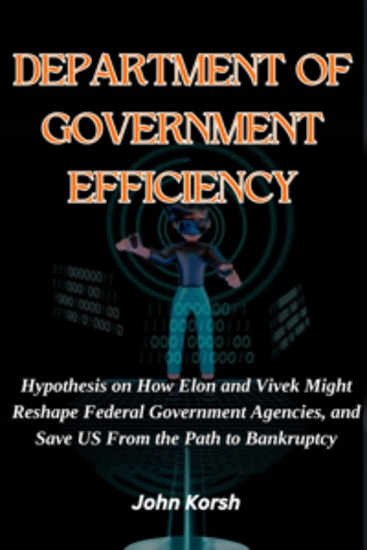
Department of Government Efficiency - Hypothesis on How Elon and Vivek Might Reshape Federal Government Agencies and Save US From the Path to Bankruptcy - cover

Department of Government Efficiency - Hypothesis on How Elon and Vivek Might Reshape Federal Government Agencies and Save US From the Path to Bankruptcy

John Korsh

Publisher: John Korsh

  • 0
  • 0
  • 0

Summary

Let me make this perfectly clear: we stand at a crossroads. The federal government is running on fumes, wasting billions of taxpayer dollars and making terrible decisions a day. It’s time for a change.Time to repair what’s broken, and trust me, the folks that can do it are out there. Well if you want to get this country back on the right track, you need bold visionary leaders who have a proven record of getting results.
Available since: 12/07/2024.

Other books that might interest you

  • The Yemen Model - Why US Policy Has Failed in the Middle East - cover

    The Yemen Model - Why US Policy...

    Alexandra Stark

    • 0
    • 0
    • 0
    A close look at failed US policies in the Middle East, offering a fresh perspective on how best to reorient goals in the region 


    In this book Alexandra Stark argues that the US approach to Yemen offers insights into the failures of American foreign policy throughout the Middle East. Stark makes the case that despite often being drawn into conflicts within Yemen, the United States has not achieved its policy goals because it has narrowly focused on counterterrorism and regional geopolitical competition rather than on the well-being of Yemenis themselves. She offers recommendations designed to reorient US policy in the Middle East in pursuit of US national security interests and to support the people of these countries in their efforts to make their own communities safe, secure, and prosperous.
    Show book
  • Disaster Nationalism - The Downfall of Liberal Civilization - cover

    Disaster Nationalism - The...

    Richard Seymour

    • 0
    • 1
    • 0
    The rise of the new far right has left the world grappling with a profound misunderstanding. While the spotlight often shines on the actions of charismatic leaders, the true peril lies elsewhere. Defeating these people will not stem the tide driving them forward. They are merely the embodiment of profound forces that are rarely understood. Propelled through the vast networks of social media and fueled by far-right influencers, enthralled by images of disaster and fantasies of doom, they have emerged from a reservoir of societal despair, fear, and isolation. Within this seething cauldron, we witness not only the surge of far-right political movements but also the sparks of individual and collective violence against perceived enemies, from 'lone wolf' killers to terrifying pogroms. Should a new fascism emerge, it will coalesce from these very elements. This is disaster nationalism. 


    Richard Seymour delves deep into this alarming development in world politics, dissecting its roots, its influencers, and the threats it poses. With meticulous analysis and compelling storytelling, Seymour offers a stark warning. The battle against disaster nationalism is not just political; it is a struggle for our collective soul and the future of civilization itself. Unless we understand the deeper forces propelling the far-right resurgence, we have little chance of stopping it.
    Show book
  • Authoritarianism - A Very Short Introduction - cover

    Authoritarianism - A Very Short...

    James Loxton

    • 0
    • 0
    • 0
    Authoritarianism is one of the buzzwords of our age. But what is it exactly? This Very Short Introduction provides a comprehensive overview of the world of authoritarian regimes, including military, single-party, and personalist regimes. It considers how understandings of authoritarianism have evolved over time, as well as the curious fact that many authoritarian regimes today hold elections. Drawing on examples from Africa, Asia, Europe, Latin America, and the Middle East, James Loxton examines the life cycle of authoritarian regimes. How are they born? What challenges do they face during life? Why do they die? The author shows how factors such as natural resource wealth and cross-border collaboration can contribute to authoritarian durability. He also highlights the disturbing fact that even when authoritarian regimes collapse, voters often use their newfound democratic rights to send former authoritarian officials back to office.
    Show book
  • 7 Areas Without Laws - Exploring the World's Last Anarchic Zones - cover

    7 Areas Without Laws - Exploring...

    John Harpoon

    • 0
    • 0
    • 0
    Laws are the invisible threads that hold societies together, shaping behavior, enforcing order, and establishing the boundaries of right and wrong. Yet, scattered across the world, there are rare places where laws hold little to no authority—zones where governments have little presence, where no single entity enforces regulations, and where the concept of governance is fluid or entirely absent. These places, whether by accident of history, geopolitical disputes, or deliberate rejection of authority, exist on the fringes of civilization.  
      
    This book explores seven of these anarchic zones, each with its own unique circumstances and challenges. From the open ocean, where maritime law is a complex tangle of loopholes and jurisdictions, to the frozen expanse of Antarctica, where no country claims true ownership, these areas defy traditional governance. Some, like Bir Tawil—a small strip of land between Egypt and Sudan—are unclaimed due to border disputes, while others, like Slab City in California or Freetown Christiania in Denmark, are self-declared autonomous communities that reject the rules of mainstream society.  
      
    The existence of these lawless zones raises important questions: Can true freedom exist without laws? Is lawlessness always synonymous with chaos, or can people thrive outside the framework of government? In some of these areas, the absence of enforcement has led to disorder, crime, and exploitation. Pirates take advantage of international waters to operate freely, and smugglers use ungoverned territories to traffic goods and people. In other places, however, the lack of laws has fostered alternative communities built on mutual cooperation, artistic expression, and self-sufficiency. 
    Show book
  • Equality and Efficiency: Book Summary & Analysis - cover

    Equality and Efficiency: Book...

    Briefly Summaries

    • 0
    • 0
    • 0
    This is a concise summary and analysis of 
    Equality and Efficiency, by Arthur M. Okun.
    It is not the original book and is not affiliated with or endorsed by 
    Arthur M. Okun.
    Ideal those seeking a quick and insightful overview.
     
    "Equality and Efficiency: The Big Tradeoff" explores the delicate balance between economic equality and efficiency, a tension that shapes policy decisions and societal outcomes. Through clear, thought-provoking analysis, the book examines how efforts to achieve fairness often come at the cost of productivity and growth, and vice versa. This accessible exploration dives into key economic concepts, social trade-offs, and the challenges of designing systems that promote both justice and prosperity, making it an essential read for those interested in economics, public policy, and social justice.
    Show book
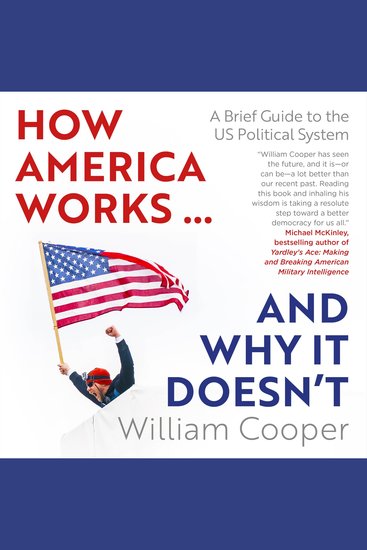
  • How America Worksand Why It Doesn't - A Brief Guide to the US Political System - cover

    How America Worksand Why It...

    William Cooper

    • 0
    • 0
    • 0
    Twenty-first-century America isn’t working the way it’s supposed to. 
    This book explains why. 
    Americans in the twenty-first century are becoming increasingly untethered from both reality and the essential principles and traditions that have shaped the nation’s historic success. A big part of why America isn’t working is because far too many Americans neither know nor care how it’s supposed to work. 
    “William Cooper presents an insightful, sensitive, and accessible account of the trials that face American democracy in the twenty-first century. This fair- and broad-minded volume makes compelling reading for those who are looking to build a better democracy.” Alexander Yen, Department of Politics and International Relations, University of Oxford 
    “Partisanship fuels personal convictions more than ever in our society, and convictions fuel mysided thinking and other cognitive biases. At no time have we needed this discussion of bias and partisan thinking more than now.” Keith E. Stanovich, author of The Bias That Divides Us 
    “William Cooper logically and authoritatively takes you step by step through all the reasons a President Trump couldn’t imprison his enemies, pardon his friends, overrule judges, weaponize the Department of Justice, prosecute Joe Biden, or order the military to enforce his unconstitutional actions” Cleveland Plain Dealer 
    “William Cooper is an insightful and thought-provoking writer about US politics. He deserves to be widely read.” Thomas Plate, former Editorial Page Editor, Los Angeles Times 
    "In How America Works . . . and Why It Doesn’t, William Cooper gives a thoughtful, readable guide to what ails American democracy. Required reading for any student of political science.” Uri Kaufman, author of Eighteen Days in October 
    "A must-read. His well-written and brief book covers a lot of important ground in a learned but accessible manner. Probably most noteworthy, though, is his astute and fair judgment―the book is not a polemic for the left or the right, but rather a fair appraisal of the strengths and weaknesses of both. I highly recommend reading it―it is an enjoyable tour of key aspects of history (as well as current events), ethics, political philosophy, constitutional law, environmental science, and cognitive psychology―all told in a lucid, efficient way." William O'Donohue, PhD, Professor, University of Nevada, Reno
    Show book