Join us on a literary world trip!
Add this book to bookshelf
Grey
Write a new comment Default profile 50px
Grey
Subscribe to read the full book or read the first pages for free!
All characters reduced
Saint's Progress - cover

Saint's Progress

John Galsworthy

Publisher: Aeneas Press

  • 0
  • 0
  • 0

Summary

A vicar of absolute faith discovers his daughter is pregnant by an officer going back to the front, and must choose between his religion and his child. Galsworthy trained as a barrister, never practised, and was told to write by Joseph Conrad, then a ship's first mate; this 1919 novel was written while the war was still in the room, and the vicar is drawn with respect, which is what makes it hurt.
Available since: 08/19/2026.
Print length: 282 pages.


Other books that might interest you

  • How a Muzhik Fed Two Officials - cover

    How a Muzhik Fed Two Officials

    Mikhail Saltykov-Shchedrin

    • 0
    • 0
    • 0
    How a Muzhik Fed Two Officials is not just a fable—it is a mirror, polished to a biting shine, reflecting the grotesque logic of power and servitude. In this brief yet mercilessly precise tale, Mikhail Saltykov-Shchedrin strips hierarchy down to its raw absurdity: those who consume and those who are consumed.
    Two officials, stranded in a land without luxury, discover an ingenious solution to their predicament—one that requires neither effort nor skill on their part. Their savior? A humble muzhik, a man shaped by centuries of unquestioning toil. But necessity breeds invention, and soon, the line between duty and exploitation blurs beyond recognition. 
    With razor-sharp irony, Saltykov-Shchedrin lays bare a world where privilege thrives on passivity, and survival itself becomes a grotesque performance. The muzhik, nameless and tireless, embodies an entire class condemned to labor without recognition, while the officials, ludicrous in their entitlement, reveal the disturbing resilience of power, even in the face of absurdity.
    Darkly comic yet chillingly relevant, How a Muzhik Fed Two Officials remains an unflinching satire on authority, dependence, and the silent mechanisms that sustain inequality. A story as brief as it is unsettling—one that lingers long after the last word.
    Show book
  • Regret - From their pens to your ears genius in every story - cover

    Regret - From their pens to your...

    Guy de Maupassant

    • 0
    • 0
    • 0
    Henri René Albert Guy de Maupassant was born on August 5th, 1850 near Dieppe in France.  
    Maupassant’s early life was badly torn when at age 11 (his younger brother Hervé was then five) his mother, Laure, a headstrong and independent-minded woman, risked social disgrace in order to obtain a legal separation from her husband. 
    After the separation, Laure kept custody of her two boys. With the father now forcibly absent, Laure became the most influential and important figure in the young boy's life.   
    Maupassant’s education was such that he rebelled against religion and other societal norms but a developing friendship with Gustave Flaubert began to turn his mind towards creativity and writing. 
    After graduation he volunteered for the Franco-Prussian war. With its end he moved to Paris to work as a clerk in the Navy Department.  Gustave Flaubert now took him under his wing.  Acting as a literary guardian to him, he guided the eager Maupassant to debuts in journalism and literature.  For Maupassant these were exciting times and the awakening of his creative talents and ambitions. 
    In 1880 he published what is considered his first great work, ‘Boule de Suif’, (translated as as ‘Dumpling’, ‘Butterball’, ‘Ball of Fat’, or ‘Ball of Lard’) which met with a success that was both instant and overwhelming.  Flaubert at once acknowledged that it was ‘a masterpiece that will endure.’ Maupassant had used his talents and experiences in the war to create something unique.  
    This decade from 1880 to 1891 was to be the most pivotal of his career.  With an audience now made available by the success of ‘Boule de Suif’ Maupassant organised himself to work methodically and relentlessly to produce between two and four volumes of work a year.  The melding of his talents and business sense and the continual hunger of sources for his works made him wealthy. 
    In his later years he developed a desire for solitude, an obsession for self-preservation, and a fear of death as well as a paranoia of persecution caused by the syphilis he had contracted in his youth.  
    On January 2nd, 1892, Maupassant tried to commit suicide by cutting his throat.  Unsuccessful he was committed to the private asylum of Esprit Blanche at Passy, in Paris.  It was here on July 6th, 1893 that Henri René Albert Guy de Maupassant died at the age of only 42.
    Show book
  • Cousin Phillis - cover

    Cousin Phillis

    Elizabeth Gaskell

    • 0
    • 0
    • 0
    Immerse yourself in the poignant and pastoral world of "Cousin Phillis" by Elizabeth Gaskell. This novella follows Paul Manning, a young engineer, who forms a deep and introspective bond with his innocent and intellectual cousin, Phillis Holman. Set against the serene backdrop of a rural 19th-century English village, the story explores themes of unspoken love, personal growth, and the impact of industrialization. Gaskell's delicate prose and rich characterization paint a touching portrait of human emotion and the complexities of life.
    Show book
  • The Unparalleled Adventures of One Hans Pfaall - cover

    The Unparalleled Adventures of...

    Edgar Allan Poe

    • 0
    • 0
    • 0
    "The Unparalleled Adventure of One Hans Pfaall" (1835) is a short story by Edgar Allan Poe. The story is regarded as one of the early examples of the modern science fiction genre. The story traces the journey of a voyage to the Moon.
    The story opens with the delivery to a crowd gathered in Rotterdam of a manuscript detailing the journey to the moon by Hans Pfaall. The letter is brought by balloon by an inhabitant of the moon. He had been sent by Pfaall to Rotterdam with the letter for Burgomaster Superbus Von Underduk after an absence of five years. The manuscript, which comprises the majority of the story, sets out in detail how Hans Pfaall, a mender of bellows, contrived to reach the Moon by benefit of a revolutionary new balloon and a device which compresses the vacuum of space into breathable air. The journey takes him nineteen days.
    Show book
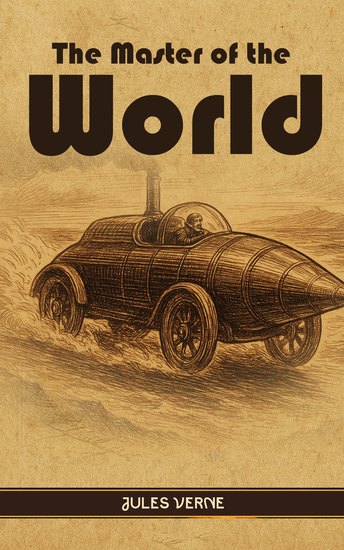
  • The Master of the World - cover

    The Master of the World

    Jules Verne

    • 0
    • 0
    • 0
    The Master of the World is a thrilling and forward-looking science fiction novel by Jules Verne that explores the intoxicating power of technological genius—and the dangers of ambition without restraint. Serving as a sequel to Robur the Conqueror, the story revisits the enigmatic inventor Robur, whose unmatched intellect has enabled him to create machines that defy the limits of land, sea, and air.
    
    When mysterious disturbances and inexplicable sightings begin to alarm authorities across the United States, government investigators are dispatched to uncover the truth. Their search leads to the hidden stronghold of Robur, who has perfected a revolutionary vehicle capable of operating as an automobile, submarine, speedboat, and aircraft all in one. With this unprecedented invention, Robur seeks not cooperation with the world, but domination over it.
    
    Blending suspense, cutting-edge imagination, and social commentary, The Master of the World examines the ethical responsibility that accompanies scientific progress. Verne raises timeless questions about control, freedom, and the moral limits of innovation, anticipating modern debates about technology and power.
    
    Dark, intense, and visionary, The Master of the World stands as one of Jules Verne's most prophetic works—a compelling classic of science fiction that warns as much as it inspires, and continues to resonate in an age defined by technological advancement.
    Show book
  • Pride and Prejudice - cover

    Pride and Prejudice

    Jane Austen

    • 0
    • 0
    • 0
    Since its immediate success in 1813, Pride and Prejudice has remained one of the most popular novels in the English language. Jane Austen called this brilliant work “her own darling child” and its vivacious heroine, Elizabeth Bennet, “as delightful a creature as ever appeared in print.” The romantic clash between the opinionated Elizabeth and her proud beau, Mr. Darcy, is a splendid performance of civilized sparring. And Jane Austen’s radiant wit sparkles as her characters dance a delicate quadrille of flirtation and intrigue, making this book the most superb comedy of manners of Regency England.
    
    ©2020 Pandora's Box (P)2020 Pandora's Box
    Show book