Join us on a literary world trip!
Add this book to bookshelf
Grey
Write a new comment Default profile 50px
Grey
Subscribe to read the full book or read the first pages for free!
All characters reduced
Addresses in America 1919 - Exploring Democracy and Social Justice Through Literary Insights - cover

Addresses in America 1919 - Exploring Democracy and Social Justice Through Literary Insights

John Galsworthy

Publisher: Good Press

  • 0
  • 0
  • 0

Summary

In "Addresses in America, 1919," John Galsworthy presents a compelling collection of speeches and lectures that reflect not only his literary prowess but also the socio-political climate of post-World War I America. Galsworthy employs a keenly observant and articulate style, merging narrative grace with a persuasive rhetorical approach. This work transcends mere documentation; it delves into themes of democracy, social justice, and the human condition, resonating with the burgeoning modernist movements of the early 20th century. His reflections serve as a poignant commentary on the shifting landscape of American society amid profound global change. John Galsworthy, an eminent British author known for his insights into social issues, was moved by the aftermath of the Great War and the evolving American ethos. His experiences traveling through a transformative America in the wake of the conflict, along with his own inquiries into the societal challenges of his time, spurred him to confront pressing issues through the lens of his sharp intellect and humane sensibility. Galsworthy's literary background, including the creation of the Forsyte Saga, underlines his ability to engage readers in thoughtful discourse. This work is essential for those seeking a nuanced understanding of early 20th-century America and its challenges. Galsworthy's eloquence and insightful observations encourage readers to reflect on the relevance of his messages today. Whether one is a student of literature, history, or sociology, "Addresses in America, 1919" promises to enrich your perspective and provoke thoughtful dialogue.
Available since: 07/10/2023.
Print length: 52 pages.

Other books that might interest you

  • China's Church Divided - Bishop Louis Jin and the Post-Mao Catholic Revival - cover

    China's Church Divided - Bishop...

    Paul P. Mariani

    • 0
    • 0
    • 0
    During the Cultural Revolution, the Chinese state sought to eradicate religious life throughout the country. But by 1978, two years after the death of Mao Zedong, the Communist Party under Deng Xiaoping cautiously embraced the revival of religion. At the same time, the newly elected Pope John Paul II made a point of renewing outreach to China. Paul P. Mariani tracks the fate of Chinese Catholicism in the wake of these transformative leadership changes, focusing on the influential Catholic community in Shanghai. 


    Earlier policies of the 1950s had fractured the Catholic community into a state-approved "patriotic" church that answered to the government and an underground church loyal to Rome. Even after the Cultural Revolution, Mariani shows, this divide remained firmly intact. The resulting tensions were on vivid display in Shanghai, owing to the leadership of the Jesuit priest Louis Jin Luxian. Bishop Jin used his position to revitalize the local Catholic community, but his cooperation with the party put him ever at odds with underground church leaders. 


    Sensitive to the ideals, compromises, and disappointments of Catholics on both sides of the rift, China's Church Divided reveals how the community navigated the irreconcilable differences between a worldwide Church centered in Rome and a regime wary of foreign spiritual authority.
    Show book
  • Gunpowder and the Printing Press: The History and Legacy of the Inventions that Modernized Europe - cover

    Gunpowder and the Printing...

    Editors Charles River

    • 0
    • 0
    • 0
    In addition to the wheelbarrow, the seismograph, the waterwheel, deep drilling, suspension bridges, and ship rudders, among countless other life-changing contraptions, the Chinese developed what were later dubbed the “Four Great Inventions of China.” Two of those were gunpowder and printing, which both spread through South Asia and the Middle East before making it to Europe.  
    For a time, gunpowder was a mere curiosity, but its destructive power and military potential would be realized quickly. The first record of a cannon in Europe comes from a manuscript written in 1326, which has an illustration showing an armored man with what looks like a slow match lighting a vase-shaped object. This crude cannon was called a pot de fer in French and vasi in Italian. While medieval engineers developed new types of cannons and explosives capable of destroying walls and castles, others were making the first handguns possible. European sources first mentioned the widespread use of handgonnes, as they were often called, in the late 14th century, precisely the time when gunpowder became cheaper.  
    	The history of printing was for ancient Asia an advancement in culture and communication, but for Europe in the 15th century, it was much more, plunging the continent into a new paradigm and aligning it for the modern world. Its importance is often overlooked, but the timeliness of the printing machine was equivalent to the invention of alphabets in antiquity and ranks up there with the digital revolution and the introduction of the internet. Put simply, it made the Renaissance possible and led to the modernization of Europe. Based on earlier Asian principles, Johannes Gutenberg’s movable type printing press propelled an industry that led to the education of the West and ultimately removed the tight grip of the Vatican from daily European life. 
    Show book
  • Mending Sunday - Embracing Differences in a Church Torn by Division - cover

    Mending Sunday - Embracing...

    Skot Welch

    • 0
    • 0
    • 0
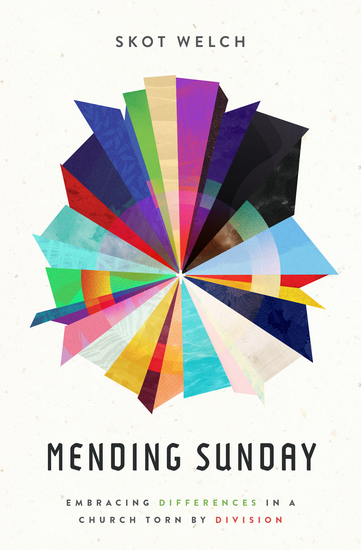
    Diversity is God’s idea—and unity is how we honor God.Our heavenly Father calls us to unite, but Christians remain some of the most divided people on the planet. It seems we mistake God’s call for unity as a command for uniformity: We split along political and denominational lines and prefer our churches, neighborhoods, and other spaces to be filled with those most “like” ourselves.Our segregated habits may satisfy our need for comfort, but division breaks God’s heart. We are called to embrace the miracle of unity, when what was once separated due to difference comes together—when people from every group, nation, and tongue praise the name of Jesus.In Mending Sunday, Skot Welch offers a pathway for putting on the mind of Christ when it comes to diversity and division. God’s unity doesn’t mean giving up our unique identities and the gifts of ethnicity, family, language, or tradition. Rather, when we put Jesus at the center of our lives and communities, we experience a grace and power we’ve never before known. In a culture bent on division, a church that embraces differences becomes the biggest witness for Christ the world has ever seen.
    Show book
  • What If No One Is Coming To Save You - And 67 Other Questions That Will Shatter Your Perceptions and Change The Way You Live Your Life - cover

    What If No One Is Coming To Save...

    Corey Gladwell

    • 0
    • 0
    • 0
    4X Best Selling Author Corey Gladwell take’s you on journey beyond what most would dare to venture in their minds. The possibilities he gives the reader of what could be are a true gift to the world. This is 68 questions that truly do shatter your perceptions and can ultimately take you into a life you only dreamed of inside and out. 
    In "What If No One Is Coming To Save You: And 67 Other Questions That Will Shatter Your Perceptions and Change The Way You" Corey Gladwell invites readers on a transformative journey of self-discovery and paradigm-shifting perspectives. This thought-provoking book delves into the power of 'what if' questions to challenge and expand our usual ways of thinking. Each chapter presents a series of insightful inquiries designed to provoke deep reflection and a reevaluation of one's beliefs and values. 
    Gladwell masterfully blends philosophy, psychology, and personal growth, encouraging readers to confront their limitations and unlock a more profound understanding of themselves and the world around them. Through a mix of personal anecdotes, scientific exploration, and practical exercises, this book offers a unique approach to personal development and consciousness expansion. 
    Whether you're seeking a new perspective on life's big questions or eager to break free from conventional thinking, "What If No One Is Coming To Save You: And 67 Other Questions That Will Shatter Your Perceptions and Change The Way You" is an essential guide for anyone looking to explore the depths of their mind and the possibilities of their existence. 
    Get Your Copy Now!
    Show book
  • Imperial Japan - The WWII Rising Sun's Brutal March of Conquest (3 in 1) - cover

    Imperial Japan - The WWII Rising...

    Sage Winters

    • 0
    • 0
    • 0
    This book contains 3 titles, which are about the following topics: 
    Japan's Surrender: The Pacific theater of World War II was a brutal and protracted conflict, defined by fierce battles, shifting strategies, and immense human cost. By 1945, the war had entered its final stages, with the Allied forces, led primarily by the United States, gradually gaining the upper hand over Imperial Japan. The end of the Pacific War seemed inevitable, yet the path to Japan's surrender was far from straightforward. The road to victory in the Pacific involved a combination of military ingenuity, strategic alliances, and significant geopolitical shifts. However, the culmination of this path was not solely the result of battlefield victories but also of profound shifts in the political, economic, and moral considerations of both the Japanese leadership and the Allied powers. 
    Pearl Harbor: The path to the attack on Pearl Harbor was paved by years of escalating tension between Japan, the United States, and other global powers. By the 1930s, Japan had increasingly pursued aggressive territorial expansion in Asia. The country sought to secure resources to fuel its growing industrial machine, leading to its invasion of China and the creation of the Greater East Asia Co-Prosperity Sphere. This expansionist ideology put Japan on a collision course with Western powers, particularly the United States, who had significant economic interests in the Pacific region. 
    The Pacific Theater: The Pacific Theater of World War II was the culmination of decades of tension, territorial disputes, and ideological differences between Japan and the Allied Powers, particularly the United States. The roots of the conflict can be traced back to Japan’s rise as an imperial power in the late 19th and early 20th centuries.
    Show book
  • Living a Committed Life - Finding Freedom and Fulfillment in a Purpose Larger Than Yourself - cover

    Living a Committed Life -...

    Lynne Twist, Van Jones

    • 0
    • 0
    • 0
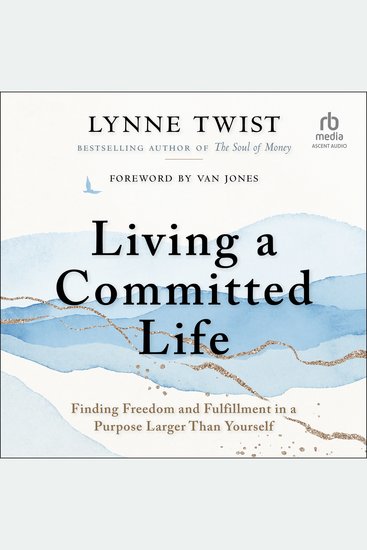
    What would life be like if you committed to something larger than yourself? Find out in the newest book from global transformation thought leader Lynne Twist. 
     
    How does one person make a difference in the world? People constantly seek to discover meaning in their lives, but as humans take on the challenges facing us in this decade and beyond, we're searching for it now more than ever. 
     
    Living a Committed Life demonstrates the power of dedication that goes beyond the self and teaches how to live a committed life that enables you to draw on resources and capacities from your most authentic self. In five parts, Lynne Twist shows how to make and keep commitments, engage in individual and collective action, and discover ways to connect and collaborate to make a difference. 
     
    By sharing stories and perspectives from her life, Twist reveals her unique experience as a thought leader and activist in multiple causes, from ending world hunger and protecting the Amazon rainforest to empowering women's leadership. The book presents the guiding principles that have enabled her own success and that turn inspiration into action for everyone.
    Show book