Join us on a literary world trip!
Add this book to bookshelf
Grey
Write a new comment Default profile 50px
Grey
Subscribe to read the full book or read the first pages for free!
All characters reduced
Abracadabra & other satires - cover

Abracadabra & other satires

John Galsworthy

Publisher: Bu Classics Books

  • 0
  • 0
  • 0

Summary

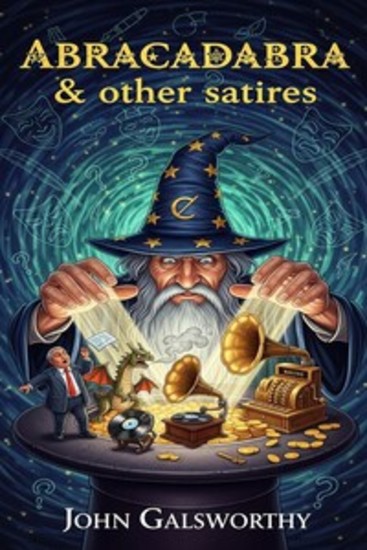
Society’s absurdities and contradictions are laid bare in this sharp collection of satirical sketches and observations. Galsworthy uses his keen wit to mock the pretensions of the upper classes and the hypocrisy of modern institutions. Each piece acts as a mirror, reflecting the follies and vanities of a world obsessed with status and appearance. Through humor and irony, the narrative challenges readers to question the "magic spells" that hold social structures together.
Available since: 03/06/2026.
Print length: 260 pages.

Other books that might interest you

  • The Boatman and Other Stories - cover

    The Boatman and Other Stories

    Billy O'Callaghan

    • 0
    • 0
    • 0
    “I know of no writer on either side of the Atlantic who is better at exploring the human spirit under assault than Billy O’Callaghan.”—Robert Olen Butler 
    The prizewinning Irish short-story writer and author of the highly praised novel, My Coney Island Baby, delivers his most accomplished book of short fiction to date—a poignant story collection that “grips from the opening page” (Bernard MacLaverty).  
    These are twelve poignant, quietly dazzling, and carefully crafted stories that explore the resiliency of the human heart and its ability to keep beating in the wake of bereavement, violence, lost love, and incomparable trauma and grief. 
    Spanning a century and two continents, from the muddy fields of Ireland to a hotel room in Paris, a dingy bar in Segovia to an airplane bound for Taipei, The Boatman and Other Stories follows an unforgettable cast of characters. Three gunshots on the Irish border define the course of a young man’s life; a writer clings fast to a star-crossed affair with a woman who has never been fully within his reach; a fisherman accustomed to hard labor rolls up his sleeves to dig a grave for his child; and a pair of newlyweds embark on their first adventure, living wild on the deserted Beginish Island. 
     
    Ranging from the elegiac to the brutally confrontational, these densely layered tales reveal the quiet heroism and gentle dignity of ordinary life. Billy O’Callaghan is a master celebrant of the smallness of the human flame against the dark: its strength and its steady brightness.
    Show book
  • Twenty-Six Men and a Girl - From their pens to your ears genius in every story - cover

    Twenty-Six Men and a Girl - From...

    Maxim Gorky

    • 0
    • 0
    • 0
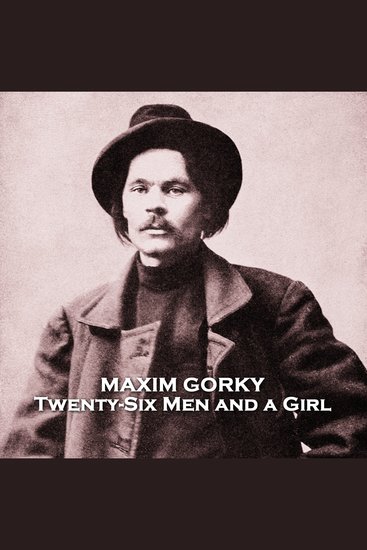
    Alexei Maximovich Peshkov was born on 28th March 1868, in Nizhny Novgorod, Russia. 
    Better known as Maxim Gorky he was orphaned at 11 and ran away from home at 12.  At 19 he had already attempted suicide and thereafter travelled, by foot, across the Russian Empire for 5 years. 
    His first book ‘Essays & Stories’ in 1898 was a sensation and so began a long career as an author of short stories, novels and plays.  Gorky saw writing as a moral and political act that would help to change the unjust world around him.  He was an ardent early advocate of the emerging Marxist movement and publicly opposed the Tsarist regime leading several times to his arrest.  
    In 1904 he began his own theatre but the censor banned every play and Gorky was forced to abandon the project. 
    But Gorky was a financially successful author, editor, and playwright and gave monies to political parties as well as for civil rights and social reform.  The brutal shooting of workers, which set in motion the Revolution of 1905, pushed Gorky more decisively toward radical solutions.  
    In 1906 he went to the United States to raise funds for the Bolsheviks. Those experiences including a scandal over travelling with his lover and not his wife deepened his contempt for the ‘bourgeois soul.’ 
    Gorky now moved to Capri in Italy, both for health reasons and to escape the increasingly repressive times in Russia.  
    An amnesty for the 300th anniversary of the Romanov dynasty saw him return to Russia in 1914. His politics remained close to the Bolshevik cause.  But soon, after the 1918 revolution, his essays referred to Lenin as a tyrant for his senseless arrests and repression.  He was soon appealing to the outside world for food aid after the catastrophic crop failure. 
    In October 1921 Gorky returned to Italy, now in Fascist hands, and settled in Sorrento until 1932.  His health worsened with the onset of tuberculosis. 
    He wrote several successful books there but now decided to find an understanding with the communist regime. Stalin invited him home and his return was hailed as a major propaganda victory.  He was decorated with the Order of Lenin, and a province, a park, and various streets re-named in his honour. 
    But he had his faults too.  In 1933, Gorky co-edited a book on the White Sea-Baltic Canal and denied even a single prisoner died during its construction, but thousands had. As well, knowing that some Nazis were homosexual, a phrase was attributed to him that said ‘exterminate all homosexuals and fascism will vanish’.  Although he was himself was quoting another he was decidedly homophobic. 
    With the increase of Stalinist repression in 1935 Gorky was placed under unannounced house arrest. 
    Maxim Gorky died on the 18th June 1936 from pneumonia.  He was 68. 
    Stalin and Molotov were among those who carried Gorky's urn of ashes at his funeral.
    Show book
  • The Rendezvous - From their pens to your ears genius in every story - cover

    The Rendezvous - From their pens...

    Ivan Turgenev

    • 0
    • 0
    • 0
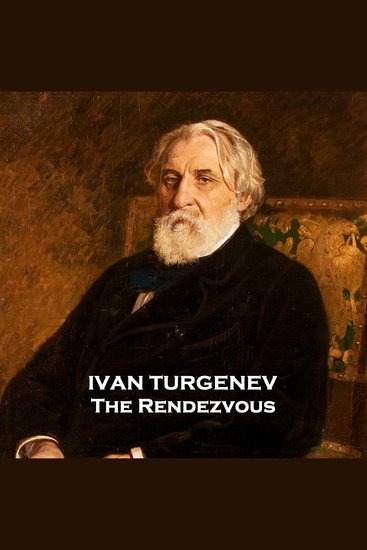
    Ivan Sergeyevich Turgenev was born on 9th November 1818 in Oryol, Russia to parents from the nobility.  He and his two brothers were raised by their mother on the family estate.  Surrounded by foreign governesses he became fluent in French, German, and English.  Their father spent little time with them and this undoubtedly had an effect on him and his brothers.  When he was nine the family moved to Moscow to give their children a proper education. 
    Turgenev studied for a year at the University of Moscow and then at the University of St Petersburg to study Classics, Russian literature, and philology.  During that time his father died from kidney stone disease.  In 1838 Turgenev studied philosophy and history at the University of Berlin for 3 years before returning to St Petersburg for his master's. 
    He started his career with the Russian Civil Service and it was only in 1852 that he made his name with his short story collection, ‘A Sportsman's Sketches’, based on his observations of peasant life and nature. 
    That same year he wrote an obituary for Nikolai Gogol: "Gogol is dead!... What Russian heart is not shaken by those three words?... He is gone, that man whom we now have the right (the bitter right, given to us by death) to call great."  The St Petersburg censor banned publication but the Moscow censor allowed it.  He was dismissed but Turgenev was held responsible and imprisoned for a month, and then exiled to his country estate.  
    Along with many other Russian intellectuals Turgenev left and settled in Paris in 1854.  During this period he wrote his finest stories and four novels.  
    Alexander II ascended the Russian throne in 1855, and the political climate became more relaxed, Turgenev returned home.  
    ‘Fathers and Sons’, Turgenev's most famous and enduring novel, appeared in 1862. Its leading character is considered the first ‘Bolshevik’ in Russian literature. But the hostile reaction prompted Turgenev's decision to again leave Russia.  
    His health declined during his later years. In January 1883, an aggressive malignant tumor was removed but by then it had metastasized in his upper spinal cord, causing him intense pain in his final few months of life.  
    Ivan Turgenev died on 3rd September 1883 of a spinal abscess, a complication of the metastatic liposarcoma, in his house near Paris.  He was buried in St Petersburg.
    Show book
  • The Man Who Went Wrong - From their pens to your ears genius in every story - cover

    The Man Who Went Wrong - From...

    Jerome K. Jerome

    • 0
    • 0
    • 0
    Jerome Klapka Jerome was born on the 2nd May 1859 at Belsize House in Caldmore, Walsall, England. 
    His family were reduced to poverty whilst he was a toddler owning to failed investments in the local mining industry. 
    After several moves in declining circumstances Jerome became a pupil at St Marylebone Grammar School.  His aim then was to go into politics, or even become a man of letters, but with the death of his father, when he was thirteen, and his mother two years later, now meant that he had to support himself and leave all thoughts of education behind. 
    He spent four years working for the London and North Western Railway, initially collecting coal that fell along the railway lines.  Thereafter, using the name Harold Crichton, he tried his hand at acting but the repertory company he joined was stretched in its resources and, at times, relied on the actors to purchase their own props and costumes.  After three years he tried journalism, teaching and work as a solicitor’s clerk.  All came to nothing.  Finally, in 1885, he had some success with ‘On the Stage―and Off’, a comic memoir collection of his stage experiences and his early attempts at acting.  
    Shortly thereafter he married and his honeymoon on the Thames became the inspiration for ‘Three Men in a Boat’.  This of course was a wild success, both critically and commercially, but also his creative high point.  
    Although he was now able to write full time, he was never able to attain all the heights of that classic humorous novel.  He remained a prolific writer of novels, plays and short stories and its from those classic works that these stories have been mined. 
    Jerome K Jerome died in Northampton General Hospital on the 14th June 1927 two weeks after suffering a paralytic stroke and a cerebral haemorrhage on a motoring tour.  He was 68.
    Show book
  • May Contain Nuts - cover

    May Contain Nuts

    Gill Oliver

    • 0
    • 0
    • 0
    An aspiring writer finds herself in search of a plot. Friends and family all have something to say about that! So can she make the deadline and cook dinner? A nutty story, British humour at its most off-the-wall. 
    Story 3 in the series My Eye
    Show book
  • Tales of Para Handy - cover

    Tales of Para Handy

    Neil Munro

    • 0
    • 0
    • 0
    Neil Munro's captivating tales of Para Handy, captain of the "Vital Spark", the "smertest" steamboat ever to sail the River Clyde.Whatever happened to the shaggy dog story? Very few, if any seem to be published these days. Maybe our lives are all too pressurised and full-on to allow us to kick back and listen to an engaging, diverting, well-told tale.PG Wodehouse was a master of the shaggy dog story, through his masterful fictional storytellers such as Mr Mulliner, The Oldest Member and even Bertie Wooster himself. But a close competitor was Neil Munro, creator of the much-loved "Tales of Para Handy", three  volumes of which were published from 1906 to 1923. These have been televised no fewer than 3 times, most recently in the 1990s with Gregor Fisher (who also starred as Rab C Nesbitt in the BBC2 TV show Naked Video) as the garrulous master mariner.The twenty-five stories performed by David Rintoul hail from the first collection, and every one is a gem. David was a huge fan of the 1960's TV series with Roddy McMillan in the starring role, and his love and knowledge of the tales shines out in his bravura performance. In the course of this audio, you'll get to know the regular cast - not just Para Handy himself, but the ship's irascible and scary engineer, Macphail, never without a penny "novella" in his hand; then there's The Tar, the lazy deckhand - and who can forget Dougie, the superstitious ship's mate? Add to that the crew of supporting characters - West Coast locals to a man (and woman) - canny, outspoken, lugubrious, eccentric . . . . and all huge fun. It's like having a second family. Try listening to one of them on your busy commute, and you'll be sure to arrive with a great big smile on your face!
    Show book