¡Acompáñanos a viajar por el mundo de los libros!
Añadir este libro a la estantería
Grey
Escribe un nuevo comentario Default profile 50px
Grey
Suscríbete para leer el libro completo o lee las primeras páginas gratis.
All characters reduced
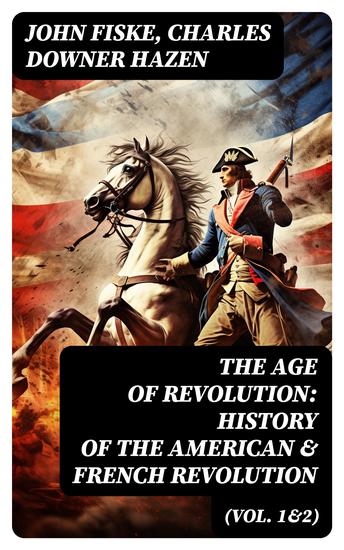
The Age of Revolution: History of the American & French Revolution (Vol 1&2) - cover

The Age of Revolution: History of the American & French Revolution (Vol 1&2)

John Fiske, Charles Downer Hazen

Editorial: DigiCat

  • 0
  • 0
  • 0

Sinopsis

The collection 'The Age of Revolution: History of the American & French Revolution (Vol. 1&2)' presents a sweeping exploration of two defining upheavals that reshaped the modern world. Across its expanse, the anthology captures the tumultuous era with a blend of stylistic rigor and narrative insight. Moving through various forms of historical discourse, from insightful analysis to vivid historical narration, the anthology illuminates the variegated landscape of revolutionary fervor. Themes of liberty, equality, and fraternity underline a narrative that bridges personal sacrifice and a collective quest for change, crafting an illuminating mosaic of revolutionary spirit. The authors featured, including luminaries such as John Fiske and Charles Downer Hazen, provide a diverse range of perspectives, each contributing their authoritative voice to the broader discourse on revolution. Their profound engagement with historical context underscores the integral connections between individual experiences and larger historical paradigms. The anthology is positioned firmly within the historiographical tradition, enriching our understanding of the Enlightenment and its enduring impact on socio-political movements. The collective insights offer a complex portrait, depicting how disparate experiences come together in a radical shift towards modernity. This anthology is an indispensable resource for readers seeking to immerse themselves in the multifaceted narratives of revolutionary transformation. It offers a rare opportunity to explore contrasts and continuities between the American and French revolutions through expertly curated writings. Scholars, students, and enthusiasts alike will find this collection invaluable for its depth of inquiry and the interplay of perspectives it fosters. Delve into this anthology to expand your understanding of the revolutionary era and appreciate the complex tapestry of voices that have shaped our historical consciousness.
Disponible desde: 16/12/2023.
Longitud de impresión: 611 páginas.


Otros libros que te pueden interesar

  • Defiled by the Biker Gang (Gay Muscle Erotica) - cover

    Defiled by the Biker Gang (Gay...

    Archer Vale

    • 0
    • 0
    • 0
    The seediest bar in town has a secret—an underground passage to the “muscle dungeon”. 
    The Weeping Pines Motel sits beside the road like a decaying roadkill carcass. This is my home now. This is where my masters make me stay. 
    How did I end up here? Stripped nude and wearing fluffy cat ears, I spend my evenings serving drinks. The men say I’m their catboy. They say I’ve joined their biker gang. 
    Each night, they feed me their seed and make me touch their muscles. It’s doing something to my brain…memories of my past are fading away. 
    The biker gang is in control now… 
    --- 
    CONTAINS EXPLICIT GAY SEXUAL CONTENT. 
    For exclusive stories, visit www.ArcherVale.com.
    Ver libro
  • Dealing with abusive relationship coaching session & meditation Getting out of it - toxic ties manipulations empower to leave have a new life overcome fears anxieties let go of guilt - cover

    Dealing with abusive...

    ThinkAndBloom

    • 0
    • 0
    • 0
    Abusive relationships usually entangle emotionally and energetically. It is hard to describe and difficult to handle. There are verbal abuses, emotional manipulations, and energetic bonding. Most victims mislead the abuses as love. There are usually forms of manipulations and seemingly love gestures. This is why victims find it hard to leave as they mostly associate their abusive actions with love. In order to get out of it, we need to empower ourselves. 
    We need to build up our strength and courage to move forward in life. We need to let go of the guilt in leaving the relationship. You are not responsible for anyone's life. You are only responsible for yours. We need to build up our spiritual strength before we take physical action.  
    In this course, we will empower you through coaching and meditations. We will cut the ties and cords of this relationship. We dissolve the entanglements energetically. We let go of the fear and give courage to ourselves. We move out of our comfort zone. We let go of the guilt of leaving the relationship.  
    In this course, we will Cutting cord End the abusive cycle Letting go of guilt Reclaim your power Empower for change Get back to balance And much more  
    Who’s this course for Wants to get out of the abusive relationshipEmpower to change Willing to work on themselves energetically Interested in meditations and coaching sessions for healing  
    Basically, we dissolve all attachments of this relationship. We cut off ties and attachments. We let go of guilt and shame to leave the relationship. We empower ourselves to own our life and know that we always deserve to have a good fulfilling life.
    Ver libro
  • Antebellum Women - Private Public Partisan - cover

    Antebellum Women - Private...

    Carol Lasser, Stacey Roberttson

    • 0
    • 0
    • 0
    How did diverse women in America understand, explain, and act upon their varied constraints, positions, responsibilities, and worldviews in changing American society between the end of the Revolution and the beginning of the Civil War? Antebellum Women: Private, Public, Partisan answers the question by going beyond previous works in the field. The authors identify three phases in the changing relationship of women to civic and political activities. They first situate women as "deferential domestics" in a world of conservative gender expectations; then map out the development of an ideology that allowed women to leverage their familial responsibilities into participation as "companionate co-workers" in movements of religion, reform, and social welfare; and finally trace the path of those who followed their causes into the world of politics as "passionate partisans." The book includes a selection of primary documents that encompasses both well-known works and previously unpublished texts from a variety of genre
    Ver libro
  • Sherman Makes Georgia Howl: The Atlanta Campaign and Sherman’s March to the Sea - cover

    Sherman Makes Georgia Howl: The...

    Editors Charles River

    • 0
    • 0
    • 0
    Both Grant and Sherman shared the same theory of war: anything that might help the enemy's war effort should be considered a military target. After the Atlanta campaign, Grant explained to Sherman that the Confederates must be “demoralized and left without hope,” and he instructed Sherman, “Take all provisions, forage and stock wanted for the use of your command. Such as cannot be consumed, destroy. Leave the valley so barren that crows flying over it...will have to carry their provender with them.” This strategy sought the total economic collapse of the South, as well as completely disabling the South’s capability of fielding armies. In addition to the wholesale plundering of Southern resources, including taking them from civilians, the Union reversed its policy of swapping prisoners, realizing it had a far bigger reserve of manpower than the South. The Atlanta Campaign was a perfect example of this, as both sides lost about the same number of casualties. By September 1864, however, Sherman still had about 80,000 men, while Hood’s army was reduced to about 30,000. 
    Following the design of Grant's innovative and successful Vicksburg Campaign, Sherman's armies eliminated their need for traditional supply lines by living off the land. 	Ultimately, Sherman’s armies cut a path of abject destruction 60 miles wide and 300 hundred miles long from Atlanta to Savannah, which some likened to a Biblical blight. And as Sherman had intended, he did indeed made Georgia “howl.”  
    Due in large part to the March to the Sea, Sherman remains controversial across much of the United States today. The South considered him akin to a terrorist and adamantly insisted that he was violating the norms of warfare by targeting civilians. In many ways, Sherman is still the scourge of the South nearly 160 years after he vowed to make Georgia howl.  
    Ver libro
  • Authentic Chicago - The Fairway Flapper the Lincolnwood Lone Ranger the Wandering Church and Other Quirky History - cover

    Authentic Chicago - The Fairway...

    John R. Schmidt

    • 0
    • 0
    • 0
    Discover the history most Chicagoans don't know---the real Chicago Way.The Windy City is full of forgotten landmarks and unusual stories that rarely get the benefit of a guided tour. Meet the African-American congressman who paved the way for Harold Washington and Barack Obama, the South Side Jewish girl who became the president of a South American country, and the visiting Romanian queen who charmed the city. Learn when Chicagoans were paid to smile, how furniture sprouts on Windy City streets after a blizzard and why Smell-O-Vision seemed like a good idea. From an in-city ski resort to the nation's greatest train robbery, author John R. Schmidt offers a glimpse of the overlooked scenery of Chicago's past.
    Ver libro
  • Women's Diaries of the Westward Journey - cover

    Women's Diaries of the Westward...

    Lillian Schlissel, Mary Clearman...

    • 0
    • 0
    • 0
    More than a quarter of a million Americans crossed the continental United States between 1840 and 1870, going west in one of the greatest migrations of modern times. The frontiersmen have become an integral part of our history and folklore, but the Westering experiences of American women are equally central to an accurate picture of what life was like on the frontier. 


    Through the diaries, letters, and reminiscences of women who participated in this migration, Women's Diaries of the Westward Journey gives us primary source material on the lives of these women, who kept campfires burning with buffalo chips and dried weeds, gave birth to and cared for children along primitive and dangerous roads, drove teams of oxen, picked berries, milked cows, and cooked meals in the middle of a wilderness that was a far cry from the homes they had left back east. Still (and often under the disapproving eyes of their husbands) they found time to write brave letters home or to jot a few weary lines at night into the diaries that continue to enthrall us. 


    In her new foreword, Professor Mary Clearman Blew explores the enduring fascination with this subject among both historians and the general public, and places Schlissel's groundbreaking work into an intriguing historical and cultural context.
    Ver libro