Junte-se a nós em uma viagem ao mundo dos livros!
Adicionar este livro à prateleira
Grey
Deixe um novo comentário Default profile 50px
Grey
Assine para ler o livro completo ou leia as primeiras páginas de graça!
All characters reduced
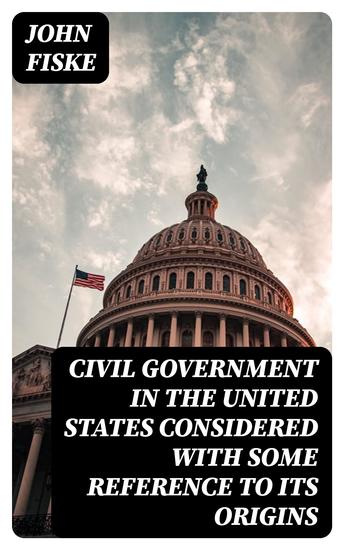
Civil Government in the United States Considered with Some Reference to Its Origins - cover
LER

Civil Government in the United States Considered with Some Reference to Its Origins

John Fiske

Editora: DigiCat

  • 0
  • 0
  • 0

Sinopse

In "Civil Government in the United States Considered with Some Reference to Its Origins," John Fiske meticulously analyzes the foundations and evolution of American governance. Employing a clear and didactic literary style, Fiske situates his work within the broader context of political philosophy and historical development, examining the principles of democracy, federalism, and individual rights. His rigorous exploration of constitutional history is woven together with reflections on the social contract theory, illuminating the ideological motivations that shaped the formation of the U.S. government. John Fiske (1842-1901), a prominent American philosopher and historian, was deeply influenced by the turbulent political landscape of his time, as well as by the transcendentalist movement. His background in both theology and history, coupled with a profound interest in social progress, informed his analysis of the American political system. Fiske's works often reveal a commitment to enlightenment principles and a belief in the inevitable progress of humanity, making his insights particularly resonant in a period marked by rapid change. This book is an essential read for anyone interested in American history, political science, or the development of democratic institutions. Fiske's lucid prose and incisive arguments invite readers to reflect on the foundational concepts that continue to shape the U.S. government today, making it not only scholarly intriguing but also relevant to contemporary discussions of governance and citizenship.
Disponível desde: 16/09/2022.
Comprimento de impressão: 303 páginas.

Outros livros que poderiam interessá-lo

  • My America - Langston Hughes on Democracy - cover

    My America - Langston Hughes on...

    Randal Maurice Jelks

    • 0
    • 0
    • 0
    Best known as the leader of the Harlem Renaissance, the celebrated poet and writer Langston Hughes believed in the power of art as resistance. What can we learn from his works today? 
    Randal M. Jelks delivers this revelatory portrait of the celebrated poet, essayist, playwright, and American artist Langston Hughes. My America traces Hughes's journey from a child captivated by the wonder of Kansas City to cosmopolitan witness in Paris, New York, Mexico City, and Madrid. We encounter Hughes as a young man discovering the pulse of modern life in a world on the verge of exploding metaphorically and literally. His experiences informed his work and his thinking on art, democracy, and activism. 
    Langston Hughes is one of the few American writers who consistently wrote about democracy from a joyous perspective, and My America explores how his works speak to the political anxieties and crises we face today. Jelks deftly examines the themes in Hughes's work, including creative expression, communal dignity, class struggle, and human suffering and what they mean for our inner well-being as democratic persons and political participants. 
    With care and no-holds-barred insight, My America removes the veneer of respectability often placed on Hughes's work and life to reveal his political adeptness. In a world threatened by fascism, Hughes's writing wasn't afforded the luxury of subtlety. He made a spiritual and political decision to stand on the side of the oppressed. He believed art should be practiced for the sake of justice. And democracy can be practiced with joy.
    Ver livro
  • Generative Artificial Intelligence - What Everyone Needs to Know ® - cover

    Generative Artificial...

    Jerry Kaplan

    • 0
    • 0
    • 0
    Advances in Generative Artificial Intelligence (GAI) have created a new class of computer systems that exhibit astonishing proficiency on a wide variety of tasks with superhuman performance, producing novel text, images, music, and software by analyzing enormous collections of digitized information. Soon, these systems will provide expert medical care; offer legal advice; draft documents; write computer programs; tutor our children; and generate music and art. These advances will accelerate progress in science, art, and human knowledge, but they will also bring new dangers. 


    Have we finally discovered the holy grail of AI—machines that match or exceed human intelligence? Which industries and professions will thrive, and which will wither? What risks and dangers will it pose? How can we ensure that these systems respect our ethical principles? Will the benefits be broadly distributed or accrue to a lucky few? How will GAI alter our political systems and international conflicts? Are we merely a stepping stone to a new form of non-biological life, or are we just getting better at building useful gadgets? 


    Generative Artificial Intelligence: What Everyone Needs to Know® equips listeners with the knowledge to answer these pressing questions.
    Ver livro
  • Rare Earth Elements & Critical Minerals: Science Supply Chains & Statecraft - What They Do Why They Matter & What The Future Holds… - cover

    Rare Earth Elements & Critical...

    Dr. Nick Coman, I. A.I.

    • 0
    • 0
    • 0
    A 36‑lecture audio course on the materials that run the modern world—from ore bodies and brines to magnets, batteries, chips, and reactors. Each lecture focuses on one element or mineral, tracing its journey from deposit geology through beneficiation and refining to the devices it powers. 
    We make the flowsheet legible: comminution and flotation; roasting, high‑pressure acid leaching, solvent extraction, and ion exchange; separation to oxides and metals; alloying and specialty powders. See how neodymium‑iron‑boron magnets are born, why lithium hexafluorophosphate matters in electrolytes, where gallium nitride wins in power, how graphite anodes evolve with silicon, and how the uranium fuel cycle and vanadium flow batteries actually work. 
    Markets and politics are treated as engineering constraints. Learn to spot yield killers, read offtake agreements, and separate strategic scarcity from narrative. Test real substitutions—ferrites in small motors, sodium‑ion for short‑range storage, gallium nitride versus silicon carbide—and where performance cliffs block redesign. We map chokepoints beyond the mine: separation capacity, reagents, waste handling, water and energy intensity, and manufacturer qualification cycles. Then we follow the consequences—export controls and quotas, permitting and community consent, tariffs and friend‑shoring, standards and labeling rules. 
    Rigorous, narrative‑driven, and built for the intellectually ambitious, this course is an operator’s guide to the science, supply chains, and statecraft of a materials‑constrained century.
    Ver livro
  • May Contain Lies - How Stories Statistics and Studies Exploit Our Biases And What We Can Do About It - cover

    May Contain Lies - How Stories...

    Alex Edmans

    • 0
    • 0
    • 0
    Our lives are minefields of misinformation. It ripples through our social media feeds, our daily headlines, and the pronouncements of politicians, executives, and authors. Stories, statistics, and studies are everywhere, allowing people to find evidence to support whatever position they want. Many of these sources are flawed, yet by playing on our emotions and preying on our biases, they can gain widespread acceptance, warp our views, and distort our decisions. 


    In this eye-opening book, renowned economist Alex Edmans teaches us how to separate fact from fiction. Using colorful examples—from a wellness guru's tragic but fabricated backstory to the blunders that led to the Deepwater Horizon disaster to the diet that ensnared millions yet hastened its founder's death—Edmans highlights the biases that cause us to mistake statements for facts, facts for data, data for evidence, and evidence for proof. 


    Armed with the knowledge of what to guard against, he then provides a practical guide to combat this tide of misinformation. Going beyond simply checking the facts and explaining individual statistics, Edmans explores the relationships between statistics—the science of cause and effect—ultimately training us to think smarter, sharper, and more critically.
    Ver livro
  • PowerNomics - The National Plan to Empower Black America - cover

    PowerNomics - The National Plan...

    Dr. Claud Anderson

    • 0
    • 0
    • 0
    In PowerNomics: The National Plan to Empower Black America, Dr. Claud Anderson dismantles the myths and illusions surrounding Black progress. He exposes how racial monopolies and an unending influx of self-proclaimed minorities threaten to relegate Black Americans to a permanent underclass within a decade. The choice to prevent this looming crisis is yours: the cure or the placebo. 
    PowerNomics is a transformative, mind-altering guide that, for the first time, offers actionable solutions to turn impoverished and powerless Black communities into a truly competitive group. It teaches a revolutionary way to see, think, and act in racial matters. 
    The decision is clear: Will you take the "all-is-well" placebo and remain complacent, or will you embrace the PowerNomics cure, confront the truth, and take action to solve the nation's race problem? The choice is yours.
    Ver livro
  • Hillbilly Nationalists Urban Race Rebels and Black Power - Interracial Solidarity in 1960s-70s New Left Organizing - cover

    Hillbilly Nationalists Urban...

    James Tracy, Amy Sonnie

    • 0
    • 0
    • 0
    Some of the most important and little-known activists of the 1960s were poor and working-class radicals. Inspired by the Civil Rights movement, the Black Panthers, and progressive populism, they started to organize significant political struggles against racism and inequality during the 1960s and into the 1970s. 


    Historians of the period have traditionally emphasized the work of white college activists who courageously took to the streets to protest the war in Vietnam and continuing racial inequality. Poor and working-class whites have often been painted as spectators, reactionaries, and, even, racists. But authors James Tracy and Amy Sonnie disprove that narrative. 


    Through over ten years of research, interviewing activists along with unprecedented access to their personal archives, Tracy and Sonnie tell a crucial, untold story of the New Left. Their deeply sourced narrative history shows how poor and working-class individuals from diverse ethnic, rural and urban backgrounds cooperated and drew strength from one another. The groups they founded redefined community organizing, and transformed the lives and communities they touched.
    Ver livro