¡Acompáñanos a viajar por el mundo de los libros!
Añadir este libro a la estantería
Grey
Escribe un nuevo comentario Default profile 50px
Grey
Suscríbete para leer el libro completo o lee las primeras páginas gratis.
All characters reduced
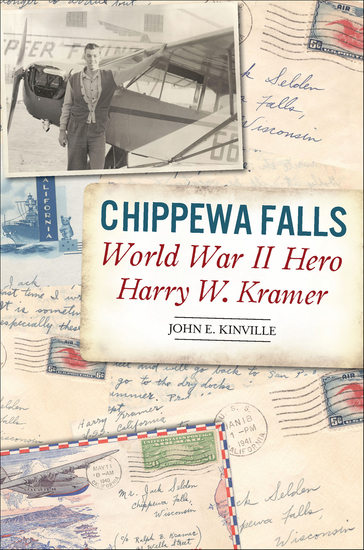
Chippewa Falls World War II Hero Harry W Kramer - cover

Chippewa Falls World War II Hero Harry W Kramer

John E. Kinville

Editorial: The History Press

  • 0
  • 0
  • 0

Sinopsis

Chippewa Falls' First World War II Casualty Young Harry Wellington Kramer was looking for adventure and a leg up in Depression-era Wisconsin. He found both aboard the Navy battleship USS California . Traveling across the western United States and the Pacific Ocean, Harry was quick to share his experiences with family and friends in Chippewa Falls. As he realized his dreams and served his country, his parents anxiously followed the developments that would lead to America's involvement in World War II. All of these events converged with the attack on Pearl Harbor, in which Harry was tragically killed fulfilling his duties. Though gone, Harry W. Kramer is not forgotten. Compiling thirty-three letters between Harry and home, local author and history teacher John E. Kinville tells the story of a life cut short but well lived.
Disponible desde: 10/04/2023.
Longitud de impresión: 210 páginas.
Otros libros que te pueden interesar

  • Is Reality Optional? - And Other Essays - cover

    Is Reality Optional? - And Other...

    Thomas Sowell

    • 0
    • 0
    • 0
    Thomas Sowell challenges all the assumptions of contemporary liberalism on issues ranging from the economy to race to education in this collection of controversial essays, and captures his thoughts on politics, race, and common sense with a section at the end for thought-provoking quotes.
    Ver libro
  • Making Makers - The Past the Present and the Study of War - cover

    Making Makers - The Past the...

    Michael P. M. Finch

    • 0
    • 0
    • 0
    Making Makers presents a comprehensive history of a seminal work of scholarship which has exerted a persistent attraction for scholars of war and strategy: Makers of Modern Strategy. It reveals the processes by which scholars conceived and devised the book, considering both successful and failed attempts to make and remake the work across the twentieth century, and illuminating its impact and legacy. It explains how and why these volumes took their particular forms, unearths the broader intellectual processes that shaped them, and reflects on the academic parameters of the study of war in the twentieth century. In presenting a complete genesis of the Makers project in the context of intellectual trends and historical contingency, this book reflects on a more complex and nuanced appraisal of the development of scholarship on war. In so doing it also offers contributions to the intellectual biographies of key figures in the history of war in the twentieth century, including Edward Mead Earle and Peter Paret. Making Makers contributes to an intellectual history of military history and contextualizes the place of history and historians in strategic and security studies. It is not only a history of the book, but a history of the networks of scholars involved in its creation, their careers, and lines of patronage, crossing international boundaries, from Europe to the USA, to Asia and Australia.
    Ver libro
  • You Are the One You've Been Waiting For - Applying Internal Family Systems to Intimate Relationships - cover

    You Are the One You've Been...

    Richard Schwartz PhD

    • 0
    • 0
    • 0
    A groundbreaking approach for practicing courageous love and resilient intimacy—from the creator of Internal Family Systems therapyDo loving relationships end because couples lack communication skills, struggle to empathize, and fail to accommodate each other’s needs? That’s a common belief within and outside of the therapeutic world… but what if it’s all wrong? In You Are the One You’ve Been Waiting For, Dr. Richard Schwartz, the celebrated founder of Internal Family Systems (IFS) therapy, offers a new way—a path toward courageous love that replaces the striving, dependent, and disconnected approach to solving relationship challenges.The breakthrough realization of IFS is that our psyche contains multiple parts, each with a life of its own. Most problems in relationships arise because we unknowingly burden our partner with the task of caring for our disowned and unloved parts. In this book, you’ll discover essential insights and tools to foster healthy dialogue with your parts and your partner, including:• How to recognize and disarm the cultural assumptions that create shame, guilt, and isolation in relationships• The Three Projects—why we fool ourselves into thinking we must change our partner, change ourselves, or give up on true intimacy• Finding and Healing Exiles—transforming the way our most vulnerable parts influence the way we treat each other• How to reorient relationship conflicts to help each of us grow toward the Self—the center of our clarity and wisdom• Courageous Love—building resilient intimacy with each other and our parts to create healthy, lasting partnerships“No one can do the work of healing our orphaned parts for us,” says Dr. Schwartz. “Yet when we begin with Self-leadership, a relationship can become a safe place in which we help each other heal and grow.” Here is an invaluable guide for therapists and laypersons alike to promote connection, trust, and understanding—within yourself and with the one you love.
    Ver libro
  • The Whigs and the Know Nothings - The History of the Influential Political Parties that Collapsed Before the Civil War - cover

    The Whigs and the Know Nothings...

    Editors Charles River

    • 0
    • 0
    • 0
    It was in the wake of the election of Andrew Jackson that the Whigs emerged as opponents to the Jacksonian Democrats during a period of American history known as the Second Party System (1828-1854). Initially, the conflict was rooted not only in different visions for the United States – the Whigs believed in a strong central bank and federally funded infrastructure projects (known as “internal improvements”) – but also in opposition to one man: Andrew Jackson. When it first formed, the Democratic Party coalesced around Jackson, and his beliefs and actions became Democratic Party dogma, which left the diverse group of people who opposed Jackson to become the Whigs.  
    The problem with this arrangement is that while the Whigs scored some notable successes as an opposition party, they found governing more difficult. The two Whigs elected president, William Henry Harrison and Zachary Taylor, died in office, raising to the presidency their respective vice-presidents, John Tyler and Millard Fillmore. Neither man succeeded in uniting the Whig Party behind him (a gargantuan task, to be sure), and neither was ever elected president in his own right. The increasing rancor over slavery is what finally killed the Whig Party.  
    	In the wake of contemporary debates over immigration, the “Know-Nothings” have been regularly cited as an example of how dangerous nativist attitudes can become and, indeed, have proven to be in America’s history. Several columnists, for instance, have striven to make comparisons between the Know-Nothings of antebellum America and the country’s recent immigration policies, helping in part to generate modern interest in a political party that many Americans have heard of but tend to know little about. The Know-Nothing movement can actually be tied to a number of violent episodes and ethnically charged riots that occurred during the late 1850s.
    Ver libro
  • Lincoln on Leadership - Executive Strategies for Tough Times - cover

    Lincoln on Leadership -...

    Donald T. Phillips

    • 0
    • 0
    • 0
    Lincoln on Leadership is the first book to examine Abraham Lincoln's diverse leadership abilities and how they can be applied to today's complex world.You think you have it rough?Only ten days before Abraham Lincoln took the oath of office in 1861, the Confederate States of America seceded from the Union, taking all Federal agencies, forts, and arenas within their territory. To make matters worse, Lincoln, who was elected by a minority of the popular vote, was thought of by his own advisors as nothing more than a gawky second-rate country lawyer with no leadership experience.What Lincoln did to become our most honored and revered president is history; now his wisdom and leadership philosophy can help you run your business. In Lincoln on Leadership you'll discover why you should:Seize the initiative and never relinquish it.Wage only one war at a time.Avoid issuing order and instead request, imply, or make suggestions.Once in a while, let things slip, unbeknownst-like... and much much more.
    Ver libro
  • Rise of Islam in the Balkans The: The History of the Ottoman Empire’s Islamization Efforts in Eastern Europe - cover

    Rise of Islam in the Balkans...

    Editors Charles River

    • 0
    • 0
    • 0
    In terms of geopolitics, perhaps the most seminal event of the Middle Ages was the successful Ottoman siege of Constantinople in 1453. The city had been an imperial capital as far back as the 4th century, when Constantine the Great shifted the power center of the Roman Empire there, effectively establishing two almost equally powerful halves of antiquity’s greatest empire. Naturally, the Ottoman Empire would also use Constantinople as the capital of its empire after their conquest effectively ended the Byzantine Empire. 
    In the wake of taking Constantinople, the Ottoman Empire would spend the next few centuries expanding its size, power, and influence, bumping up against Eastern Europe and becoming one of the world’s most important geopolitical players. It was a rise that would not truly start to wane until the 19th century. In fact, its decline would be brought about not just because of military setbacks and government corruption, but also because of nationalist uprisings among its multiethnic territories. The fact that the other existing multicultural empire, the Austro-Hungarian Empire, also did not survive World War I makes clear just how hard governing such a vast expanse of land can be. The Ottoman Empire’s inability to create a shared identity, a weak central state, and growing inner dissensions were some of the main factors explaining its long demise. 
    Of course, before that demise, the Ottomans brought plenty of their own cultural influence to the lands they reached, and nowhere is that more evident than in the spread of Islam. While Ottoman conflicts with European powers were often portrayed as religious conflicts, the fact is that the Ottomans managed to bring Islam with them into parts of Europe, especially the Balkans, and Islam took hold in various regions, adding even more demographic complexity to a place that already had no shortage of it.
    Ver libro