Join us on a literary world trip!
Add this book to bookshelf
Grey
Write a new comment Default profile 50px
Grey
Subscribe to read the full book or read the first pages for free!
All characters reduced
The school and the society - cover

The school and the society

John Dewey

Publisher: Passerino

  • 0
  • 0
  • 0

Summary

John Dewey (October 20, 1859 – June 1, 1952) was an American philosopher, psychologist, and educational reformer. He was one of the most prominent American scholars in the first half of the twentieth century.

The School and Society: Being Three Lectures (1899) was John Dewey's first published work of length on education. A highly influential publication in its own right it would also lay the foundation for his later work. In the lectures included in the initial publication, Dewey proposes a psychological, social, and political framework for progressive education. Notably, this includes collaborative practical experimentation as the central element of school work. He argues that the progressive approach is both an inevitable product of the Industrial Revolution and a natural fit with the psychology of children. 
Available since: 09/07/2024.

Other books that might interest you

  • Urban Crime and Safety - Understanding and Addressing Issues - cover

    Urban Crime and Safety -...

    Lyric Vale

    • 0
    • 0
    • 0
    Urban crime is a complex and pervasive issue that affects millions of people across the globe. As cities continue to grow and evolve, the challenges of maintaining safety and reducing criminal activity become more pressing. Urban areas, often characterized by dense populations, diverse social dynamics, and limited resources, can create an environment where crime thrives. These cities face a unique set of circumstances that contribute to the rise of criminal activities, ranging from petty theft to violent crimes. The relationship between urban crime and safety is multifaceted and requires a comprehensive understanding of its causes, impact, and the strategies necessary for effective crime prevention. 
    The rise in urban crime can be attributed to several factors, including social inequality, economic disparity, inadequate law enforcement, and environmental design issues. High levels of poverty, unemployment, and lack of education in certain neighborhoods often serve as breeding grounds for criminal behavior. In many urban centers, individuals with limited opportunities turn to crime as a means of survival or social mobility. The breakdown of social networks and a lack of community cohesion further exacerbate these challenges, making it difficult to foster a sense of security and mutual trust among residents. 
    Urban crime also places a significant strain on local law enforcement and public resources. Police departments are often overwhelmed by the volume and diversity of crimes that occur in cities. Additionally, urban environments may present logistical challenges for law enforcement agencies, such as limited manpower, insufficient technology, and high crime concentrations in certain areas. This can lead to delayed responses, reduced effectiveness, and strained relations between law enforcement and the communities they serve.
    Show book
  • New Possibilities at 57 - cover

    New Possibilities at 57

    Rekha Balakrishna

    • 0
    • 0
    • 0
    At 57, this woman started her own business and is popularising her range of Satvic mixes through LinkedIn
    Show book
  • Breeding - The Human History of Heredity Race and Sex - cover

    Breeding - The Human History of...

    John Waller

    • 0
    • 0
    • 0
    Breeding charts more than two thousand years of ideas about the nature of sex and heredity. From the speculations of the ancient, medieval and early modern worlds to the birth of genetics in the modern age, John Waller examines how we came to solve one of the greatest of enigmas: why offspring tend to look like their parents.  But this book goes further than telling a story of scientific advance. It also explores the social and political realities which often determined how people used the concept of heredity. It reveals how, from Plato's Republic to the modern IQ and race debate, the notion that some qualities of body and mind are inborn has been used to justify the supremacy of social elites and the racist ideologies of those who have profited from slavery and colonial expansion. This is a history of scientific developments, ideological inventions, and how the two have changed one another.
    Show book
  • Narcissism 3 Books in 1: All You Need to Know About: Divorcing a Narcissist and Co-parenting with a Toxic Ex; Covert Narcissism; Empaths Sociopaths and Energy Vampires; Codependency - cover

    Narcissism 3 Books in 1: All You...

    Mia Warren

    • 0
    • 0
    • 0
    Discover the ultimate bundle of audiobooks that will equip you with invaluable knowledge and insights to navigate the challenging world of relationships with narcissists. Being involved with a narcissist can be an incredibly distressing experience, and this comprehensive collection of audiobooks is here to guide you through the process of dealing with and healing from toxic relationships.In "Co-Parenting with a Narcissist: A Complete Guide to Divorce a Narcissistic Ex and to Heal from a Toxic Relationship," you'll gain practical strategies to successfully navigate the complexities of divorcing a narcissist, while also learning how to support your children through this challenging time. Discover effective tips for co-parenting with a narcissist and reclaim your peace of mind.Unmask the covert narcissist in "The Covert Narcissist: A Complete Guide to Identify Passive-Aggressive Manipulation and Gaslighting." This audiobook will empower you with the ability to recognize and understand the subtle manipulative tactics employed by covert narcissists. Armed with this knowledge, you can regain control over your own life and protect yourself from their toxic influence.Delve into the fascinating dynamics between empaths and narcissists in "Empath and Narcissist: A Practical Guide to Understand the Nature of Empathy and Narcissism." Gain a deeper understanding of these contrasting personalities and why they often attract each other. Break free from harmful cycles and negative thinking patterns while debunking society's myths surrounding these relationships.By immersing yourself in these insightful audiobooks, you'll equip yourself with invaluable tools to cope with narcissistic relationships and regain control over your own life. Take the first step towards healing and empowerment today.Ready to embark on a journey of self-discovery and growth? Grab this audiobook bundle now and reclaim your peace, happiness, and freedom from toxic relationships!
    Show book
  • Mahatma Gandhi - The Most Famous Political Activist of India - cover

    Mahatma Gandhi - The Most Famous...

    Kelly Mass

    • 0
    • 0
    • 0
    Mohandas Karamchand Gandhi was an Indian attorney, anti-colonial patriot, and political ethicist who used nonviolent resistance to lead the triumphant struggle for India's independence from British rule, motivating civil liberties and liberty movements around the globe. The epithet Mahtm (which means "great-souled" or "age-old" in Sanskrit) was at first appointed to him in South Africa in the year 1914 and is now used all across the world. 
    Gandhi was born into a Hindu family in seaside Gujarat and studied law at the Inner Temple in London. 
    In the year 1893, he came to South Africa to represent an Indian business owner in a case after 2 years in India, where he was not able to establish a rewarding law practice. 
    He spent the next 21 years of his life in South Africa. Gandhi raised his family here and was the first to use nonviolent resistance in a civil liberties struggle. 
    He went back to India in the year 1915, at the age of 45. He started setting in motion peasants, farmers, and city workers to fight oppression and high land taxes. Gandhi led statewide projects to reduce poverty, promote women's rights, build spiritual and ethnic amity, get rid of untouchability, and, above all, accomplish swaraj, or self-rule, after presuming management of the Indian National Congress in the year 1921. 
    Gandhi has meant much for the peace, the independence, and the culture of India, as well as his acts of non-violent resistance that have influenced the world. Let’s take a look at what else he did.
    Show book
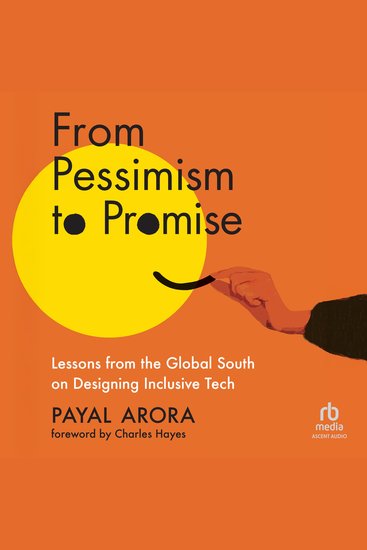
  • From Pessimism to Promise - Lessons from the Global South on Designing Inclusive Tech - cover

    From Pessimism to Promise -...

    Payal Arora, Charles Hayes

    • 0
    • 0
    • 0
    When it comes to tech, the mainstream headlines are bleak: Algorithms control and oppress. AI will destroy democracy and our social fabric, and possibly even drive us to extinction. While legitimate concerns drive these fears, we need to equally account for the fact that tech affords young people something incredibly valuable—a rare space for self-actualization. In From Pessimism to Promise, award-winning author Payal Arora explains that, outside the West, where most of the world's youth reside, there is a significant different outlook on tech: in fact, there is a contagion of optimism toward all things digital. These users, especially those in marginalized contexts, are full of hope for new tech. 


    Drawing on field insights in diverse global contexts such as Brazil, India, and Bangladesh, Arora describes what drives Gen Z to embrace new technologies. From Pessimism to Promise discusses the shift to relationally-driven approaches to design; how to create "algorithms of aspiration"; how to reimagine the digital space for sex, pleasure, and care; and, what we can learn from feminist digital activists and women's collectives in the Global South on shared digital provenance and value, as well as indigenous approaches to sustainability, that challenges sacred ideas on degrowth, circular economy, and the doughnut economy.
    Show book