Join us on a literary world trip!
Add this book to bookshelf
Grey
Write a new comment Default profile 50px
Grey
Subscribe to read the full book or read the first pages for free!
All characters reduced
John Dewey: Philosophical Works - cover

John Dewey: Philosophical Works

John Dewey

Publisher: DigiCat

  • 0
  • 0
  • 0

Summary

In "John Dewey: Philosophical Works," the seminal American philosopher encapsulates his innovative contributions to pragmatism, education, and democracy. Dewey's writing style is marked by clarity and a commitment to practical implications, making complex philosophical concepts accessible to a broader audience. The collection reflects the early 20th-century intellectual climate, emphasizing the interplay between experience and thought, thus situating Dewey within the larger context of American idealism while challenging traditional dogmas of the time. His philosophical inquiries extend beyond abstract theorizing to address pressing social issues, advocating for progressive education and experiential learning as essential to fostering a democratic society. John Dewey (1859-1952) was a pivotal figure in the development of modern educational theory and social reform, deeply influenced by his experiences within the context of an evolving America. His philosophical journey was informed by a belief in the social nature of knowledge and the importance of education as a vehicle for social change. Dewey's teachings at institutions like the University of Chicago and Columbia University reflect his dedication to creating a more participatory democratic society, a vision that permeates this collection of his works. For readers interested in philosophy, education, or social theory, "John Dewey: Philosophical Works" is an essential anthology that provides insight into Dewey's transformative ideas. This collection not only enhances understanding of his philosophical legacy but also serves as a guide for contemporary discourses on democracy and learning, making it invaluable for scholars, educators, and anyone seeking to engage with Dewey's enduringly relevant ideas.
Available since: 10/11/2022.
Print length: 360 pages.


Other books that might interest you

  • Real Extraterrestrial Contact For Sleep: Telepathic Messages and Healing Encounters - cover

    Real Extraterrestrial Contact...

    True Alien UFO Stories

    • 0
    • 0
    • 0
    This audiobook is narrated by an AI Voice.  
    Fall asleep to eleven remarkable accounts of real extraterrestrial contact featuring telepathic messages and encounters that seemed to offer healing, enlightenment, or profound understanding. These stories venture beyond mere sightings into apparent meaningful communication and direct interaction with beings from elsewhere in the cosmos. Experience the profound encounter of a deaf mute man who received messages he could somehow understand despite his condition, and the witness who came away from their experience knowing deeply that all life is one interconnected whole. Discover the churchgoing alien that suggested these beings may understand and respect our spiritual practices, and humanoids who appeared in unexpected locations across the globe seemingly with purpose. These stories include jaywalking aliens casually crossing streets as if they belonged, UFOs parked patiently by roadsides as if waiting for someone, and laughing beings who seemed to find something genuinely amusing about human behavior or our world. From alien street sweepers performing mysterious maintenance tasks to humanoids observed in quiet coastal communities, each account carries elements of attempted communication and connection. Little green men of popular culture made surprisingly real, and high strangeness incidents that combined multiple paranormal elements, round out this collection. Perfect for wonder-filled peaceful sleep.
    Show book
  • Our Lady of the World's Fair - Bringing Michelangelo's "Pieta" to Queens in 1964 - cover

    Our Lady of the World's Fair -...

    Ruth D. Nelson

    • 0
    • 0
    • 0
    Driven by different motives, Robert Moses and Francis Cardinal Spellman had the same vision: to display Michelangelo's masterpiece, the Pietà, in the Vatican's pavilion at the 1964 World's Fair in New York City. 


    As Ruth D. Nelson gracefully showcases, Moses believed this blockbuster would guarantee the fair's financial success. At the same time, Spellman, Archbishop of New York and the spiritual leader of Cold War America's Catholic community, hoped that at a time of domestic strife and global conflict, the Pietà's presence would have a positive spiritual impact on the nation. Although the fair did not turn out to be the financial bonanza that Moses expected, the Pietà drew record crowds of the faithful, art lovers, and the curious. 


    Nelson's fascinating uncovering of the intensive planning that went into designing the pavilion, transporting the art piece across the Atlantic, and coordinating Pope Paul VI's visit to New York in 1965—the first papal visit to the Western Hemisphere—demonstrates the sheer scale and opportunity of the two men's endeavors. Our Lady of the World's Fair depicts the skepticism and fierce criticism that faced the two New York power brokers. Rather than letting the negative weigh them down, they united and called on every resource at their disposal to make this unlikely cultural coup possible.
    Show book
  • Guddo - cover

    Guddo

    Kesra Ram

    • 0
    • 0
    • 0
    ‘Guddo’ by Kesra Ram is an emotional and painful story of two women, Guddo and Preeto, whose lives are filled with struggle, oppression, and silent suffering. The novel highlights how women often endure lifelong pain due to societal pressures, family honor, and traditions that leave them with no voice or choice.
    Show book
  • Secret Control of the Masses - cover

    Secret Control of the Masses

    Phil G

    • 0
    • 0
    • 0
    We are living in a world of deception. We are constantly deluded and manipulated to do as we are told. It is often a very subtle system of control, but sometimes it is so obvious that nobody would even believe it. Ancient secret societies have grown over generations and their descendants now hold power in the biggest businesses, governments, organizations and religions on the planet. Using fear and enticement, they feed from us. Whether it is a global pandemic or a celebrity scandal, the hand of the hidden elite is in control. This is the revelation of the hidden brotherhood.
    Show book
  • The Adoptee's Journey - From Loss and Trauma to Healing and Empowerment - cover

    The Adoptee's Journey - From...

    Cameron Lee Small

    • 0
    • 0
    • 0
    Every adoption is rooted in loss. 


    Adoption is often framed by happy narratives, but the reality is that many adoptees struggle with unaddressed trauma and issues of identity and belonging. Adoptees often spend the majority of their youth without the language to explore the grief related to adoption or the permission to legitimize their conflicting emotions. 


    Adoptee and counselor Cameron Lee Small names the realities of the adoptee's journey, narrating his own and other adoptees' stories in all their complexity. He unpacks the history of how adoption has worked and names how the church influenced adoption practices with unintended negative impacts on adoptees' faith. Small's own tumultuous search for and reunion with his mother in Korea inspired him to help other adoptees navigate what it means to carry multiple stories. His adoptee-centered advocacy helps adoptees regain their agency and identity on a journey of integration and healing, with meaningful relationships in all their family systems.
    Show book
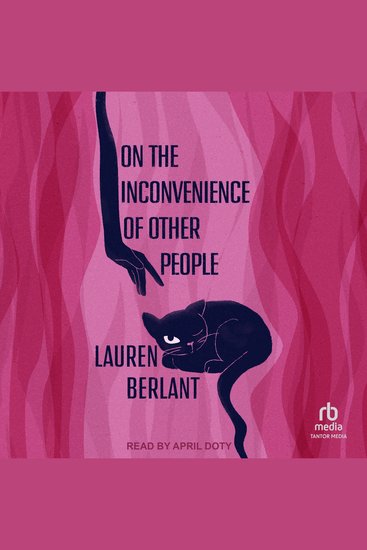
  • On the Inconvenience of Other People - cover

    On the Inconvenience of Other...

    Lauren Berlant

    • 0
    • 0
    • 0
    In On the Inconvenience of Other People, Lauren Berlant continues to explore our affective engagement with the world. Berlant focuses on the encounter with and the desire for the bother of other people and objects, showing that to be driven toward attachment is to desire to be inconvenienced. Drawing on a range of sources, including Last Tango in Paris, Ralph Waldo Emerson, Claudia Rankine, Christopher Isherwood, Bhanu Kapil, the Occupy movement, and resistance to anti-Black state violence, Berlant poses inconvenience as an affective relation and considers how we might loosen our attachments in ways that allow us to build new forms of life. Collecting strategies for breaking apart a world in need of disturbing, the book's experiments in thought and writing cement Berlant's status as one of the most inventive and influential thinkers of our time.
    Show book