Join us on a literary world trip!
Add this book to bookshelf
Grey
Write a new comment Default profile 50px
Grey
Subscribe to read the full book or read the first pages for free!
All characters reduced
How We Think - cover

How We Think

John Dewey

Publisher: DigiCat

  • 0
  • 0
  • 0

Summary

In "How We Think," John Dewey presents a profound exploration of the process of reflective thinking, which he delineates as a crucial component of effective learning and problem-solving. Dewey's literary style is characterized by clarity and accessibility, making complex philosophical concepts approachable for a broad audience. The text situates itself within the pragmatist tradition, challenging static notions of knowledge and emphasizing the dynamic interplay between thought and experience in an increasingly complex world. Through detailed analysis and practical examples, Dewey articulates methods for improving educational practices and enhancing critical and creative thinking skills. John Dewey (1859-1952) was a pivotal figure in American philosophy and education, known for his advocacy of experiential learning and democracy in education. His extensive career as a philosopher, psychologist, and educational reformer provided him with insights into the deficiencies of traditional pedagogical methods, which inform the core arguments of this work. Dewey's dedication to fostering a more interactive and engaged learning environment illuminated the necessity for a paradigm shift in both educational practices and the cultivation of intellectual habits. "How We Think" is an essential read for educators, students, and anyone interested in the cognitive processes underlying effective learning. Dewey's insightful analysis not only enhances one's understanding of thinking as a skill but also serves as a manifesto for a more thoughtful and engaged society. This book is an invaluable resource for developing the reflective skills needed in both personal and professional contexts.
Available since: 11/13/2022.
Print length: 1101 pages.

Other books that might interest you

  • Satisfying Hubby’s Sex Drive: Female Cuckolds 59 - FFM Threesome Hothusband Cuckquean Breeding Erotica - cover

    Satisfying Hubby’s Sex Drive:...

    Connie Cuckquean

    • 0
    • 0
    • 0
    My hothusband has an insatiable sexual appetite that I can’t keep up with, so he invites cuckcake Annabelle over for some ffm cheating fun in this threesome cuckquean story.
    Show book
  • Spectacle State - How Hindutva Shapes Feeling and Culture - cover

    Spectacle State - How Hindutva...

    Brahma Prakash

    • 0
    • 0
    • 0
    'The triumph of Hindutva, as of any successful ideological project, rests on its careful engineering of human souls. Spectacle State is a rare and much-needed account of this profound transformation in inner lives.' 
    -Pankaj Mishra, author of The World after Gaza and Age of Anger 
    'Combining deep theoretical insights with an impressive range of materials and examples, Brahma Prakash offers us a compelling and engaging account-riveting and disturbing in equal measure-of the cultural transformations of India's public life in recent decades.' 
    -Thomas Blom Hansen, professor of anthropology, Stanford University 
    'Subtly weaving in theoretical insights from global scholarship on ""fascist aesthetics"" while pointing out the volte face by academic writers succumbing to the charms of Hindutva, this engaging work ultimately relies on a close personal reading of the key instruments of a murderous cultural politics, fast becoming mainstream.' 
    - Meena Dhanda, professor of philosophy and cultural politics, University of Wolverhampton, and visiting professor, London School of Economics and Political Science 
     
    In today's India, power does not only govern -it marches, blares, dances and displays itself in colour, sound and action. From the beat of the drum and the glare of the loudspeaker to the rise of the bulldozer and the spread of the angry Hanuman, politics and power surrounds us - intense, sensorial and immediate. 
    In Spectacle State, Brahma Prakash looks at the contemporary Right beyond speeches and slogans and moves through a series of vivid scenes from everyday life, to show how emotion and feelings have been claimed by the Right. It is in this charged liminal space that violence appears in the garb of celebration, hate as preservation of self-identity, and devotion as display.  
    Moving between village processions, street performances, monuments, music and festivals, Spectacle State traces fear, pride, anger, piety are produced and circulated through the most innocuous of things. In the end, it asks: What happens when power, politics and hate batter the thin walls between culture and religion to produce a new language for a whole country?
    Show book
  • Children's Language Development - The Role of Parental Input Vocabulary Composition And Early Communicative Skills - cover

    Children's Language Development...

    Brian Gibson

    • 0
    • 0
    • 0
    This audiobook is narrated by an AI Voice.  
    Why do some children begin speaking in full sentences while others struggle with single words? 
    Language is the foundation of connection, learning, and lifelong success. Yet not all children develop language at the same pace, and the reasons why may surprise you. Children's Language Development reveals how the earliest interactions between caregiver and child play a vital role in shaping future communication, comprehension, and expression. 
    This book provides a research-driven roadmap to unlocking your child’s full linguistic potential. 
    From the quality and quantity of parental input to the structure of early vocabulary and the significance of nonverbal communication, this book brings together decades of developmental psychology, linguistics, and neuroscience to answer one critical question: How can we best support a child’s language journey from the very beginning? 
    Inside, you’ll learn: 
    The way you talk to your child directly influences vocabulary growth and language processing 
    The difference between expressive and receptive language—and why it matters 
    Why vocabulary composition (not just quantity) is a key predictor of later success 
    The crucial role of gestures, joint attention, and turn-taking in early communication 
    What current research says about screen time, multilingual environments, and the impact of socio-economic context 
    Give your child the strongest possible start in life through the power of intentional communication. 
     Buy Children's Language Development now to build a richer, more responsive, and more effective foundation for your child’s future.
    Show book
  • How to Analyze People - Learn the Advanced Methods and Techniques of Speed Reading and Analyzing People - cover

    How to Analyze People - Learn...

    Kevin Hallstone

    • 0
    • 0
    • 0
    In this volume, our focus shifts slightly to the actual personality types; everyone should be aware of and susceptible to when they cross our paths. These are the people you probably don't want to know. 
    Why? They're people who really don't like other people. Well, they do, but what they like about people is exploiting, damaging, and controlling them. They like people for what they can do for them financially, in their careers, and in terms of their status in society. 
    We've covered some of the general personality types in Book One of our series. That information will have given you some insight into the people you meet and how to read them. But what I've saved for this volume is an examination of those who walk among us who are corrosive and psychologically compromised. Also, in this book, you'll be reading about the role of intuition in detecting the truth about situations and people and how to foster and use it to protect yourself and others from the excesses of the disorders described in this book. 
    We'll be focusing on personality disorders, the behaviors of those who are burdened with them, and how to see them coming. There are tell-tale signs early on in interactions with these people that can save you a lot of drama and chaos.  
    As you move along, you'll note an overlap between symptoms and behaviors. In the Cluster B personality disorders, we'll be looking at, the symptomatic overlap is not only common but expected. Further, those who fall under the headings in the cluster often have what is referred to as "co-morbidities." These are the double whammy types, who live with more than one personality challenge or disorder.
    Show book
  • The Battle of Broken Hill - Lost Stories - cover

    The Battle of Broken Hill - Lost...

    John Gardner

    • 0
    • 0
    • 0
    These are lost stories. Forgotten Australian history. Brought back to life by two years of investigation and research.
    
    Some call it the first act of terrorism on Australian soil.
    
    A day when the horrors of World War I came to Australian shores.
    
    It was New Year's Day. 1915. The Great War, World War I, was just months old.
    
    In the outback mining town of Broken Hill, a small band of Afghan camel drivers lived on the fringes in their own community, known as the Ghantown. These men with their camels trekked essential food and supplies to isolated communities, remote cattle and sheep stations, deep in Australia's unforgiving desert lands.
    
    The Afghans were different: different skin colour, different faith, different dress. A way of life alien to almost everyone in Broken Hill. Some of these tough foreigners were loyal to a Sultan in Turkey, who had just declared war on Australia.
    
    Broken Hill was a proud, tough trade union town. Many workers, in this then uncompromising town, disliked the Afghanis. Mainstream Broken Hill regarded the foreigners as scabs who stole badly needed work from the Teamsters' Union. Bullying and racism were daily cruelties in this outback realm.
    
    Simmering tensions were about to erupt. What followed was a spasm of violence so shocking it became known as The Battle of Broken Hill.
    Show book
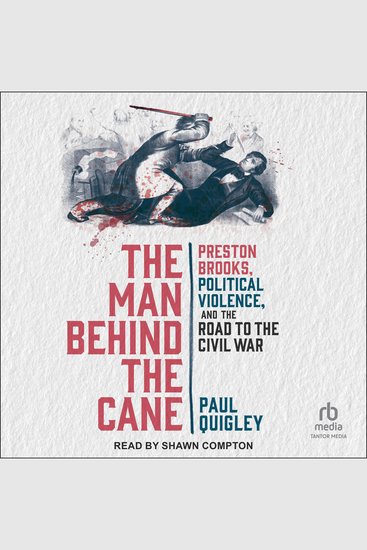
  • The Man Behind the Cane - Preston Brooks Political Violence and the Road to the Civil War - cover

    The Man Behind the Cane -...

    Paul Quigley

    • 0
    • 0
    • 0
    In 1856, South Carolina Congressman Preston Brooks assaulted Massachusetts Senator Charles Sumner with a cane in the United States Capitol, defending his family's honor and the rights of slaveholders. In beating Sumner unconscious, Brooks fueled a nationwide clash over slavery that ended in civil war.Southern historian Paul Quigley brings Brooks to life more vividly than ever, revealing how his personal struggles shaped the fateful decision to attack Sumner. Raised in the slaveholding culture of honor and scarred by missed opportunities for glory in the Mexican-American War, Brooks came to believe in the redemptive power of violence. Quigley uses Brooks's life to examine the deeper currents propelling the United States to the brink of destruction. Brooks's story reveals the increasingly fraught relationship between words and violence. With the caning, Brooks sparked an ominous national debate over the righteousness of bloodshed in a polarized nation.Examining enduring issues of masculinity, honor, and free speech, The Man Behind the Cane shows how words and violent behavior became perilously entangled in the fight over slavery and casts new light on the origins of the Civil War—and the ongoing dangers of political violence in our own time.
    Show book