Join us on a literary world trip!
Add this book to bookshelf
Grey
Write a new comment Default profile 50px
Grey
Subscribe to read the full book or read the first pages for free!
All characters reduced
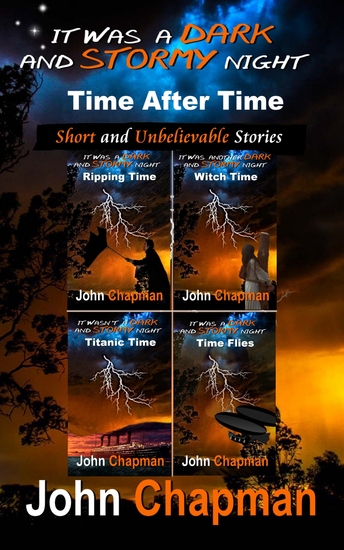
It was a dark and stormy night- Time after Time - Short and unbelievable stories - cover

It was a dark and stormy night- Time after Time - Short and unbelievable stories

John Chapman

Publisher: JayDax

  • 0
  • 0
  • 0

Summary

You won't believe this, but I'm about to tell you a story that will change the course of history. A story about time travel, secret agents, and paradoxes. It's a story that will start with a chance encounter with a time traveler known as Jack the Ripper, and it will end with the founding of TACO, the Time Agency Chronoclasm Organisation, a powerful agency controlling time travel throughout history.
 
The second short story tells how I was coerced into joining TACO as an observer on a mission to rescue the Blair witch. It was either that or be slightly dead. Apparently, the Blair witch was also a TACO agent and had been set-up to be almost killed by the good citizens of Blair by BELL, the time travel equivalent of the FBI. They wouldn't tell me what BELL stood for.
 
The third story, my second time-travel mission, was to make sure the Titanic sank! Over 1,500 died but their deaths saved the lives of millions throughout the timeverses.
 
The fourth story deals with paradoxes. 1493 wasn't ready for flying machines so Alex Pearin (aka Jack the Ripper) and I traveled to Florence in Tuscany to talk to Leonardo da Vinci about paradoxes and why he shouldn't build the world's first flying machine. Alex and I ended up helping Leonardo complete a flying machine and helping him on its first flight. I also solve a couple of other mysteries and discover I founded BELL.
Available since: 10/25/2023.
Print length: 110 pages.

Other books that might interest you

  • A Model Crime - From their pens to your ears genius in every story - cover

    A Model Crime - From their pens...

    William Pett Ridge

    • 0
    • 0
    • 0
    William Pett Ridge was born at Chartham, near Canterbury, Kent, on 22nd April 1859.  
    His family’s resources were certainly limited. His father was a railway porter, and the young Pett Ridge, after schooling in Marden, Kent became a clerk in a railway clearing-house. The hours were long and arduous, but self-improvement was Pett Ridge’s goal.  After working from nine until seven o’clock he would attend evening classes at Birkbeck Literary and Scientific Institute and then to follow his passion; the ambition to write.  He was heavily influenced by Dickens and several critics thought he had the capability to be his successor.  
    From 1891 many of his humourous sketches were published in the St James's Gazette, the Idler, Windsor Magazine and other literary periodicals of the day. 
    Pett Ridge published his first novel in 1895, A Clever Wife. By the advent of his fifth novel, Mord Em'ly, a mere three years later in 1898, his success was obvious.  His writing was written from the perspective of those born with no privilege and relied on his great talent to find humour and sympathy in his portrayal of working class life. 
    Today Pett Ridge and other East End novelists including Arthur Nevinson, Arthur Morrison and Edwin Pugh are being grouped together as the Cockney Novelists.   
    In 1924, Pugh set out his recollections of Pett Ridge from the 1890s: “I see him most clearly, as he was in those days, through a blue haze of tobacco smoke. We used sometimes to travel together from Waterloo to Worcester Park on our way to spend a Saturday afternoon and evening with H. G. Wells. Pett Ridge does not know it, but it was through watching him fill his pipe, as he sat opposite me in a stuffy little railway compartment, that I completed my own education as a smoker... Pett Ridge had a small, dark, rather spiky moustache in those days, and thick, dark, sleek hair which is perhaps not quite so thick or dark, though hardly less sleek nowadays than it was then”. 
    With his success, on the back of his prolific output and commercial success, Pett Ridge gave generously of both time and money to charity. In 1907 he founded the Babies Home at Hoxton.  This was one of several organisations that he supported that had the welfare of children as their mission.  
    His circle considered Pett Ridge to be one of life's natural bachelors. In 1909 they were rather surprised therefore when he married Olga Hentschel.  
    As the 1920’s arrived Pett Ridge added to his popularity with the movies. Four of his books were adapted into films.  
    Pett Ridge now found the peak of his fame had passed. Although he still managed to produce a book a year he was falling out of fashion and favour with the reading public and his popularity declined rapidly.  His canon runs to over sixty novels and short-story collections as well as many pieces for magazines and periodicals. 
    William Pett Ridge died, on 29th September 1930, at his home, Ampthill, Willow Grove, Chislehurst, at the age of 71. 
    He was cremated at West Norwood on 2nd October 1930.
    Show book
  • The Reincarnations - cover

    The Reincarnations

    Nathan Elias

    • 0
    • 0
    • 0
    These loosely connected stories are laced with the familiar and the uncanny, the real and the surreal, the ordinary and the fabulistic. A documentary filmmaker refuses to give up on finding his daughter who mysteriously disappears by the river. A small-time real estate agent recovers from a brief psychotic episode upon discovering his fiancée's affair. An actress struggles to grasp reality when the recordings of lucid dreams are used in movies instead of live performances. An eccentric teenager recounts his first romance from beyond the grave. 


    Spanning the boundaries of literary and speculative fiction, The Reincarnations revolves around multiple forms of Zenlike rebirth. Equal parts raw emotion and wild imagination, Nathan Elias's debut story collection ushers in an electrifying yet tender new voice in fiction.
    Show book
  • After a Dance - Selected Stories - cover

    After a Dance - Selected Stories

    Bridget O'Connor

    • 0
    • 0
    • 0
    'These are some of the wildest, arresting, just plain brilliant short stories I've read in a long time.' - Roddy Doyle, author of The Woman Who Walked Into DoorsAfter a Dance is the compiled collection of short stories from acclaimed writer Bridget O'Connor, with an exclusive preface written and read by the author's daughter, Constance Straughan.Bridget O'Connor was one of the great short story writers of her generation. She had a voice that was viscerally funny and an eye for both the glaring reality and the absurdity of the everyday.In After A Dance, we meet a selection of O'Connor's most memorable characters often living on the margin of their own lives: from the anonymous thief set on an unusual prize to the hungover best man clinging to what he's lost, to the unrepentant gold-digger who always comes out on top. From unravelling narcissists to melancholy romantics all human life is here - at its best and at its delightful worst.
    Show book
  • The Short Stories of Henry W Nevison - Though more famous for exposing slavery as a journalist was also a talented story writer - cover

    The Short Stories of Henry W...

    Henry W. Nevinson

    • 0
    • 0
    • 0
    Henry Woodd Nevinson was born on October 11th, 1856. 
    Nevinson was schooled at Shrewsbury School and at Christ Church, Oxford. John Ruskin influenced his time at Oxford. Fascinated by German Culture he spent some time at Jena before publishing, in 1884, Herder & His times, a study on Johnann Gottfried Herder. 
    In 1897 he became the Daily Chronicle's reporter for the Greco-Turkish War. He was also noted for his reporting on the Second Boer War. 
    During the 1880s Nevinson had attached his politics to Socialism and by 1889 had joined the Social Democratic Federation. 
    In 1904, he was hired by Harper's Monthly Magazine to report on a supposed trade in slaves from Angola to the cocoa plantations of São Tomé. He produced evidence of people being trafficked to settle debts or seized by Portuguese agents and taken in shackles to the coastal towns. Once there he wrote that Portuguese officials "freed" them and continued the charade by declaring they were now voluntary workers who agreed to go to São Tomé for five years. Despite severe ill health he continued to follow the slaves to São Tomé. He found plantation conditions so appalling that one in five workers died each year. His account was serialised from August 1905 and then published as ‘A Modern Slavery’ in 1906. 
    He was also a suffragist, being one of the founders in 1907 of the Men's League for Women's Suffrage. 
    In 1914 he co-founded the Friends' Ambulance Unit and later in World War I, as a war correspondent, was wounded during the infamous Gallipoli campaign. 
    E. M. Forster described Nevinson's book, ‘More Changes, More Chances’ in 1925 as "exciting", and that "He has brought to the soil of his adoption something that transcends party-generosity, recklessness, a belief in conscience joined to a mistrust of principles". 
    A committed Socialist Nevinson could see, during the 20s and 30s, the foundations of a titanic struggle began to gather its forces. He would later state "I detest the cruel systems of persecution and suppression now existing under Hitler in Germany, Mussolini in Italy and Stalin in Russia". 
    Nevinson married Margaret Wynne Jones and, after her death in 1933, he married his long-time lover, and fellow suffragist, Evelyn Sharp. 
    Henry W. Nevinson died on November 9th, 1941. 
     
    01 - Henry W. Nevinson. A Short Story Volume - An Introduction 
    02 - St George of Rochester by Henry W. Nevinson 
    03 - The Aristocrat of Labour by Henry W. Nevinson
    Show book
  • The Flayed Hand - cover

    The Flayed Hand

    Guy de Maupassant

    • 0
    • 0
    • 0
    Title: The Flayed Hand 
    Author: Guy de Maupassant 
    Narrator: Jonathan Dunne 
    Original Publication: 1875 
    Public Domain: Yes 
    Series Placement: Number 25 in the Timeless Terrors series 
    Description: 
    The Flayed Hand by Guy de Maupassant is a macabre tale of obsession, vengeance, and the supernatural — a chilling exploration of how the dead may reach back to punish the living. When a collector acquires a mummified human hand, said to have belonged to a murderer, he regards it as a mere curiosity. But when the relic’s gruesome history begins to manifest in reality, terror takes hold, and reason gives way to horror. 
    Maupassant’s sharp realism and psychological insight lend the story a disturbing plausibility, transforming a simple ghost tale into a meditation on guilt, possession, and the price of curiosity. 
    Narrated by Amazon bestselling horror author Jonathan Dunne, this performance captures the story’s eerie tension and mounting dread — the quiet unease of an ordinary setting pierced by the inexplicable. While the text itself resides in the public domain, this narration is an original work and copyright © 2025 Jonathan Dunne. 
    This audiobook is part of Timeless Terrors, a series devoted to reviving the dark classics of horror and the uncanny — timeless stories that still chill the blood, rendered in haunting new performances for a modern audience. 
    Listeners should prepare for a tale where curiosity becomes curse, where relics of the past refuse to rest, and where the hand of the dead may yet reach for the living.
    Show book
  • Man-size in Marble - cover

    Man-size in Marble

    Edith Nesbit

    • 0
    • 0
    • 0
    A young couple finds the perfect country cottage with one caveat - it has a horrible legend attached to it.  
    Edith Nesbit wrote under the name E. Nesbit, and is most famous for her stories for children, and has influenced the likes of J.K. Rowling, C.S. Lewis and P.L. Travers. She wrote over 60 books, including The Railway Children, Five Children and It, and The Story of the Treasure Seekers.  
    Her second, darker reputations was as a purveyor of horror stories, which are sublime in their elegance and simplicity. This story is quite simple, but when you take into account the beauty of the language, the skill of the plot movement, and the intriguing supporting characters, it really ranks high when it comes to classic ghost stories.
    Show book