Join us on a literary world trip!
Add this book to bookshelf
Grey
Write a new comment Default profile 50px
Grey
Subscribe to read the full book or read the first pages for free!
All characters reduced
The AI-Human Workforce - cover

The AI-Human Workforce

Johan van Rooyen, Ruban Ganeshu

Publisher: Publishdrive

  • 0
  • 0
  • 0

Summary

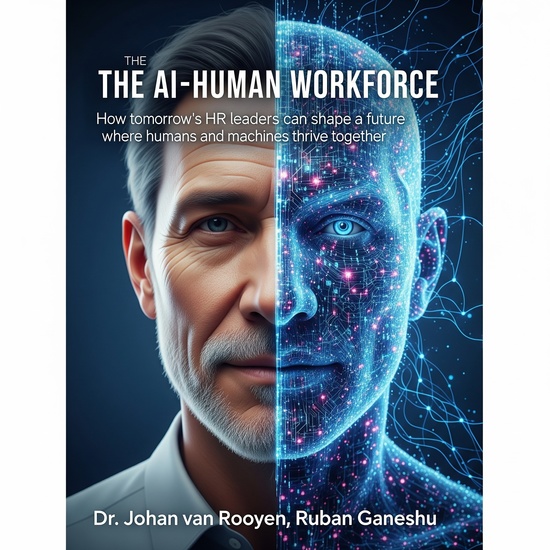
The workplace is changing faster than ever before. Artificial Intelligence, robotics, and machine learning are no longer futuristic buzzwords, they’re rewriting the rules of talent management, leadership, and organizational success today. As we enter a new era of work, HR professionals face a choice: adapt, lead, or be left behind.
 
In The AI-Human Workforce, Dr. Johan van Rooyen and Ruban Ganeshu take readers beyond the hype, exploring how technology will transform every aspect of human resources over the next decade. Through cutting-edge research, real-world case studies, and bold future scenarios, this book reveals how organizations can balance efficiency and humanity in a machine-augmented workplace.
 
From AI-powered recruitment and predictive talent analytics to managing hybrid teams of humans and intelligent agents, this book provides the tools and insights HR professionals need to design organizations where both people and technology thrive. It tackles complex ethical dilemmas, explores the rise of “Chief Purpose Officers,” and shows how companies can retain top talent by delivering more than a paycheck; offering meaning, impact, and well-being in an automated world.
 
This is not just a book about the future of HR, it’s a blueprint for building the future of work itself.
Available since: 08/11/2025.
Print length: 268 pages.
Other books that might interest you

  • Risk Makes Sense - Human Judgement and Risk - cover

    Risk Makes Sense - Human...

    Dr Robert Long, Joshua Long

    • 0
    • 0
    • 0
    In a world of growing risk aversion, one could be forgiven for thinking that risk doesn’t make sense. Risk elimination thinking and behaviour sets a trajectory for a ‘dumb down’ workplace culture. The more efforts are made to ‘engineer out the idiot’, the more the system creates an unthinking workforce. 
    A Newsletter in 2011 by the Health and Safety Executive (HSE) in the UK lists a number of things that have been banned. Dodgem cars, school sack races and kite flying, amongst the activities which have been banned. Some schools have banned kids playing on monkey bars and others have banned leather footballs. A local council has instituted a $1000 penalty for kite flying on council ovals in case somebody might get hit. Even the Royal British Legion had to stop selling poppies with pins on Remembrance Day in case people might prick themselves. 
    The report above demonstrates just how absurd things have developed in our risk adverse society. The reality is, there is no learning without risk. Risk is not bad. You can’t live life without a ‘trade-off ’ for risk. You can’t learn without risk. We seem more than ever preoccupied with lawsuits than learning, more anxious about injury than adventure and, fearful of harm rather than welcoming creativity. The evolving language of risk elimination and cult-like fixation with everything ‘zero’ is a language that fosters the development of an unthinking workforce. As risk aversion increases, so do the resulting management systems that accompany it. This results in ‘flooding’ the worker so that they default to gut instincts, personal micro-rules and ‘risk quackery’. This increases risk. Rather than resist risk or extinguish risk, we need to embrace it and better understand it from a social-psychological and cultural perspective. 
    This book advocates a social psychology approach when applied to risk, a new approach to risk that identifies that risk makes sense and is sense-able.
    Show book
  • The Great American West - Volume 2 - cover

    The Great American West - Volume 2

    Berry Burks Jeff Tracy

    • 0
    • 0
    • 0
    The Great American West is a series that was originally done on radio narrated by Jeff Tracy and Berry Burks.
     
    Jeff Tracy’s radio career started in college and is still going on to this day. Jeff has hosted seven different syndicated shows, covering, Horses, rodeo, history, BBQ and golf. Jeff appears on television as The Cowboy Cook and has appeared in movies.
     
    Berry has one of the most iconic voices in radio with a career of over 35 years. From Texas and Oklahoma, over to Indiana then to the West coast Berry is one of the best story tellers in the business.
     
    The voice of Dallas McKennon is featured in this series. Dallas played Cincinnatus on the Daniel Boone show with Fess Parker. Dallas also voiced hundreds of characters for Walt Disney and acted in dozens of movies and TV shows.
     
    In each episode of The Great American West, we explore the facts, myths and the fiction about significant events or historical figures in our western heritage. You’ll hear stories about Wyatt Earp, Bat Masterson, Jesse James, Bell Star, Annie Oakley and many others. The stories were written by a group of ex-Hollywood writers and American West history experts. The Great American West stories were written only with facts and no theory. These stories were crafted prior to the advent of the internet, meaning they had to read books, periodicals and transcripts. The idea was to let the listener make up their own minds.
     
    Our fine cadre of writers was headed by our lead writer, Patty Sprigg, who wrote for NBC television, The Daniel Boone and Disney shows among others. Nancy Bacon who wrote for NBC and David Nivens Four Star Productions. Rounding out our stable of writers was Ted Bryant, news anchor, political analyst and historical scholar.
     
    We hope you enjoy listening to The Great American West as we really enjoyed voicing these shows.
    Show book
  • The Mandela Effect - Exploring the Phenomenon of False Collective Memories - cover

    The Mandela Effect - Exploring...

    John Harpoon

    • 0
    • 0
    • 0
    The Mandela Effect is a psychological phenomenon in which large groups of people remember an event, fact, or detail differently from documented reality. The term originates from a widespread belief that Nelson Mandela died in prison during the 1980s, despite historical records confirming his release in 1990 and later presidency of South Africa. Since then, the Mandela Effect has come to describe various collective false memories, ranging from misremembered movie quotes to altered brand logos and even significant historical events. While some view it as mere confusion or misinformation, others see it as evidence of alternate realities or shifts in consciousness.  
    The phenomenon gained widespread recognition through the internet, where individuals began sharing their experiences of remembering things differently than historical records suggest. Social media platforms, online forums, and viral discussions have amplified these false memories, making them more widespread and reinforcing the belief that something unusual is occurring. Many people report feeling unsettled upon discovering that their memories do not align with reality, further fueling speculation about the cause. Some theories suggest that quantum physics, parallel universes, or glitches in reality could be responsible. Others argue that the Mandela Effect is a result of how human memory works, shaped by cognitive biases and external influences.  
    Memory is not a perfect recording of past events; rather, it is a reconstructive process that can be influenced by suggestion, misinformation, and group reinforcement. Psychological research has shown that memories can be distorted over time, leading to the formation of collective false memories.
    Show book
  • Geist und Materie Gott und die Welt – ein verborgener Gesamtzusammenhang Spirit and Matter God and the World – a Hidden Overall Context - Ein kleiner Essay A short Essay - cover

    Geist und Materie Gott und die...

    Luc Ciompi

    • 0
    • 0
    • 0
    … "Wenn ich also das Ergebnis meiner Untersuchung in knappster Form zusammenfassen müsste, so ergäbe sich etwa Folgendes: Energie ist eine Urkraft unbekannter Herkunft mit einem ungeheuren Differenzierungspotenzial. 'Tote' wie lebende Materie ist zunehmend raffiniert organisierte Energie. Das organisierende Prinzip ist der Weltgeist, ein grenzenloses abstraktes Potenzial von Kombinationsmöglichkeiten, welche im Lauf der Evolution vom Big Bang bis heute immer differenzierter realisiert und materialisiert worden sind. Aspekte des Weltgeists werden von lebendigen Organismen sukzessive entdeckt und genutzt. Sowohl der Weltgeist wie auch die Energie können wahlweise als göttlichen oder natürlichen Ursprungs aufgefasst werden."
    
    … "So if I had to summarize the result of my investigation in the briefest form, it would be something like the following: energy is a primal force of unknown origin with a tremendous potential for differentiation. 'Dead' and living matter is increasingly sophisticatedly organized energy. The organizing principle is the world spirit, a limitless abstract potential of possible combinations, which has been realized and materialized in an increasingly differentiated way in the course of evolution from the Big Bang to the present day. Aspects of the world spirit are successively discovered and utilized by living organisms. Both the world spirit and the energy can be understood to be either of divine or natural origin."
    Der Autor:
    Luc Ciompi, Prof. em.; Studium der Medizin, Facharzt für Psychiatrie und Psychotherapie; psychoanalytische und systemisch-familientherapeutische Ausbildung; 1977–1994 Ordentlicher Professor an der medizinischen Fakultät der Universität Bern, Mit-Vorsteher des Departements der Universität Bern und ärztlicher Direktor der Sozialpsychiatrischen Universitätsklinik Bern; 1984–1998 Begründer und erster ärztlicher Leiter der therapeutischen Wohngemeinschaft "Soteria Bern"; seit 1995 freier wissenschaftlicher Buchautor und Publizist; psychotherapeutische Beratungs- und Supervisionstätigkeit, Computerforschung zum Konzept der Affektlogik.
    Show book
  • Hans-Ulrich Rudel: The Life and Legacy of the Luftwaffe’s Deadliest Stuka Pilot - cover

    Hans-Ulrich Rudel: The Life and...

    Editors Charles River

    • 0
    • 0
    • 0
    Few people personified the advancements, abilities, and tactical adeptness of the Luftwaffe like Hans-Ulrich Rudel, the most successful dive bomber in the history of warfare. Like hundreds of millions of others born in the early 20th century, his life was shaped by the Second World War, which started when he was just 23. He was born into and shaped by one of the most brutal and infamous regimes in history, and once indoctrinated, he fought determinedly and with real commitment in support of that regime. He flew over 2,500 combat missions, reportedly destroying over 500 Soviet tanks, 170 artillery pieces, 800 other vehicles, and a battleship on the way to becoming the highest-decorated Nazi soldier of World War II, receiving the Knight’s Cross with Golden Oak Leaves, Swords, and Diamonds. He was shot down, or crash landed, multiple times, and even after having reportedly been told by Hitler to stop flying on several occasions, he insisted on returning to the front to fight with his comrades. He lost a leg to gunfire in early 1945 but carried on with his combat missions despite the pain and the practical difficulties of flying with one leg. There is no denying his bravery, however unpleasant the cause for which he fought. 
    Hans-Ulrich Rudel is therefore a challenging character to analyze. His autobiography, Stuka Pilot, was originally entitled Trotzdem (“In spite of everything”), pointing strongly to his continuing support, post-war, for the Nazi ideology. But his book remains a detailed, fascinating, largely credible (and mostly ideology-free) account of his wartime experiences, even as his final pages include references to his proud insistence on performing the Nazi salute in front of the American soldiers who had taken him prisoner and who were providing medical care to his amputated stump.
    Show book
  • Flourishing Chinese Empires - Art Trade and Power (3 in 1) - cover

    Flourishing Chinese Empires -...

    Rolf Hedger

    • 0
    • 0
    • 0
    After centuries of division, China experienced an extraordinary renaissance through three dynasties that elevated the empire to unprecedented heights of cultural brilliance and global influence. "Flourishing Chinese Empires: Art, Trade, and Power" examines the Sui, Tang, and Song dynasties—a golden age when China stood as the world's most advanced civilization. 
    The short-lived Sui Dynasty (581-618 CE) accomplished the crucial task of reunification through ambitious projects including the Grand Canal, standardized administration, and reformed examination system. Though bankrupted by these massive undertakings and unsuccessful military campaigns, the Sui created the essential foundation for the glory that followed. 
    The Tang Dynasty (618-907 CE) transformed this unified state into a cosmopolitan empire of unrivaled splendor. China's borders expanded dramatically while its capital at Chang'an became the world's largest and most sophisticated city—a multicultural metropolis where Persian merchants, Japanese monks, and Korean scholars mingled in bustling markets and elegant gardens. This was the era of China's greatest poets, its artistic zenith in sculpture and painting, and unprecedented openness to foreign influences. 
    The Song Dynasty (960-1279 CE) compensated for military vulnerability with stunning economic and technological advancement. Urbanization accelerated as printing spread literacy, commerce flourished through paper money, maritime trade expanded, and scientific innovation thrived. Though constantly threatened by powerful northern neighbors, the Song fostered a refined cultural environment where landscape painting, philosophical inquiry, and scholarly pursuits reached remarkable sophistication.
    Show book