Join us on a literary world trip!
Add this book to bookshelf
Grey
Write a new comment Default profile 50px
Grey
Subscribe to read the full book or read the first pages for free!
All characters reduced
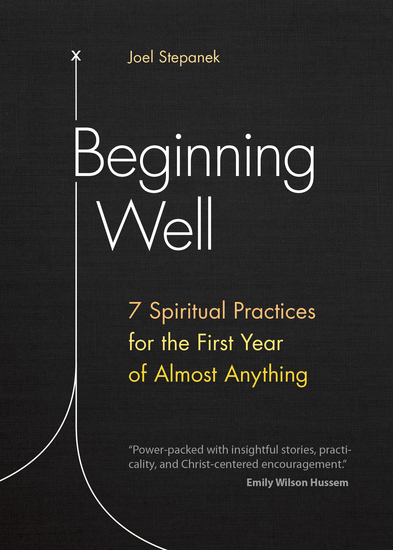
Beginning Well - 7 Spiritual Practices for the First Year of Almost Anything - cover

Beginning Well - 7 Spiritual Practices for the First Year of Almost Anything

Joel Stepanek

Publisher: Ave Maria Press

  • 0
  • 0
  • 0

Summary

Are you starting a new job, retiring, getting married, expanding your family, or making any significant change in your life?The first year of almost anything new can be both a blessing and a challenge. In Beginning Well, Joel Stepanek, vice president of parish services at Life Teen International, shows how being shaken out of your routine when you start something new can free you to become a better Christian. He offers seven spiritual practices to get you through transitions and help you lay a strong foundation for true happiness.Stepanek has worked in pastoral ministry and organizational development for more than fifteen years; he understands that life’s transitions are important to spiritual and emotional well-being and provide the chance to see Christ in places you may not have thought to look before. Stepanek will help you refine your thoughts and behavior to more closely align your life to the Gospel as you grow through your first year of almost anything.In Beginning Well, you will learn how tolet go of what you left;use what you’ve already learned;ask, listen, watch, and learn;create routines and rituals to help bridge the old and the new;pause and assess;find a good mentor; andseek and embrace joy.Stepanek draws on his experience, personal faith, biblical narrative, and Catholic tradition to show you how to grow and thrive as you begin your next big thing.
Available since: 02/11/2022.
Print length: 160 pages.
Other books that might interest you

  • Zen Buddhism And Its Relation To Art - cover

    Zen Buddhism And Its Relation To...

    Arthur Waley

    • 0
    • 0
    • 0
    A great primer on the history of Japanese art as it evolved under the Buddhist (and later Zen) movements embedding in Japan's culture. Written by the first great populariser of Chinese and Japanese cultural artefacts, including translating a great number of Chinese poems and literary works.
    Show book
  • The Cave of Hira - cover

    The Cave of Hira

    Assala

    • 0
    • 0
    • 0
    Hira's journey explores the intersection of dreams, reality, and faith, as she seeks to uncover the meaning behind the visions that haunt her nights and the strange emotions they awaken. Is it a call to something greater, or merely the manifestations of her loneliness?
    Show book
  • Holy Bible - James - New Living Translation (NLT) - cover

    Holy Bible - James - New Living...

    Tyndale House Publishers

    • 0
    • 0
    • 0
    HOLY BIBLE - JAMES: NEW LIVING TRANSLATION (NLT) The Holy Bible, New Living Translation, is an authoritative Bible translation, rendered faithfully into today’s English from the ancient texts by 90 leading Bible scholars. The NLT’s living language breathes life into even the most difficult-to-understand Bible passages—but even more powerful are stories of how people’s lives are changing as the words speak directly to their hearts.  The New Living Translation is perfect for every age and stage of life, allowing every member of the family to read the same text.   What method did the translators use in making the NLT?  The translators of the New Living Translation set out to render the message of the original texts of Scripture into clear, contemporary English. As they did so, they translated as simply and literally as possible when that approach yielded an accurate, clear, and natural English text. Many words and phrases were rendered literally and consistently into English, preserving essential literary and rhetorical devices, ancient metaphors, and word choices that give structure to the text and provide echoes of meaning from one passage to the next.  On the other hand, the translators rendered the message more dynamically when the literal rendering was hard to understand, was misleading, or yielded archaic or foreign wording. They clarified difficult metaphors and terms to aid in the reader’s understanding. The translators first struggled with the meaning of the words and phrases in the ancient context; then they rendered the message into clear, natural English. Their goal was to be both faithful to the ancient texts and eminently readable. The result is a translation that is both exegetically accurate and idiomatically powerful. More than 90 Bible scholars, along with a group of accomplished English stylists, worked closely together toward that goal. In the end, the NLT is the result of precise scholarship conveyed in living, contemporary language.
    Show book
  • When We Spoke to the Dead - How Ghosts Gave American Women Their Voice - cover

    When We Spoke to the Dead - How...

    Ilise S. Carter

    • 0
    • 0
    • 0
    Ghosts spoke. Women listened. Everything changed. 


    In the 1840s, the Fox Sisters—and the legions of mediums they inspired—ignited the Spiritualist movement that swept through Victorian parlors and presidential campaigns alike. Contacting the dead wasn't merely a parlor trick: It was a political statement, a declaration of self that still echoes. Séances attracted suffragists and scientists, skeptics and charlatans, giving women a voice in a society that often refused to hear them. But as Spiritualism surged, it also blurred the lines between faith, fraud, feminism, and financial opportunity, drawing figures as varied as Harry Houdini, Victoria Woodhull, and even modern self-help gurus into its ever-expanding orbit. 


    From wartime séances to the rise of televangelists, from Victorian ghosts to goop-approved wellness rituals, When We Spoke to the Dead unearths the forgotten roots of today's obsession with manifestation, mysticism, and the power of belief. Exploring America's deep-seated hunger for the unseen—whether through politics, personal empowerment, or grief—this book traces how the supernatural, once condemned as heresy, became the ultimate commodity.
    Show book
  • A Tale of Death and Glory - The Acts of Saint Sebastian and His Companions - cover

    A Tale of Death and Glory - The...

    Saint Ambrose of Milan

    • 0
    • 0
    • 0
    In his illustrious life, Saint Sebastian was the senior commanding officer of the elite forces for the greatest military power on the planet—the Roman Empire. By his glorious death, he became a commander in the greatest military power in the universe—the communion of saints of the Roman Catholic Church. 
    Throughout the Church’s history, countless martyrs have offered their lives to Christ rather than deny Him. One of the most revered is Saint Sebastian, and for this, his name appears in the Roman Canon. A native of Milan, Saint Sebastian was the primus pilus, the senior centurion of elite soldiers in the Roman army who commanded eight hundred of the best soldiers in the world’s greatest military at the time. Taking the same ethic for the spiritual battle as he did for the empire’s battles, Saint Sebastian worked tirelessly and inconspicuously to strengthen other Christians, especially during the cruel persecutions and martyrdoms of the third century. 
    The heroic examples of Saint Sebastian and his companions inspired others to follow the Lamb of God, even to the point of death, giving their lives as holocausts to the one, true living God rather than worship devils. It is only fitting that another great saint from Milan, Saint Ambrose, detailed the courage and fidelity of these brave soldiers. A Tale of Death and Glory will compel you to stay firm in your faith amidst the growing threats of persecution from secular authorities and to seek heaven with renewed vigor, for “this earthly life passes quickly, like a fleeting dream.” 
    Show book
  • With God in Solitary Confinement - cover

    With God in Solitary Confinement

    Richard Wurmbrand

    • 0
    • 0
    • 0
    During his 14-year imprisonment in Communist Romania, Richard Wurmbrand spent three years completely alone, with no human contact except for the guards who interrogated and tortured him. Though he had no Bible, pen or paper, Richard composed and memorized hundreds of sermons in rhyme to pass the lonely hours of solitude, clinging to Christ through nightly meditation on God's Word. With God in Solitary Confinement features a collection of these contemplations that he committed to memory. Through Richard's expanded sermons, you are invited to fellowship with your persecuted Christian brothers and sisters. You will discover, through his honest reflections, the depths of despair and heights of faith experienced by those who are imprisoned and tortured for the name of Christ.
    Show book