Join us on a literary world trip!
Add this book to bookshelf
Grey
Write a new comment Default profile 50px
Grey
Subscribe to read the full book or read the first pages for free!
All characters reduced
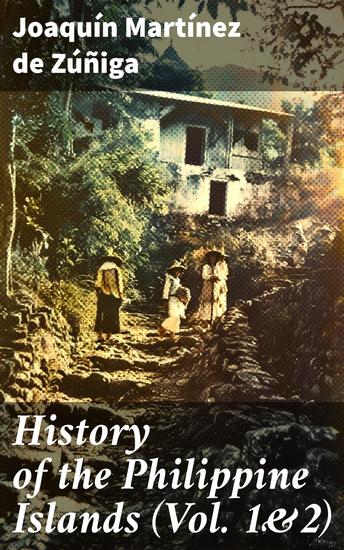
History of the Philippine Islands (Vol 1&2) - Their Discovery Population Language Government Manners Customs Productions and Commerce (Complete Edition) - cover

History of the Philippine Islands (Vol 1&2) - Their Discovery Population Language Government Manners Customs Productions and Commerce (Complete Edition)

Joaquín Martínez de Zúñiga

Translator John Maver

Publisher: Good Press

  • 0
  • 0
  • 0

Summary

In 'History of the Philippine Islands' (Vol. 1 & 2), Joaqu√≠n Mart√≠nez de Z√∫√±iga offers a meticulously researched chronicle of the Philippine archipelago from its earliest days through to the late 19th century. His narrative deftly intertwines historical fact with rich cultural observations, providing readers with an engaging and immersive experience. Crafted in a scholarly yet accessible style, this work serves as one of the earliest comprehensive histories of the Philippines, situating it within the broader context of Spanish colonialism and the dynamics of power that shaped this vibrant region. Z√∫√±iga's use of primary sources and his attention to local customs and political structures highlight the complexities of Philippine history, making it a critical reference for students of both history and post-colonial studies. Joaqu√≠n Mart√≠nez de Z√∫√±iga, a Spanish friar and historian, dedicated much of his life to the Philippines, which served as both his home and the focal point of his scholarly interests. His firsthand experiences and interactions with the local populace endowed him with a unique perspective, leading him to document not only historical events but also the rich tapestry of Filipino culture and identity during a transformative period in its history. His work is a testament to the challenges and nuances of colonial historiography. This monumental work is highly recommended for scholars, students, and anyone interested in understanding the intricacies of Filipino history and culture. Z√∫√±iga'Äôs insightful observations and thorough documentation render this two-volume set an invaluable resource for both historical inquiry and cultural appreciation. Readers will not only gain knowledge about the past but will also be encouraged to reflect on the legacies of colonialism that continue to shape the Philippines today.
Available since: 12/18/2023.
Print length: 288 pages.
Other books that might interest you

  • Anchor's Long Chain The (Unabridged) - cover

    Anchor's Long Chain The...

    Yves Bonnefoy

    • 0
    • 0
    • 0
    An experiment with the sonnet form by one of the foremost French poets of his generation.
    
    Yves Bonnefoy has wowed the literary world for decades with his diffuse volumes. First published in France in 2008, The Anchor's Long Chain is an indispensable addition to his oeuvre. Enriching Bonnefoy's earlier work, the volume, translated by Beverley Bie Brahic, also innovates, including an unprecedented sequence of nineteen sonnets. These sonnets combine the strictness of the form with the freedom to vary line length and create evocative fragments. Compressed, emotionally powerful, and allusive, the poems are also autobiographical-but only in glimpses. Throughout, Bonnefoy conjures up life's eternal questions with each new poem.
    
    Longer, discursive pieces, including the title poem's meditation on a prehistoric stone circle and a legend about a ship, are also part of this volume, as are a number of poetic prose pieces in which Bonnefoy, like several of his great French predecessors, excels. Long-time fans will find much to praise here, while newer listeners will quickly find themselves under the spell of Bonnefoy's powerful, discursive poetry.
    Show book
  • The Boy Who Wouldn't Eat Breakfast - cover

    The Boy Who Wouldn't Eat Breakfast

    Eugene Bradley Coco

    • 0
    • 0
    • 0
    Saturday morning at the farm is a busy, noisy place! Once Robby the Rooster wakes up and loudly exclaims “Cock-A-Doodle-Doo,” Zach is up and ready to play. When Zach runs into the kitchen to eat breakfast, he decides he doesn't have time for this important meal. So off Zach runs to see Horace the Horse. But Horace can't play with Zach because he is busy eating his breakfast of hay. Find out what happens when Zach finds Clara the Cow and Cori the Chicken. Fun barnyard sound effects and whimsical music will have animal lovers listening over and over again to this delightful story about “The Boy Who Wouldn't Eat Breakfast.”
    Show book
  • Kant You Not - A Categorical Imperative to Stay Awake - cover

    Kant You Not - A Categorical...

    Sophia Blackwell

    • 0
    • 0
    • 0
    Ever tried reading Kant and felt your brain melt into a puddle of transcendental confusion? You're not alone! "Kant You Not" is the hilarious antidote to philosophical pretension that explains Immanuel Kant's revolutionary ideas without inducing narcolepsy. 
    In this irreverent guide to history's most unnecessarily complicated philosopher, author Sophia Blackwell translates Kantian gibberish into actual human language while mercilessly mocking his impenetrable prose, bizarre personal habits, and occasionally absurd conclusions. 
    You'll discover: 
    Why a man who never left his hometown somehow revolutionized Western philosophy 
    How Kant needed 800 pages to say "we can't know things as they really are" 
    Why he thought lying to axe murderers was morally wrong (seriously) 
    How to fake Kantian knowledge at dinner parties without reading the originals 
    Why we're still talking about this guy 200+ years later (Stockholm syndrome) 
    Perfect for philosophy students suffering through assigned readings, professors who secretly hate teaching Kant, or anyone who enjoys watching brilliant ideas get roasted. "Kant You Not" proves that philosophy can be educational AND entertaining—a concept that would probably make Kant himself deeply uncomfortable. 
    Buy now and transform your philosophical confusion into laughter! No prior knowledge required—just a willingness to question everything, especially sentences that run for more than half a page. 
    Part of the bestselling "Cogito Ergo Nope!" series that makes philosophy accessible without being condescending and funny without sacrificing accuracy.
    Show book
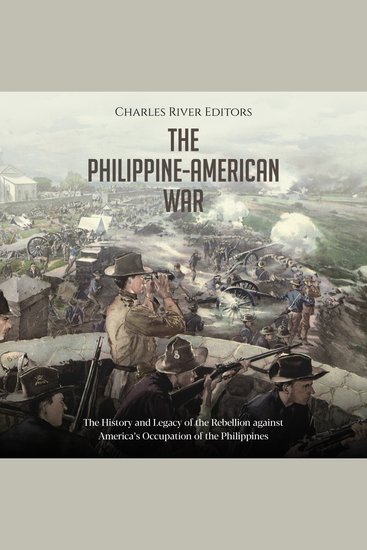
  • Philippine-American War The: The History and Legacy of the Rebellion against America’s Occupation of the Philippines - cover

    Philippine-American War The: The...

    Editors Charles River

    • 0
    • 0
    • 0
    On April 27, 1898 six American ships of the line, led by the Olympia with Commodore George Dewey aboard, headed toward Manila Bay. After several days of sailing over the South China Sea, Dewey hoped to sail past the Spanish fort at Corregidor to arrive at Manila without detection, and sailed without lights in order to do so. He made it into the bay, where the naval battle with the Spanish South Pacific Squadron began in the wee hours of May 1, 1898. Dewey was a student of the Mahanian school of naval strategy, so called for the aggressive Alfred T. Mahan, a top naval strategist and President of the Naval War College. As such, he concentrated his efforts on the offensive, preferring to meet the Spanish fleet on his own terms and to avoid, if it all possible fire from land-based batteries that lined Manila Bay. He refused to engage the batteries on land, sailing straight past the firing batteries and toward the Spanish fleet. Dewey issued his most famous command just before 6:00 that morning, “You may fire when ready, Gridley!”  
    The leader of an 1896 insurgency against the Spanish, Emilio Aguinaldo y Famy, had left the Philippines in an agreement following Spanish promises of reform that never materialized. As a recognized Filipino leader, he was brought to Manila by an American ship within days of the American victory at Manila, but the events that followed were to prove controversial and lead to U.S. control of the Philippines, along with a revolution of the Filipino people that would prove to be far longer and more costly than the Spanish-American war itself. The Philippines had no meaningful connection to Cuba except as a Spanish colony, and Spanish forces in the islands were no threat to the U.S. Pacific coast, but the island chain appeared to offer a convenient location for a naval base in an age when warships were coal-powered and needed coaling bases. 
    Show book
  • Lessons from a Fledgling Democracy - cover

    Lessons from a Fledgling Democracy

    M.D. Mamphela Ramphele

    • 0
    • 0
    • 0
    How are the successes and failures of the fledgling South African democracy relevant to all democratic nations? Why a nation cannot truly thrive without full socio-economic equity. Why true freedom must also include freedom from an imprisoned mind. What is the importance of teaching a full, robust history of a nation?
    Show book
  • Rebel Russia - Dissent and Protest from the Tsars to Navalny - cover

    Rebel Russia - Dissent and...

    Anna Arutunyan

    • 0
    • 0
    • 0
    Navalny. Lenin. Pugachev. The Russian rebel—in his epic battle against the Leviathan of the Russian state—has enthralled readers and writers for decades. The rebel's story is almost always a sad one that ends in exile, imprisonment, or martyrdom, leaving but a seed for the future reform of the Leviathan which he or she had taken on.Why do revolts—from the Decembrist uprising to the Snow Revolution that brought Alexei Navalny to the forefront of contemporary Russian politics—seem to end up failing or producing an even worse form of despotism? In reality, the brave words and deeds of dissidents have shaped the course of Russian history more often than we might think. Through the stories of prominent rebels from the time of Ivan the Terrible to the present day, as well as her own experiences reporting on her country's decent into authoritarianism, Russian-American journalist Anna Arutunyan explores how the rebel and the Tsar defined each other through a centuries-long dance of dissent and repression. These characters and their lives not only reveal the true nature of the Russian state, they also offer hope for a future Russian democracy.
    Show book