Join us on a literary world trip!
Add this book to bookshelf
Grey
Write a new comment Default profile 50px
Grey
Subscribe to read the full book or read the first pages for free!
All characters reduced
Of Mobsters And Movie Stars - The Bloody "Golden Age" of Hollywood - cover

Of Mobsters And Movie Stars - The Bloody "Golden Age" of Hollywood

Joan Renner

Publisher: WildBlue Press

  • 0
  • 0
  • 0

Summary

In this gripping historical account, expert crime historian Joan Renner explores the shadowy world of fame and crime during Hollywood's most glamorous era. As Los Angeles transformed into the epicenter of film, it also became a haven for notorious criminals and mobsters, weaving a complex tapestry of allure and danger that is sure to intrigue. Renner brings to life stories that are more thrilling than fiction, including harrowing LAPD showdowns, dark dealings behind the studio gates, and tragic fates of luminaries whose off-screen lives were as dramatic as their on-screen personas. She delves into infamous episodes, such as the shocking case of Roscoe "Fatty" Arbuckle, accused of “accidentally” crushing to death a young actress beneath his enormous weight as he raped her, and other lesser-known, but equally hair-raising stories of actors brought down by scandal and corruption. OF MOBSTERS AND MOVIE STARS offers a profound and enlightening look at Hollywood's dual nature, illustrating how its seductive glitter was deeply entangled with its sinister impulses. This book is essential for anyone fascinated by how America's “City of Dreams” became a stage for some of the most gripping dramas of the twentieth century. Step into the Prohibition Era with Joan Renner as she reveals the hidden crimes and undying ambition behind Hollywood's shimmering façade.
Available since: 05/14/2024.
Print length: 365 pages.
Other books that might interest you

  • To Bow Bridge - From their pens to your ears genius in every story - cover

    To Bow Bridge - From their pens...

    Arthur Morrison

    • 0
    • 0
    • 0
    Arthur Morrison was born on November 1st, 1863, in Poplar, in the East End of London. From the age of 8, after the death of his father, he was brought up, along with two siblings, by his mother, Jane. 
    Morrison spent his youth in the East End. In 1879 he began as an office boy in the Architect's Department of the London School Board and, in his spare time, visited used bookstores in Whitechapel Road. He first published, a humorous poem, in the magazine Cycling in 1880. 
    In 1885 Morrison began writing for The Globe newspaper. In 1886, he switched to the People's Palace, in Mile End and, in 1888, published the Cockney Corner collection, about life in Soho, Whitechapel, Bow Street and other areas of London.  
    By 1889 he was an editor at the Palace Journal, reprinting some earlier sketches, and writing commentaries on books and articles on the life of the London poor. 
    By 1890 he was back at The Globe and published ‘The Shadows Around Us’, a supernatural collection of stories.  Also at this time he began to develop a keen interest in Japanese Art. 
    In October 1891 his short story A Street appeared in Macmillan's Magazine. The following year he married Elizabeth Thatcher and then befriended publisher and poet William Ernest Henley for whom he wrote stories of working-class life in Henley's National Observer between 1892-94.  
    In 1894 came his first detective story featuring Martin Hewitt, described as "a low-key, realistic, lower-class answer to Sherlock Holmes”. 
    Morrison published A Child of the Jago in 1896 swiftly followed by The Adventures of Martin Hewitt. 
    In 1897 Morrison wrote seven stories about Horace Dorrington, a deeply corrupt private detective, described as "a cheerfully unrepentant sociopath who is willing to stoop to theft, blackmail, fraud or cold-blooded murder to make a dishonest penny."  
    To London Town, the final part of a trilogy including Tales of Mean Streets and A Child of the Jago was published in 1899. Following on came a wide spectrum of works, including novels, short stories and one act plays.  
    In 1911 he published his authoritative work Japanese Painters, illustrated with art from his own collection.  
    Although he retired from journalistic work in 1913 he continued to write about Art.  
    In his last decades Morrison served as a special constable, and reported on the first Zeppelin raid on London. Tragically in 1921 his son, Guy, who had survived the war, died of malaria.  
    The Royal Society of Literature elected him as a member in 1924 and to its Council in 1935.   
    In 1930 he moved to Chalfont St Peter, Buckinghamshire. Here he wrote the short story collection Fiddle o' Dreams and More. 
    Arthur Morrison died on the 4th December 1945.  He was 82 years.
    Show book
  • Designing Terry Pratchett’s Discworld - cover

    Designing Terry Pratchett’s...

    Paul Kidby

    • 0
    • 0
    • 0
    A brilliant fully illustrated biography that brings Terry Pratchett’s universally beloved Discworld to life as never before and pays tribute to an enduring creative collaboration. 
    “It's still magic, even if you know how it's done.” –Sir Terry Pratchett 
    Designing Terry Pratchett’s Discworld is a celebration of Discworld art and a brilliant homage to the decades-long collaboration between artist Paul Kidby and Sir Terry Pratchett that takes readers behind the scenes of one of the great creative partnerships. 
    It shows how the Discworld was brought to visual life—from the earliest sketches to the final magnificent masterpieces—and how Pratchett and Kidby were influenced by art and pop culture, fusing them into the Discworld universe. While Pratchett was the undisputed creative fountainhead, for three decades Kidby has been the artistic force taking the people, places, and pieces of man-eating luggage from Terry's ever-fertile imagination right into our world. 
    Packed with never-before-seen art and the stories behind it, it is a must-have for Pratchett fans of all ages. 
    Supplemental enhancement PDF accompanies the audiobook.
    Show book
  • Dust to God - A Spiritual Memoir and Philosophical Journey into Meaning Oneness and the Sacred Hidden in Everyday Life - cover

    Dust to God - A Spiritual Memoir...

    Nicholas G Coleman PhD

    • 0
    • 0
    • 0
    What if the sacred has been hiding in plain sight all along? 
    Dust to God is a vivid spiritual memoir and philosophical road-trip spanning fifty years, across continents and states of consciousness – guided by the seers, saints and sages of the world’s wisdom traditions – from mining fields in northwest Australia to the Divinity School at Cambridge University, and far beyond. 
    Through often amusing and sometimes confronting true stories, the author explores humanity’s oldest and most persistent questions: 
    Who am I? 
    What is reality? 
    Is there a deeper meaning beneath ordinary life? 
    And why has the universe evolved beings who ask these very questions? 
    This is not a book of doctrine or dogma. It is a lived inquiry into Oneness, meaning, and the nature of what many call God - revealed through real encounters, inner awakenings, and the outer events of a richly lived life. Dust to God is new skin for old knowledge that offers: 
    A deeply personal spiritual autobiography 
    A philosophical journey accessible to non-academics 
    An antidote to anxiety, confusion, and modern disconnection 
    A reminder of the wisdom we are all born with —- and often forget 
    “A fabulous feast of story and philosophy - a deeply spiritual inner journey through the outer physical world”— Murshida Nuria Daly, President, International Sufi Movement in Australia 
    If all the world is a stage and we are merely players, Dust to God dares to step behind the curtain to meet the playwright face to face, and to rediscover the sacred woven quietly through everyday existence.
    Show book
  • A Life of Enlivening Mystical Experiences - cover

    A Life of Enlivening Mystical...

    MD Jean Shinoda Bolen

    • 0
    • 0
    • 0
    In this 2025 interview with Justine Willis Toms, we delve into Bolen’s Japanese-American heritage and some of the mystical moments that have been guideposts in her life, including a transformative moment while a Girl Scout in the mountains, sleeping under the stars. Early in her life she attended five different schools as her family moved to avoid internment camps during WWII. She thrived by being curious and friendly, and learned resilience during her frequent school changes. She also speaks about her son Andy's death and his posthumous communication with his father. Bolen emphasizes the importance of love, joy, and curiosity in life, and the potential for spiritual support and collective consciousness. She encourages us to contribute our own unique gifts to our communities of influence and to recall our own life-enhancing mystical moments.  
    Jean Shinoda Bolen, M.D. is a psychiatrist, a Jungian analyst, and an internationally known speaker. She is a former board member of the Ms. Foundation, an advocate for a 5th UN World Conference on Women and a convener of the Millionth Circle Initiative, as well as a permanent
    Show book
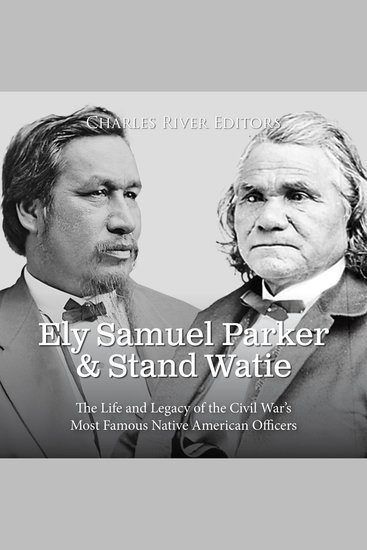
  • Ely Samuel Parker and Stand Watie: The Life and Legacy of the Civil War’s Most Famous Native American Officers - cover

    Ely Samuel Parker and Stand...

    Editors Charles River

    • 0
    • 0
    • 0
    One of the best known of the six nations is the Seneca, and arguably the most famous Seneca chief was Ely Samuel Parker. Over the course of his life, he was a Seneca chief, a civil engineer, a close friend and adjutant to General Ulysses S. Grant, an advocate for the Indian peoples, and the first Native American Commissioner of the Department of Indian Affairs. His marriage to a much younger socialite scandalized Washington, and he made a fortune on Wall Street and lost it all. He ended his life in genteel poverty, working for nearly 20 years in an obscure position for the New York City Police Department. Parker was a largely self-taught engineer, who worked on various canal projects, and was hired by the Department of the Treasury to supervise the construction of several buildings in Galena, Illinois, where he met a shy salesclerk named Ulysses S. Grant. At the age of 18, he dined with President Polk, later talked with President Lincoln, and had the commanding general of the U.S. Army as the best man at his wedding.  
    Stand Watie’s life connects the traditional Cherokee homeland in Tennessee and Georgia, the fight within the tribe over leaving for the West or staying on their homeland and trying to resist, and the Trail of Tears. At the same time, his life also includes the ongoing split between mixed-blood and full-blood Cherokee in the Cherokee Nation, and the chaos of Indian Territory during the Civil War. Like the country as a whole, the Cherokee Nation was split over the question of slavery, and with an estimated 100 slaves owned, Watie was the biggest native slaveholder in the region. At the start of the war, Watie was commissioned as a colonel in Confederate service and later as a brigadier general. His 1st Cherokee Mounted Rifles Regiment fought more engagements than any other Confederate unit west of the Mississippi River. As a result, Watie is perhaps the most famous figure of a widely overlooked aspect of the Civil War.
    Show book
  • Conduct of Life volume 2 - cover

    Conduct of Life volume 2

    Moïse Almosnino, Walter Hilliger

    • 0
    • 0
    • 0
    The major work of Rabbi Moses Almosnino (1515-1580), “Conduct of Life,” remains to this day an essential reference in classical Judeo-Spanish literature, now finally available in English in its first translation. First published in Ladino in 1564 as, Sefer Hanhagat ha-hayim and in 1729 as “Regimiento de la vida”, this three-volume edition is part of the prestigious collection Veritas è terra orietur. The work aims to disseminate the timeless teachings of ethics, in the words of the author: “In all that has been said, my intention is only to make you understand how the one who follows the path of virtue and customs of practising good and pure knowledge since childhood, lives a happy and fulfilled life (Volume 1, chapter 2)” This second volume addresses the confusion of indeterminism with free will (Volume 2, chapter 1) and how virtues arise from free will to surpass the force of destiny chapter 2), their conditions (chapter 3); the three types of strength or courage, which is the first virtue (chapter 4), its five properties and eleven conditions (chapter 5); as well as the ten ethical virtues, temperance (chapter 6), the sixteen properties of liberality chapters 7-8), magnificence (chapter 9), magnanimity and its fifty properties (chapter 10-12), modesty (chapter 13), meekness (chapters 14-16), affability (chapter 17), honesty or truth (chapters 18-19), and courtesy (chapter 20); following the order and numbering of Aristotle's Nicomachean Ethics.“Conduct of Life” draws heavily from the Nicomachean Ethics but transcends this source by situating itself at the universal intersection of several traditions: Greco-Arabic philosophy, Judeo-Christian scholasticism, classical Sephardic Judaism, and medieval Jewish thought. Thus, this work contributes to peace and intercultural understanding among peoples.
    Show book