Join us on a literary world trip!
Add this book to bookshelf
Grey
Write a new comment Default profile 50px
Grey
Subscribe to read the full book or read the first pages for free!
All characters reduced
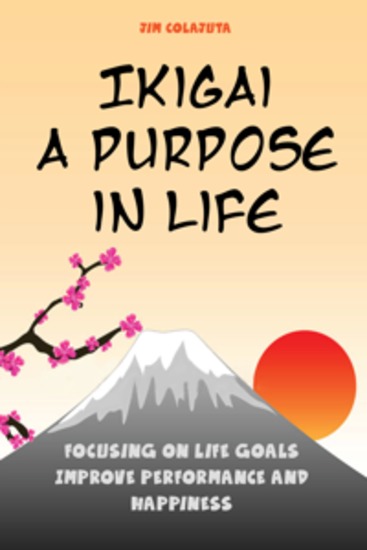
Ikigai: A Purpose in Life - Focusing on Life Goals Improves Performance and Happiness - cover

Ikigai: A Purpose in Life - Focusing on Life Goals Improves Performance and Happiness

Jim Colajuta

Publisher: Jim Colajuta

  • 0
  • 0
  • 0

Summary

The day you decide that your life is your own is the best day of your life. There will be no apologies or excuses. There was no one to lean on, rely on, or point the finger at. The gift is yours, it's an incredible journey, and you're solely responsible for its quality. This is the first day of your life. Having a purpose in life is one of the most fundamental human needs. Ikigai, a Japanese concept, means "a reason for being." It refers to living a fulfilling life. Many different activities can provide people with a sense of purpose in life. These activities can range from volunteering to providing social support to older people and even caring for pets, all linked to increased happiness, better health outcomes, and longer lifespan.Everyone is equipped with an ikigai. Your ikigai is the reason you get up in the morning, the reason you want to live fully and cheerfully. Your ikigai isn't something you make up; it's something you're born with. The Japanese believe that discovering one's ikigai necessitates a long, contemplative search that can lead to life satisfaction and meaning. All you have to do is dig far enough to locate it. Your ikigai lies at the crossroads of four circles: what you enjoy, what the world requires, what you can be compensated for, and what you're skilled at.
Available since: 09/06/2025.


Other books that might interest you

  • Kamakura Shogunate - Samurai Power and the Mongol Invasions - cover

    Kamakura Shogunate - Samurai...

    Rolf Hedger

    • 0
    • 0
    • 0
    The rise of the Kamakura Shogunate marks a pivotal moment in Japanese history, transitioning from the aristocratic Heian period to the feudal system dominated by the samurai. This era began with the victory of Minamoto no Yoritomo, who, after the Genpei War (1180-1185), established a new form of governance centered in Kamakura, a small coastal town far from the imperial capital of Kyoto. 
    The Genpei War was a civil conflict between the Taira and Minamoto clans, which ultimately ended with the defeat of the Taira in the Battle of Dan-no-ura in 1185. Minamoto no Yoritomo, the leader of the Minamoto clan, emerged as the victor, but his triumph was not simply a personal or clan-based success. Yoritomo's victory laid the foundation for a shift in the political landscape of Japan. The Taira had represented the old courtly aristocracy that governed Japan through the imperial system, but the rise of the Minamoto signaled the beginning of samurai dominance and a move toward military rule. 
    In 1192, Yoritomo was granted the title of shogun by the emperor, an act that formalized his military authority. This title, meaning "generalissimo" or "commander of the army," was traditionally given to military leaders in times of war but had never been used as the primary governing title before. This marked the official beginning of the Kamakura Shogunate, a military dictatorship that would rule Japan for over a century. Though the emperor remained the nominal ruler, Yoritomo’s power was based in Kamakura, far from the imperial court, which shifted the balance of power from the capital to the military elite.
    Show book
  • Noachic & Flood Traditions: Enoch Giants and the Great Deluge Across Apocrypha - Ancient Jewish & Christian Retellings That Expand Genesis’ Flood and the Watcher Myth - cover

    Noachic & Flood Traditions:...

    Various Ancient Writers, Tim...

    • 0
    • 0
    • 0
    What if the Great Flood was only the beginning—echoing a clash of angels, giants, and divine decrees hidden in lost scriptures? 
    From the caves of Qumran to the monasteries of medieval Ethiopia, ancient writers retold the flood saga with breath-taking scope.  
    This collection unites those voices so readers can experience the full epic for the first time. 
    What You’ll Discover Inside: 
    •	1 Enoch (“Book of the Watchers”) – The descent of 200 angels, their forbidden unions, and Enoch’s celestial intercession. 
    •	Book of Giants – Fragmentary but thrilling accounts of Nephilim dreams and doom. 
    •	2 Enoch & 3 Enoch – Enoch’s elevation to the angel Metatron and panoramic tours through ten heavens. 
    •	Jubilees – Chronological retelling of creation to Sinai, detailing the ark’s construction and covenantal rainbow. 
    •	Genesis Apocryphon – Dead Sea Scroll narrative expanding Noah’s birth and adventures. 
    •	Testament of Amram & Related Watcher Texts – Glimpses of angelic warfare shaping Israel’s destiny. 
    Rich with mythology, moral warning, and apocalyptic hope, these texts invite you to witness a world on the brink—and the divine rescue that reshaped humanity’s future.
    Show book
  • Letters To Mikey - Messages of Hope and Optimism for Young Americans - cover

    Letters To Mikey - Messages of...

    Glenn Cort

    • 0
    • 0
    • 0
    In America we have so much, but there is something missing. There is a widespread fear of what we are becoming. Our new normal is indescribable, yet undeniable. Subtle, yet controlling. We can all feel it but we can’t put our finger on what it is. 
    There is a generalized sense of noise and confusion that has dominated our society for years. It’s as if we’ve become unglued from anything — truth or reality — that has formerly held us together. 
    Driven by the fear of the moment, Letters to Mikey (LTM) is the story of a parent and part time teacher who sits down to write a birthday card for his eighteen-year-old son and is at a loss for words for what is happening to society. So, he drops everything, moves to an island and visits a place that he hasn’t been to for years... the local library. What he finds there is truly astonishing! 
    Written for young adults and teenagers, LTM explains truth in a way that kids can rely on to have less frustration and worry about this crazy world we live in. It provides real reasons for optimism for a brighter future as well as coping mechanisms, tools and strategies to enable a future generation to bring an end to terrible disagreement and hate forever. These aren't false promises. It's possible.  
    Geared to start a movement, LTM seeks to tap into our greatest resource — young people.
    Show book
  • Avoiding the Worst - How to Prevent a Moral Catastrophe - cover

    Avoiding the Worst - How to...

    Tobias Baumann

    • 0
    • 0
    • 0
    How can we avoid worst-case scenarios? 
    From Nineteen Eighty-Four to Black Mirror, we are all familiar with the tropes of dystopian science fiction. But what if worst-case scenarios could actually become reality? And what if we could do something now to put the world on a better path? 
    In Avoiding the Worst, Tobias Baumann lays out the concept of risks of future suffering (s-risks). With a focus on s-risks that are both realistic and avoidable, he argues that we have strong reasons to consider their reduction a top priority. Finally, he turns to the question of what we can do to help steer the world away from s-risks and towards a brighter future.
    Show book
  • The Souls of Black Folk - cover

    The Souls of Black Folk

    W.E.B. DuBois

    • 0
    • 0
    • 0
    The Souls of Black Folk is a 1903 work of American literature by W. E. B. Du Bois. It is a seminal work in the history of sociology and a cornerstone of African-American literature.
    The book contains several essays on race, some of which the magazine Atlantic Monthly had previously published. To develop this work, Du Bois drew from his own experiences as an African American in American society. Outside of its notable relevance in African-American history, The Souls of Black Folk also holds an important place in social science as one of the early works in the field of sociology.
    In The Souls of Black Folk, Du Bois used the term "double consciousness", perhaps taken from Ralph Waldo Emerson ("The Transcendentalist" and "Fate"), applying it to the idea that black people must have two fields of vision at all times. They must be conscious of how they view themselves, as well as being conscious of how the world views them.
    Show book
  • Narcissism - The Complete Guide To Understanding the Narcissist and Toxic People in Your Life How to live happily with Skills for Healing from Emotional Abuse - cover

    Narcissism - The Complete Guide...

    Isabella Males

    • 0
    • 0
    • 0
    Do you need to know how to disarm that narcissist in your life? 
    This audiobook is an expertly informed guide to help you understand, handle and heal from dealing with narcissistic people in your life 
    Falling victim to narcissistic abuse can leave you feeling confused, isolated, and in need of help finding a way forward. 
    You'll learn to identify and dissect all kinds of narcissistic reactions, coping mechanisms and narcissistic supply- both healthy and extreme- so that you can determine exactly what kind of narcissistic traits you're dealing with. and create a simple plan of action for moving forward into the future, for the betterment of yourself and those around you. 
    Through helping you grow the inherent forces of the Self, this Audiobook opens you to an unimaginable state of power. This profound shift transforms the narcissist’s influence from a deadly storm into a harmless breeze, allowing you to finally come home and become who you were born to be.There are ways to make it work with a narcissist, and if you’ve got one in your life, start listening this audiobook today to figure out how best to handle your relationship!!Get your copy today!
    Show book