Join us on a literary world trip!
Add this book to bookshelf
Grey
Write a new comment Default profile 50px
Grey
Subscribe to read the full book or read the first pages for free!
All characters reduced
The Three Days' Tournament - A Study in Romance and Folk-Lore - cover

The Three Days' Tournament - A Study in Romance and Folk-Lore

Jessie L. Weston

Publisher: Good Press

  • 0
  • 0
  • 0

Summary

In 'The Three Days' Tournament,' Jessie L. Weston masterfully intertwines Arthurian legend with elements of folktale, crafting a rich and imaginative narrative that explores themes of chivalry, honor, and the complexities of human relationships. Set against the vibrant backdrop of a mythic medieval landscape, Weston's prose is both lyrical and precise, capturing the essence of its characters and their quests. This work stands within the literary context of early 20th-century studies of myth and folklore, drawing on Weston's background in anthropology and comparative religion to provide a deep analysis of cultural motifs present in the tales of King Arthur and his knights. Weston, an influential scholar and writer renowned for her expertise in mythology, was profoundly shaped by the early feminist movements and the burgeoning interest in folklore during her era. Her profound understanding of mythical narratives and their psychological underpinnings allowed her to present a fresh perspective on established legends. Through her scholarly pursuits, Weston sought to reclaim and reinterpret stories that had long been dominated by a patriarchal lens, interpreting the motives and desires of her characters with nuance and depth. Readers interested in Arthurian lore and the intersections of myth and literature will find 'The Three Days' Tournament' to be an engaging and insightful read. Weston's ability to blend scholarly analysis with captivating storytelling invites both casual readers and scholars alike to delve into a narrative that resonates with timeless themes of courage and the quest for identity. This book is not just a retelling of legends, but a profound exploration of human experience through the lens of myth.
Available since: 10/12/2023.
Print length: 49 pages.


Other books that might interest you

  • The Conscious Code - Decoding the Implications of Artificial Consciousness - cover

    The Conscious Code - Decoding...

    Prof. Rocky Scopelliti

    • 0
    • 0
    • 0
    In an age where Artificial Intelligence (AI) evolves at a breakneck pace, the boundaries of machine capabilities are constantly being redefined. Propelled by advancements in deep learning and related technologies, AI is inching ever closer to mimicking human intellect. But can it achieve consciousness? And if so, at what cost to humanity?
     
    This book delves deep into the multi-faceted debate surrounding artificially conscious AI. It untangles ethical quandaries, philosophical dilemmas, technological challenges, political considerations, and the regulatory landscape. By drawing connections between AI research, neuroscience, and cognitive science, the narrative provides a comprehensive understanding
     of what consciousness might mean in the context of AI.
     
    As over a thousand AI luminaries globally sound the alarm, urging a pause on certain AI developments, the book underscores the urgency of its message. Recent incidents have spotlighted AI systems with capabilities so advanced that even their creators grapple to fully grasp or control them. It’s imperative, now more than ever, to critically assess the implications of AI consciousness, weighing its potential risks against its benefits. This book offers both a timely warning and a call to informed action.
    Show book
  • A Brief History of the Countryside in 100 Objects - cover

    A Brief History of the...

    Sally Coulthard

    • 0
    • 0
    • 0
    A Waterstones Best Book of 2024: Nature Writing 
    The untold story of rural Britain revealed through its artefacts 
    'A really lovely, fascinating book. I dived straight into this clever, joyous, celebration of nature, history, and – of course – the countryside.' Charles Spencer, author of The White Ship 
    For most of human history, we were rural folk.  
    Our daily lives were bound up with working the land, living within the rhythm of the seasons. We poured our energies into growing food, tending to animals and watching the weather. Family, friends and neighbours were often one and the same. Life revolved around the village and its key spaces and places – the church, the green, the school and the marketplace. 
    And yet rural life is oddly invisible our historical records. The daily routine of the peasant, the farmer or the craftsperson could never compete with the glamour of city life, war and royal drama. Lives went unrecorded, stories untold. 
    There is, though, one way in which we can learn about our rural past. The things we have left behind provide a connection that no document can match; physical artefacts are touchstones that breathe life into its history. From farming tools to children’s toys, domestic objects and strange curios, the everyday items of the past reveal fascinating insights into an often-forgotten way of life. Birth, death, celebration, work, crime, play, medicine, beliefs, diet and our relationship with nature can all be read from these remnants of our past. 
    From ancient artefacts to modern-day memorabilia, this startling book weaves a rich tapestry from the fragments of our rural past. 
    In her non-fiction book A Brief History of the Countryside in 100 Objects, Sally Coulthard explores the social and cultural dynamics of rural life in Europe. The book, steeped in anthropology and environmental conservation, emphasises the importance of regional studies and the protection of our environment. 
    For fans of Jane Cooper (The Lost Flock), Charles King (Every Valley), Lee Alan Dugatkin (Mr. Jefferson and the Giant Moose), James Rebanks (The Shepherd's View), and Clara Parkes (Vanishing Fleece). 
    HarperCollins 2024
    Show book
  • Glossy - The inside story of Vogue - cover

    Glossy - The inside story of Vogue

    Nina-Sophia Miralles

    • 0
    • 0
    • 0
    Vogue magazine started, like so many great things do, in the spare room of someone's house. But unlike other such makeshift projects that flare up then fizzle away, Vogue burnt itself onto our cultural consciousness. 


    Today, 128 years later, Vogue spans twenty-two countries, has an international print readership upwards of twelve million, and nets over sixty-seven million monthly online users. Uncontested market leader for a century, it is one of the most recognizable brands in the world and a multi-million dollar money-making machine. It is not just a fashion magazine, it is the establishment. But what—and more importantly who—made Vogue such an enduring success? 


    Glossy will answer this question and more by tracing the previously untold history of the magazine, from its inception as a New York gossip rag, to the sleek, corporate behemoth we know now. This will be a biography of Vogue in every sense of the word, taking the listener through three centuries, two world wars, plunging failures, and blinding successes, as it charts the story of the magazine and those who ran it.
    Show book
  • Martin Guerre - cover

    Martin Guerre

    Alexandre Dumas

    • 0
    • 0
    • 0
    "Martin Guerre" by Alexandre Dumas recounts the gripping true story of identity and deception in 16th-century France. Martin Guerre, a peasant, abandons his family, only for a man claiming to be him to return years later. The impostor, Arnaud du Tilh, seamlessly integrates into Martin’s life, earning the trust of his wife and community. However, cracks in his facade lead to a dramatic trial that questions truth, loyalty, and justice. Dumas explores themes of identity, love, and societal expectations, painting a vivid picture of rural life and legal drama. A tale of intrigue and human complexity, it reflects on the fragility of trust and the consequences of ambition, blending history with suspenseful storytelling.
    Show book
  • The Queer and Transgender Resilience Workbook - Skills for Navigating Sexual Orientation and Gender Expression - cover

    The Queer and Transgender...

    PhD Anneliese A. Singh, PhD...

    • 0
    • 0
    • 0
    The Queer and Transgender Resilience Workbook will teach you how to challenge internalized negative messages, handle stress, build a community, and embrace your true self. 


    Resilience is a key ingredient for psychological health and wellness. It's what gives people the psychological strength to cope with stress and setbacks. But if you are queer or gender non-conforming, life stresses may also include discrimination in housing and health care, employment barriers, homelessness, family rejection, physical attacks or threats, and general unfair treatment and oppression. So, how can you gain resilience in a society that is so often toxic and unwelcoming? 


    In this important workbook, you'll discover how to cultivate the key components of resilience: holding a positive view of yourself and your abilities; knowing your worth and cultivating a strong sense of self-esteem; effectively utilizing resources; being assertive and creating a support community; fostering hope and growth within yourself, and finding the strength to help others. 


    By learning to challenge internalized negative messages and remove obstacles from your life, you can build the resilience you need to embrace your truest self.
    Show book
  • A Rare Recording of Eleanor Roosevelt - cover

    A Rare Recording of Eleanor...

    Eleanor Roosevelt

    • 0
    • 0
    • 0
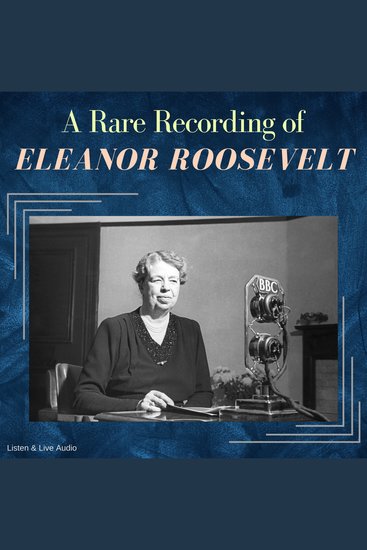
    Eleanor Roosevelt (October 11, 1884 - November 7, 1962) was born in New York City and was a niece of President Theodore Roosevelt. She would have a long and distinguished career as an American political figure, diplomat, and activist, making her one of the most admired women of the twentieth century. She served as the first lady of the United States from 1933 to 1945, during her husband President Franklin D. Roosevelt's four terms in office, making her the longest-serving first lady of the United States. Roosevelt served as United States Delegate to the United Nations General Assembly from 1945 to 1952. President Harry S. Truman later called her the "First Lady of the World" in tribute to her human rights achievements. The following recording is a radio address Roosevelt made to the nation hours after the attack on Pearl Harbor.
    Show book