Join us on a literary world trip!
Add this book to bookshelf
Grey
Write a new comment Default profile 50px
Grey
Subscribe to read the full book or read the first pages for free!
All characters reduced
Notes from a Shipwreck - cover

Notes from a Shipwreck

Jessica Mookherjee

Publisher: Nine Arches Press

  • 0
  • 0
  • 0

Summary

Notes from a Shipwreck, the third collection of poetry by Jessica Mookherjee, is a richly detailed and illuminating voyage of dislocation and longing. By turns evocative, unsettling, and full of 'small acts of magic', Mookherjee simultaneously finds the past, present, and future in the tempestuous, lyrical tides that flow through her poems.
Here, seafaring lore and shanties interweave with wreckage and survival, drawn by strong currents of history – where migration, colonialism, pandemics and climate change shape the course we are on. The sea is a territory of grief and transformation, alluring and dangerous, where safe harbours and landfall are not always certain. Mookherjee's enchanting, salt-sharp poetry encompasses the many journeys embarked on – whether seeking refuge, escape, or into exile – and consider not only the deep blue sea and its myriad mythologies, but to understand 'what makes a land and person,' – the keen human instinct to seek belonging.
Available since: 09/08/2022.
Print length: 72 pages.
Other books that might interest you

  • One-Act Play Collection 002 - cover

    One-Act Play Collection 002

    Various

    • 0
    • 0
    • 0
    This collection of eight one-act dramas features plays by Eugene O'Neill, George Bernard Shaw, John Galsworthy, Susan Glaspell, William Dean Howells and John Millington Synge.  It also includes a dramatic reading of a short story by Frank Richard Stockton.  (Summary by Elizabeth Klett) Before Breakfast read by: Elizabeth Klett, Pat Redstone The Buller-Podington Compact read by: Algy Pug, Lars Rolander, David Lawrence, mb, Elizabeth Klett, Levi Throckmorton The Dark Lady of the Sonnets read by: Max Korlinge, Bob Gonzalez, Elizabeth Klett, Arielle Lipshaw, mb The First and the Last read by: Algy Pug, mb, Diana Majlinger, Elizabeth Klett How He Lied to Her Husband read by: Diana Majlinger, Bob Gonzalez, mb, Arielle Lipshaw The Outside read by: John Steigerwald, mb, Bart de Leeuw, Elizabeth Klett, Arielle Lipshaw, David Lawrence The Parlor-Car read by: Barry Eads, Betsie Bush Riders to the Sea read by: Poilin Hynes, Algy Pug, Arielle Lipshaw, Elizabeth Klett, Barty Begley, Diana Majlinger, David Lawrence, Kalynda
    Show book
  • GAZA Today - Would You Turn Your Back - cover

    GAZA Today - Would You Turn Your...

    Mike Blake

    • 0
    • 0
    • 0
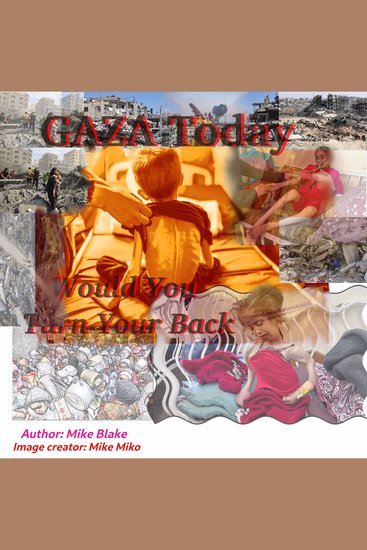
    GAZA Today: Would You Turn Your Back. 
    (Harmony-Join Book 4) 
    Everyone knows what Gaza is. A strip of land in the Middle East, being vociferously fought over. 
    I don't want to get into the Politics of it, but at least a brush with it is unavoidable if you attempt 
    any kind of dialogue or description of the occurrences that are happening there - truly awful. 
    This poem is a short one, and keeps to the suffering of its people, and not delving too much into sides 
    of the Political spectrum. 
    I think the suffering in a modern day scenario with instant and graphic footage of this one-sided war 
    is horrific. 
    Regardless of who did what to who, and who did it first etc, it should be focused on the humanitarian side 
    in any conflict lest we lose sight of what we maybe fighting for - I think the focus on humanity has been totally 
    lost. 
    Are we to Turn Our Back on these people. The West should push for extreme Sanctions to reign in the seemingly 
    unstoppable gungho aggression of the combatants - There is a Geneva convention you know. 
    It can only mean something if it is enforced... 
    Footnote: This Poem is all about the kids in this conflict. Whose right and whose wrong, shouldn't come into it 
    on the humanitarian field of view.
    Show book
  • Voices from Ukraine: Two Plays - cover

    Voices from Ukraine: Two Plays

    Neda Nezhdana, Natalka Vorozhbyt

    • 0
    • 0
    • 0
    Two powerful plays about the shattering impact of war, and the astonishing resilience of those living through it, written by two of Ukraine's leading playwrights.
    'They've mobilised all the living now, the fifth call took the last of the living. But the war keeps on. So high command asked us.'
    Sasha, a Colonel in the Ukrainian Army, has died suddenly of a heart attack, leaving his relatives Katia and Oksana to mourn for him. But a year later, as war intensifies, the army has resorted to recruiting the dead. Sasha is anxious to be resurrected so he can rejoin the fight, but can his family bear to lose him all over again? Take the Rubbish Out, Sasha by Natal'ya Vorozhbit blends reality and the supernatural in a startling exploration of the effects of war and conflict.
    'I want to report a robbery... I was robbed. What was stolen from me? Almost everything... Home, land, car, work, friends, city, faith in goodness...'
    Donbas, 2014. A nameless woman stands in the street, trying to sell a basket of kittens. She has lost everything else she holds dear. Her only remaining hope is to find a home for the kittens, since she cannot offer them one herself. Pussycat in Memory of Darkness by Neda Nezhdana is an unflinching examination of Russia's war on Ukraine through the brutalised eyes of one woman.
    The two plays were translated by Sasha Dugdale and John Farndon, respectively, and performed in English at the Finborough Theatre, London, as part of their #VoicesFromUkraine season in 2022.
    10% of the proceeds from sales of this book will be donated to the Voices of Children Charitable Foundation, a Ukrainian charity providing urgently needed psychological and psychosocial support to children affected by the war in Ukraine.
    Show book
  • The Poetry of Khalil Gibran - Collection from the titan of world literature author of The Prophet - cover

    The Poetry of Khalil Gibran -...

    Kahlil Gibran

    • 0
    • 0
    • 0
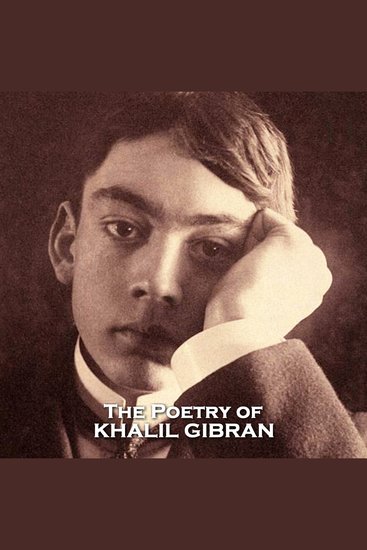
    Gibran Khalil Gibran was born on 6th January 1883 in the village of Bsharri, Beirut Vilayet, then part of the Ottoman Empire 
    His mother took him and his siblings to the United States in 1895 where he was enrolled into a Boston school and his creative talents soon noted.  He was sent home to be schooled at the Collège de la Sagesse in Beirut but returned to Boston following the death of his youngest sister in 1902.  Within a year his mother had also died. 
    In 1904, Gibran's drawings were displayed for the first time and, a year later, his first book, in Arabic, was published in New York City.  With financial help from a benefactress he studied art in Paris from 1908 and here his path crossed with dissident Syrian exiles.  Over the years he would meet many more like-minded exiles who were exploring ways to overthrow the yoke of the Ottoman Empire.   
    By 1911 he had settled in New York working on his drawings and paintings which were now being regularly exhibited. His writing was also attracting much attention and gaining an audience.   
    His first book in English, ‘The Madman’ became an international phenomenon.  Whilst his writing has overshadowed his visual works there is no doubt that a copy of ‘The Mad Man’ is never far from any bookshelf.  This and other works have ensured his stature as an artist is world-wide and that it continues into these more modern times.  Gibran was regarded as a literary rebel and a leading figure of the Arabic literary Renaissance and made influential contributions to Western poetry, stories and thought. 
    Khalil Gibran died on 10th April 1931 in New York City from cirrhosis and incipient tuberculosis in one lung.  He was 48.   
    Gibran was one of a number of Arab intellectuals and writers who lived in the United States at the beginning of the twentieth century and who had a great influence on the development of modern Arabic literature through the exploration of Western literary movements.  The group was presided over by Gibran himself and was baptized Arrabitah, or “The League.”  Its influence is acknowledged as fundamental. 
    In this volume of poetry Gibran is able to capture and demonstrate and enlighten much of the human condition and the wonder of the world around him.
    Show book
  • Cassie and the Lights - cover

    Cassie and the Lights

    Alex Howarth

    • 0
    • 0
    • 0
    'I needed to be better... and summat needed to change – to keep them safe. To fix my family.'
    When her mother disappears, teenager Cassie wants to care for her sisters on her own. But can kids be parents? Or should Cassie let foster parents adopt her sisters and create a new family?
    Alex Howarth's play Cassie and the Lights is a tender and playful examination of what makes a family and what holds it together. Based on real-life events and interviews with children in care, it celebrates the resilience of young people and the power of sisterhood.
    The play has been performed at the Edinburgh Festival Fringe, VAULT Festival in London, 59E59 in New York City and Adelaide Fringe Festival in Australia. It toured the UK in 2024, produced by Patch of Blue and 3 hearts canvas, in association with Southwark Playhouse and Verse Unbound.
    Show book
  • Lamia - cover

    Lamia

    John Keats

    • 0
    • 0
    • 0
    Brought to you by Altrusian Grace Media and narrated by Matthew Schmitz.
     
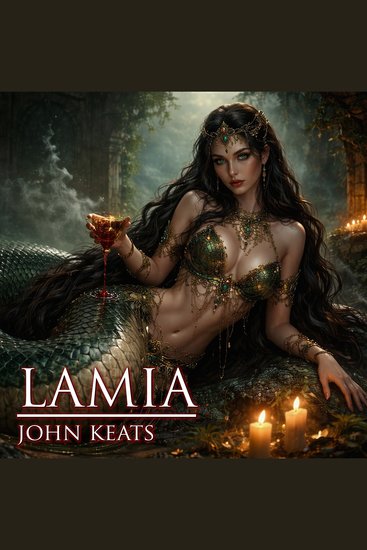
    "Lamia" is the English Romantic poet John Keats's lush, eerie tale of enchantment defeated by merciless rationality. Set in the world of ancient Greco-Roman myth, the poem tells the story of the serpent-spirit Lamia, who talks the god Hermes into transforming her into a beautiful woman so she can pursue her beloved, a handsome young man named Lycius. The couple is blissfully happy for a time—but their joy can't last. Icy reason, in the form of the philosopher Apollonius, at last punctures their shared dream. Often remembered as a Romantic screed against "cold philosophy," this poem is in fact a nuanced and ambivalent portrait of the beauties and dangers of the imagination—especially the imaginative visions of lovers. Keats published this poem in his 1820 collection Lamia, Isabella, the Eve of St. Agnes, and Other Poems.
    Show book