Join us on a literary world trip!
Add this book to bookshelf
Grey
Write a new comment Default profile 50px
Grey
Subscribe to read the full book or read the first pages for free!
All characters reduced
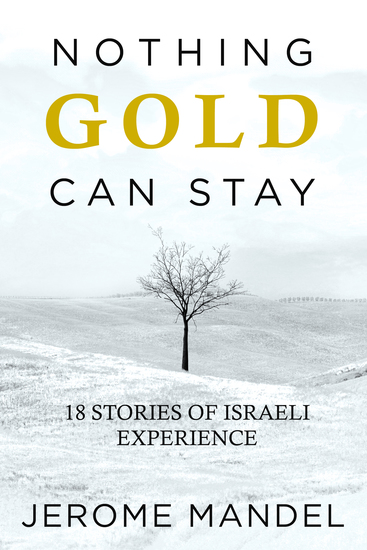
Nothing Gold Can Stay - 18 Stories of Israeli Experience - cover

Nothing Gold Can Stay - 18 Stories of Israeli Experience

Jerome Mandel

Publisher: Next Chapter

  • 0
  • 0
  • 0

Summary

This evocative collection delves into the lives of characters facing defining moments and unexpected challenges. Here, you'll encounter strong, self-determined women, including a widowed mother rebuilding her life after a traumatic accident, and a daughter helping her ailing mother.
 
Whether it's the unsettling visit to Auschwitz by an assimilated American family, a Polish patriot dealing with an unexpected gift from a Holocaust survivor, or a tale of magical realism, the stories in this book offer a unique view of the human condition.
 
A thought-provoking collection, Jerome Mandel's NOTHING GOLD CAN STAY is a compassionate, profound exploration of human nature and self-discovery.
Available since: 01/24/2024.
Print length: 222 pages.
Other books that might interest you

  • Love in the Trenches: A Botanical Battlefield - cover

    Love in the Trenches: A...

    Ella Stories

    • 0
    • 0
    • 0
    A macho army sergeant falls in love with a gentle botanist who is researching the healing properties of plants in the war zone. The soldier must navigate his unfamiliar feelings while reconciling with his tough exterior, and the botanist, a firm pacifist, has to reconcile with the soldier's violent profession. Together, they learn new paths of communication, and in the process, discover peace in the chaos.
    Show book
  • The Price We Pay - cover

    The Price We Pay

    M.H. Lee

    • 0
    • 0
    • 0
    What If You Didn't Have To Struggle Anymore?Clark has spent every day of his life fighting to survive his terminal illness and provide for his family, but then all his wishes are unexpectedly answered and he's left asking the question, what now?
    Show book
  • Seahenge - A Short Story - cover

    Seahenge - A Short Story

    J.F. Penn

    • 0
    • 0
    • 0
    What was drowned will be drowned again…  
    Marine archaeologist Dr. Evelyn Price has spent her life uncovering the mysteries of the deep ocean. But when a violent storm uncovers an ancient timber circle off the coast of England, she faces a discovery that will challenge everything she knows. 
    As the tide rises and storm clouds gather, Evelyn and her team race against time to decipher the strange symbols on the wooden pillars, before the sea comes to claim its own once more. 
    Seahenge is a gripping archaeological short story that blends cutting-edge science with ancient myth. It will leave you questioning what really lies beneath the waves…
    Show book
  • Honest Work - A Good Women Story - cover

    Honest Work - A Good Women Story

    Halle Hill

    • 0
    • 0
    • 0
    Maudette works at the state fair. She hates her job, she hates what her mother does for a living, she hates the people in her town, especially one of her mother’s clients, a local deacon. Working the tilt-a-whirl one day, she begins to consider revengeHonest Work is a short story from Halle Hill’s Good Women, which delves into the lives of twelve Black women across the Appalachian South. Darkly funny and deeply human, Good Women observes how place, blood ties, generational trauma, obsession, and boundaries―or lack thereof―influence how we navigate our small worlds, and how those worlds so often collide in ways we don’t expect.
    Show book
  • Imaginative Woman An - From their pens to your ears genius in every story - cover

    Imaginative Woman An - From...

    Thomas Hardy

    • 0
    • 0
    • 0
    Thomas Hardy was born in the hamlet of Upper Bockhampton about three miles east of Dorchester in Dorset, England, on 2nd June 1840.  
    Despite a fairly wide education and being an avid reader his parents thought it unlikely he would lead a successful scholarly or clerical career and he was apprenticed in 1856, at age 16, to a local architect whose speciality was in church restoration.  Hardy’s only opportunity to read was in the morning before work between the hours of five and eight.  
    On the back of a failed love affair he moved to London and spent five years working as an assistant to the architect Arthur Blomfield, also a restorer and designer of churches. Hardy though had by now become disillusioned with institutionalised forms of Christianity and abandoned any lingering hopes of ordination in the Anglican Church.  However, his writing of poetry was now flourishing, although it was still rejected for publication.  
    His novel ‘Desperate Remedies’, was published anonymously in 1871 and he now resolved to write full time though he was not yet in a position to achieve financial security or literary success. His second novel, ‘Under the Greenwood Tree’, appeared in 1872 and in 1873 ‘A Pair of Blue Eyes’, the most autobiographical of his works arrived. With ‘Far From the Madding Crowd’ in 1874, came critical acclaim, public attention and financial success. This was repeated in 1878 with ‘The Return of the Native’, and the ensuing years saw him rise to ever greater popularity.  
    His classic ‘The Mayor of Casterbridge’ arrived in 1886 and 5 years later ‘Tess of the d’Urbervilles’. The latter only saw publication after extensive alterations to its plot and the deletion of long passages to lessen the shock to the prudish Victorian audience who were dismayed by the seduction and ruin of a young girl by a rakish aristocrat.  
    ‘Jude the Obscure’, his last novel, suffered the same fate when it was published in 1895.  The uproar so disturbed him that he returned to poetry. In 1898 he had an earlier poetry collection, ‘Wessex Poems’ published. 
    Hardy spent the years between 1903 and 1908 writing ‘The Dynasts’, an epic poem on the Napoleonic Wars. 
    In his twilight years came honours and awards from the great and the good in recognition of his stature as one of the most outstanding of British authors across novels, short stories and poetry. George V conferred on him the Order of Merit in 1910. 
    From 1920 to 1927 he worked, in secret, on his autobiography, which was later published after his death as the work of his second wife, Florence Hardy.  
    Thomas Hardy OM died on the 11th January 1928. 
    His heart was buried alongside his first wife in Stinsford churchyard, Dorchester.
    Show book
  • Demir-Kaya - From their pens to your ears genius in every story - cover

    Demir-Kaya - From their pens to...

    Alexander Kuprin

    • 0
    • 0
    • 0
    Alexander Kuprin was born in Narovchat, Penza in Russia on 7th September 1870. 
    At 3 his Father died and he and mother moved to Moscow. By 10 he was enrolled at the Second Moscow Military High School and there his interest in literature began. The Alexander Military Academy followed and two years later he was a sub-lieutenant and posted to an Infantry Regiment for a further four years. 
    Despite his duties he was a now a keen writer and published his first short story at this time. His military duties also garnered him experiences for his breakthrough work ‘The Duel’.  Leaving the military he left for Kiev to work for local newspapers.  He continued to publish both stories and novels and by 1901 he was in St Petersburg becoming part of a group that included Chekhov, Ivan Bunin, Maxim Gorky and Leonid Andreyev.  
    In the years that followed further controversial works and acclaim followed.  His comments on the regime meant he was also put under secret police surveillance.   
    As World War I erupted, Kuprin opened a military hospital but was then given command of an infantry company in Finland. He was soon discharged on grounds of ill health.  
    The October Revolution saw him praise Lenin, but he warned that the Bolsheviks threatened Russian culture and might cause further widespread suffering to the peasants.  As Civil War raged he took his family to Helsinki and then on to Paris. 
    Exile saw his talents decline further and his succumbing to alcoholism. He became lonely and withdrawn. The family's poverty increased his malaise.   
    In May 1937, the Kuprin’s returned to Moscow.  He now saw his work published but wrote almost nothing new.  In 1938 his health rapidly deteriorated.  Already suffering from a kidney problems and sclerosis, he had now developed cancer of the oesophagus.  
    Alexander Kuprin died on 25th August 1938.
    Show book