Join us on a literary world trip!
Add this book to bookshelf
Grey
Write a new comment Default profile 50px
Grey
Subscribe to read the full book or read the first pages for free!
All characters reduced
Three Men in a Boat - cover

Three Men in a Boat

Jerome K. Jerome

Publisher: The Ebook Emporium

  • 0
  • 0
  • 0

Summary

"I like work: it fascinates me. I can sit and look at it for hours."

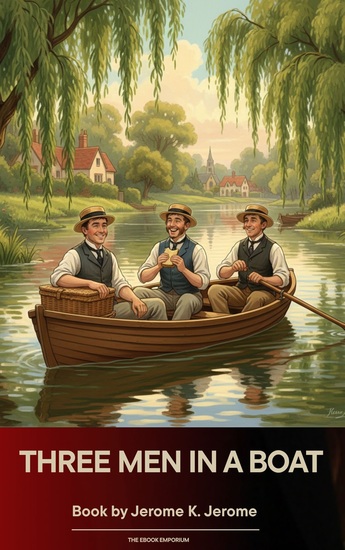
Meet J., Harris, and George—three quintessential Victorian gentlemen who convince themselves they are suffering from "overwork" and every malady in the medical dictionary (except housemaid's knee). Their cure? A leisurely rowing trip up the River Thames from Kingston to Oxford. Accompanied by the world's most cynical fox terrier, Montmorency, the trio embarks on a journey filled with disastrous cooking, tangled tow-lines, unreliable barometers, and the eternal struggle of opening a tin of pineapple without a tin-opener.

The Comedy of the Everyman: Jerome K. Jerome's genius lies in his ability to find the universal in the mundane. Whether it's the chaotic attempt to hang a picture by Uncle Podger or the legendary "Cheese" story that drives an entire train carriage to madness, the humor is as fresh and relatable today as it was in the 1880s.

A Love Letter to the Thames: Between the slapstick and the satire, the novel contains beautiful, lyrical descriptions of the river. It captures a specific moment in British history when the Thames was transitioning from a commercial highway to a place of leisure and "messing about in boats."

A Timeless Remedy for Stress: Three Men in a Boat remains the perfect antidote to the "seriousness" of modern life. It celebrates friendship, the absurdity of human nature, and the idea that the best stories come from the things that go spectacularly wrong.

Pack your bags (but leave the heavy cheeses behind). Purchase "Three Men in a Boat" today and laugh your way up the river.
Available since: 01/12/2026.
Print length: 213 pages.
Other books that might interest you

  • 3 Stories - Parents Losing a Child - A trio of classic tales perfect for a commute walk or quiet night in - cover

    3 Stories - Parents Losing a...

    Anton Chekhov, Guy de...

    • 0
    • 0
    • 0
    There is something about the number 3.    
     
    The Ancient Greeks believed 3 was the perfect number, and in China 3 has always been a lucky number, and they know a thing or two.   
     
    Most religions also have 3 this and 3 that and, of course, in these more modern times, three’s a crowd may be too many, except when it’s a ménage à trois.  It seems good things usually come in threes. 
     
    Whatever history and culture says WE think 3, a hat-trick of stories, is a great number to explore themes and literary avenues that classic authors were so adept at creating. 
     
    From their pens to your your ears. 
     
    01 - 3 Stories - Parents Losing A Child 
    02 - Silence by Leonid Nikolaevich Andreyev 
    03 - The Vendetta by Guy de Maupassant 
    04 - Misery by Anton Chekhov
    Show book
  • The Cats of Ulthar - From their pens to your ears genius in every story - cover

    The Cats of Ulthar - From their...

    HP Lovecraft

    • 0
    • 0
    • 0
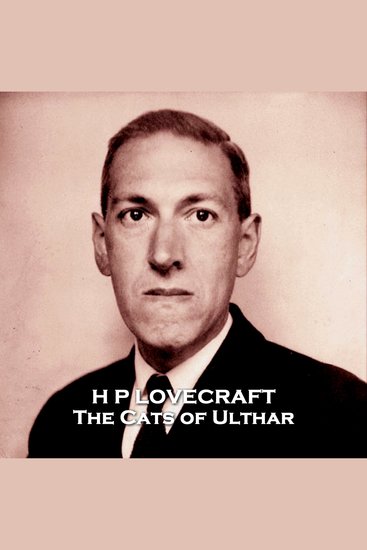
    Howard Phillips Lovecraft is among the greatest American masters of fantasy and the supernatural.  
    Born in 1890, a native of Providence, Rhode Island, his health was uncertain from childhood and he led a sheltered early life. His semi-invalidism enabled him to read omnivorously, and as a shy imaginative child he began to invent what would in his adult life become a whole macabre fantastic world of his own, peopled by creatures out of his own weird imagination.  
    As an adult he was retiring, almost a recluse. Tall, thin and pale, but with bright alert eyes, he was much given to wandering his native city in the dark hours of the night, and he became a devoted student of its antiquities.  
    Although he began to write early he had nothing published until he was in his twenties. He set many of his stories around the imaginary town of Arkham, and invented an entire mythology of his own, its core being the demoniac cult of Cthulhu, based on the lore or legend that the world was at one time inhabited by another race who, in practising black magic, lost their foothold or were expelled, yet live on outside, ever ready to take possession of this earth again. 
    Since his early death in 1937 his stories have continued to attract attention and praise from an ever-growing audience.
    Show book
  • Aloysha the Pot - From their pens to your ears genius in every story - cover

    Aloysha the Pot - From their...

    Leo Tolstoy

    • 0
    • 0
    • 0
    Leo Tolstoy was born in 1828 in the Russian province of Tula to a wealthy noble family. As a child, he had private tutors but he showed little interest in any formal education. When he went to the University of Kazan in 1843 to study oriental languages and law, he left without completing his courses.  Life now was relaxed and idle but with some writing also taking place.  Gambling debts forced an abrupt change of path and he joined the army to fight in the Crimean War.  He was commended for his bravery and promoted but was appalled at the brutality and loss of life.  He recorded these and other earlier experiences in his diaries which formed the basis of several of his works. 
    In 1852 ‘Childhood’ was published to immediate success and was followed by ‘Boyhood’ and ‘Youth’. 
    His experience in the army and the horrors he witnessed resulted in ‘The Cossacks’ in 1862 and the trilogy ‘Sevastopol Tales’. After the war he travelled around Europe, visiting London and Paris and meeting such luminaries as Victor Hugo and Charles Darwin.  
    It was now that Tolstoy began his masterpiece, ‘War and Peace’. Published in 1869 it was an epic work that changed literature. He quickly followed this with ‘Anna Karenina’.  
    These successes made Tolstoy rich and helped him accomplish many of his dreams but also brought problems as he grappled with his faith and the lot of the oppressed poor. These revolutionary views became so popular that the authorities now kept him under surveillance.  
    He led a life of asceticism and vegetarianism and put his socialist ideals into practice by establishing numerous schools for the poor and food programmes. He also believed in giving away his wealth, which caused much discord with his wife.  
    His writing continued to bring forth classics such as ‘The Death of Ivan Ilyich’ and many brilliant and incisive short stories such as ‘How Much Land Does A Man Need’.  
    In 1901 Tolstoy was excommunicated from the Church and controversially deselected for the Nobel Prize for Literature. 
    Whilst undertaking a pilgrimage by train in October 1910 with his daughter Aleksandra he caught pneumonia in the nearby town of Astapovo.  Leo Tolstoy died on November 9th, 1910, he was 82.
    Show book
  • Landor's Cottage - cover

    Landor's Cottage

    SAMPI Books, Edgar Allan Poe

    • 0
    • 0
    • 0
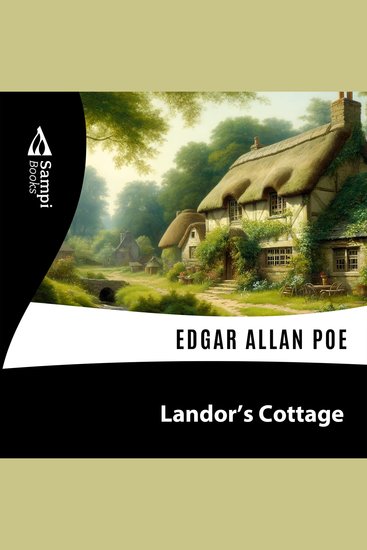
    "Landor's Cottage" is a short story by Edgar Allan Poe that describes in detail the bucolic landscape and architecture of a charming country house encountered by the narrator during a walk. The tale is notable for its rich visual description and serene atmosphere, contrasting with Poe's darker works.
    Show book
  • The Land of Mist - cover

    The Land of Mist

    Sir Aarthur Conan Doyl

    • 0
    • 0
    • 0
    From the creator of Sherlock Holmes, experience this close encounter with the supernatural. 
     
    Sir Arthur Conan Doyle’s novel The Land of Mist continues the story of the fictional character Professor George Edward Challenger. It follows the first two books of the Professor Challenger series, originally published in Strand Magazine in the early 20th century: The Lost World and The Poison Belt. 
     
    The first book in the series, The Lost World, introduced readers to the intriguing character of Professor Challenger on his expedition through the uncharted Amazon wilderness. Next, as The Poison Belt plunged the world into a cloud of poisonous ether, Professor Challenger sought refuge in a sealed room equipped with cylinders of oxygen. 
     
    In this third novel of the series, The Land of Mist reacquaints readers with Professor Challenger as an avid Spiritualist. When Professor Challenger and his friend Edward Malone investigate a haunted house in Derbyshire, England, the professor initially presents himself as a skeptic of psychic phenomena. However, he soon discovers that there is more to this world than meets the eye.
    Show book
  • Rudin - cover

    Rudin

    Ivan Turgenev

    • 0
    • 0
    • 0
    "Rudin" by Ivan Turgenev is a captivating and introspective novel that explores the complexities of human nature, love, and intellectual ideals in 19th-century Russia. Through the compelling character of Dmitry Rudin, Turgenev presents a profound examination of the clash between lofty ideals and the realities of life. With its lyrical prose and profound exploration of the human condition, "Rudin" serves as a timeless reflection on the complexities of human nature and the eternal quest for personal fulfillment. Turgenev's masterful storytelling and astute social commentary make this novel a compelling and thought-provoking work that continues to resonate with readers today.
    Show book