Join us on a literary world trip!
Add this book to bookshelf
Grey
Write a new comment Default profile 50px
Grey
Subscribe to read the full book or read the first pages for free!
All characters reduced
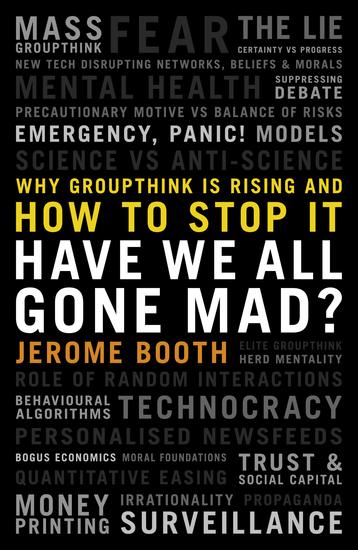
Have We All Gone Mad? Why groupthink is rising and how to stop it - Why groupthink is rising and how to stop it - cover

Have We All Gone Mad? Why groupthink is rising and how to stop it - Why groupthink is rising and how to stop it

Jerome Booth

Publisher: Biteback Publishing

  • 0
  • 0
  • 0

Summary

"With refreshingly clear-sighted analysis, Jerome Booth spells out how political, financial and social groupthink has damaged Britain – and, crucially, how we can tackle it. Highly recommended." – Liam Halligan, Daily Telegraph
"Most of the worst political decisions of recent years were made when all the mainstream politicians thought the same thing and no one challenged them. Jerome Booth wisely analyses why this situation happens so often and what can be done about it. Every politician and every decision-maker should read this book." – Lord Frost, former Cabinet Office minister
"It is a long time since I read a book with which I agreed so comprehensively." – Lord Lilley, former Secretary of State
***
We like to think of ourselves as rational, but human beings are fundamentally irrational creatures – and nowhere is that more apparent than in the fug of groupthink we see around us, from the boardroom to social media.
Of the various forms of collective irrationality, groupthink is particularly dangerous. It involves adherence to a faulty consensus, often has a binary moral dimension (one is seen as either virtuous or evil) and is sustained through fear to challenge. Counter-intuitively, the most intelligent and erudite amongst us are particularly susceptible, and when groupthink takes hold, vigorous efforts are made to shut down debate and to bully and punish transgressors.
As a result, toleration, liberalism, history, reason and science are under threat. Mass groupthink amongst both the elite and the masses affects millions of people. It has led to financial mismanagement leading up to the 2008 crisis and beyond; poor decision-making at the onset of Covid-19; exaggerated, unchallenged claims which have motivated nonsensical policies; and distortions in academia and journalism.
In this remarkable and prescient book, Dr Jerome Booth investigates why some of us have abandoned reason in favour of trite memes, intolerance and hatred. Have we all gone mad? Or can we identify the patterns and causes of what is happening and try to stop it?
Available since: 11/29/2022.
Print length: 320 pages.

Other books that might interest you

  • Superbloom - How Technologies of Connection Tear Us Apart - cover

    Superbloom - How Technologies of...

    Nicholas Carr

    • 0
    • 0
    • 0
    From the author of The Shallows, a bracing exploration of how social media has warped our sense of self and society. 
      
    From the telegraph and telephone in the 1800s to the internet and social media in our own day, the public has welcomed new communication systems. Whenever people gain more power to share information, the assumption goes, society prospers. Superbloom tells a startlingly different story. As communication becomes more mechanized and efficient, it breeds confusion more than understanding, strife more than harmony. Media technologies all too often bring out the worst in us. 
      
    A celebrated commentator on the human consequences of technology, Nicholas Carr reorients the conversation around modern communication, challenging some of our most cherished beliefs about self-expression, free speech, and media democratization. He reveals how messaging apps strip nuance from conversation, how “digital crowding” erodes empathy and triggers aggression, how online political debates narrow our minds and distort our perceptions, and how advances in AI are further blurring the already hazy line between fantasy and reality. Even as Carr shows how tech companies and their tools of connection have failed us, he forces us to confront inconvenient truths about our own nature. The human psyche, it turns out, is profoundly ill-suited to the “superbloom” of information that technology has unleashed. 
      
    With rich psychological insights and vivid examples drawn from history and science, Superbloom provides both a panoramic view of how media shapes society and an intimate examination of the fate of the self in a time of radical dislocation. It may be too late to change the system, Carr counsels, but it’s not too late to change ourselves.
    Show book
  • Dirtbag Massachusetts - A Confessional - cover

    Dirtbag Massachusetts - A...

    Isaac Fitzgerald

    • 0
    • 0
    • 0
    NEW YORK TIMES BESTSELLER 


    USA TODAY BESTSELLER 


    Winner of the New England Book Award for Nonfiction 


    "The best of what memoir can accomplish . . . pulling no punches on the path to truth, but it always finds the capacity for grace and joy." —Esquire, "Best Memoirs of the Year" 


    A TIME Best Book of the Season * A Rolling Stone Top Culture Pick * A Publishers Weekly Best Memoir of the Season * A Buzzfeed Book Pick * A Goodreads Readers' Most Anticipated Book * A Chicago Tribune Book Pick * A Boston.com Book You Should Read * A Los Angeles Times Book to Add to Your Reading List * An Entertainment Weekly Best Book of the Month 


    Isaac Fitzgerald has lived many lives. He's been an altar boy, a bartender, a fat kid, a smuggler, a biker, a prince of New England. But before all that, he was a bomb that exploded his parents' lives—or so he was told. In Dirtbag, Massachusetts, Fitzgerald, with warmth and humor, recounts his ongoing search for forgiveness, a more far-reaching vision of masculinity, and a more expansive definition of family and self. 


    Fitzgerald's memoir-in-essays begins with a childhood that moves at breakneck speed from safety to violence, recounting an extraordinary pilgrimage through trauma to self-understanding and, ultimately, acceptance. From growing up in a Boston homeless shelter to bartending in San Francisco, from smuggling medical supplies into Burma to his lifelong struggle to make peace with his body, Fitzgerald strives to take control of his own story: one that aims to put aside anger, isolation, and entitlement to embrace the idea that one can be generous to oneself by being generous to others. 


    Gritty and clear-eyed, loud-hearted and beautiful, Dirtbag, Massachusetts is a rollicking book that might also be a lifeline. 


    "Fitzgerald nestles comfortably on a bar stool beside writers like Kerouac, Bukowski, Richard Price and Pete Hamill . . . The book’s charm is in its telling of male misbehavior and, occasionally, the things we men get right. The fights nearly all come with forgiveness. It is about the ways men struggle to make sense of themselves and the romance men too often find in the bottom of a bottle of whiskey . . . an endearing and tattered catalog of one man's transgressions and the ways in which it is our sins, far more than our virtues, that make us who we are." —New York Times Book Review 


    "Isaac Fitzgerald's memoir-in-essays is a bighearted read infused with candor, sharp humor, and the hope that comes from discovering saints can be found in all sorts of places." —Rolling Stone, "Top Culture Picks of the Month" 


    "Dirtbag, Massachusetts is the best of what memoir can accomplish. It's blisteringly honest and vulnerable, pulling no punches on the path to truth, but it always finds the capacity for grace and joy." —Esquire, "Best Memoirs of the Year" 


    "Told without piety or violin strains of uplift, but rather, an embrace of the chaos of just getting by." —Chicago Tribune, "Books for Summer 2022: Our Picks" 


    "Fitzgerald reflects on his origins—and coming to terms with self-consciousness, anger, and strained family relationships. His writing is gritty yet vulnerable." —TIME, "27 New Books You Need to Read This Summer" 


    "Fitzgerald never stopped searching for a community that would embrace him. That search took him from San Francisco to Burma (now Myanmar), and he candidly shares the formative experiences that helped him put aside anger to live with acceptance and understanding." —Washington Post, "12 Noteworthy Books for July" 


    "Fitzgerald's project
    Show book
  • Days of the Week - cover

    Days of the Week

    Kim Mitzo Thompson, Karen Mitzo...

    • 0
    • 0
    • 0
    Kids will love this playful story as they learn the days of the week. Simple sentence structures and repetitive words will encourage young children to fall in love with learning to read.  Kids will enjoy following along word-for-word with the recorded story that features sound effects and professional voices to help children develop vocabulary and improve listening skills.  This reader features adorable art showing diversity to help children form a sense of acceptance and understanding of different races and individual differences.
    Show book
  • Let's Get Dressed - cover

    Let's Get Dressed

    Kim Mitzo Thompson, Karen Mitzo...

    • 0
    • 0
    • 0
    Kids will love this playful story about clothing words and learning what is appropriate to wear for different occasions. Simple sentence structures and repetitive words will encourage young children to fall in love with learning to read.  Kids will enjoy following along word-for-word with the recorded story that features sound effects and professional voices to help children develop vocabulary and improve listening skills.  This reader features adorable art showing diversity to help children form a sense of acceptance and understanding of different races and individual differences.
    Show book
  • Genocides - Historic Details of the Armenian Cambodian Rwandan Yugoslavian Sudanese and Nazi Genocide - cover

    Genocides - Historic Details of...

    Kelly Mass

    • 0
    • 0
    • 0
    This book consists of 6 topics, all selected to describe some of the worst atrocities of mankind: Genocides, mass rapes, abuse, mutilation and murder. It contains these topics: 
    Armenian Genocide: At the time of World War I, the Ottoman Empire committed the Armenian genocide, which led to the organized death of around one million ethnic Armenians. It was primarily achieved by mass executions, death marches resulting in the Syrian Desert, and the pushed Islamization of Armenian women and kids. 
    Cambodian Genocide: The Cambodian genocide was the methodical abuse and death of Cambodians by the Khmer Rouge, led by Pol Pot, the general secretary of the Communist Party of Kampuchea, who pushed Cambodia towards being an entirely self-dependent agrarian socialist state.  
    Genocide in Darfur: The Darfur genocide describes the methodical killing of ethnic Darfuri people in Western Sudan throughout the existing dispute. It's considered the first genocide of the twenty-first century. The International Bad Guy Court (ICC) has prosecuted many individuals for criminal offenses against mankind, rape, mass relocations and deportations, and abuse because of the genocide being committed. 
    Holocaust: At the time of WWII, the Holocaust, was a genocide of European Jews. Between 1941 and 1945, Nazi Germany and its allies killed around 6 million Jews in German-occupied Europe, representing about two-thirds of Europe's Jewish population. 
    Rwandan Genocide: Throughout the Rwandan Civil War, between April seventh and July fifteenth, 1994, the Rwandan genocide happened. Equipped militias murdered members of the Tutsi minority ethnic group, and some moderate Hutu and Twa. 
    Yugoslavian Genocide: Throughout the Bosnian War of 1992-- 1995, the Yugoslavian or Bosnian genocide describes either the Srebrenica massacre or the larger criminal activities against mankind in areas controlled by the Army of Republika Srpska (VRS).
    Show book
  • Home Bound - An Uprooted Daughter's Reflections on Belonging - cover

    Home Bound - An Uprooted...

    Vanessa A. Bee

    • 0
    • 0
    • 0
    In this memoir of identity and discovery, Vanessa A. Bee explores the way we define "home" and "belonging"—from her birth in Yaoundé, Cameroon, to her adoption, to experiencing housing insecurity in Europe and her eventual immigration to the US. After her parents' divorce, Vanessa traveled with her mother to Lyon and later to London, eventually settling in Reno, Nevada, as a teenager, right around the financial crisis and the collapse of the housing market. At twenty, still a practicing evangelical Christian and newly married, Vanessa applied to and was accepted by Harvard Law School, where she was one of the youngest members of her class. There, she forged a new belief system, divorced her husband, left the church, and pursued a career in economic justice upon graduation. 


    Vanessa's upbringing has caused her to grapple for years with foundational questions such as: What is home? Is it the country we're born in, the body we possess, or the name we were given and that identifies us? Is it the house we remember most fondly, the social status assigned to us, or the ideology we forge? What defines us and makes us uniquely who we are? 


    Vanessa tackles these timeless questions thematically and unpacks the many layers that contribute to and condition our understanding of ourselves and of our place in the world.
    Show book