Join us on a literary world trip!
Add this book to bookshelf
Grey
Write a new comment Default profile 50px
Grey
Subscribe to read the full book or read the first pages for free!
All characters reduced
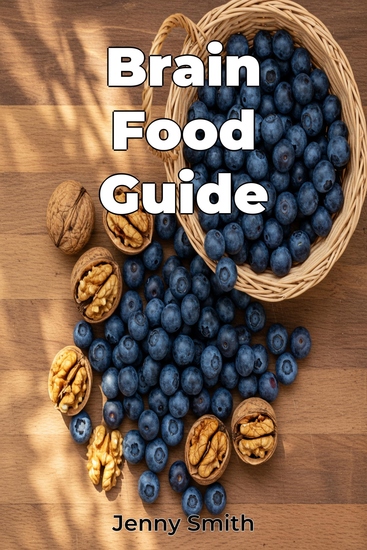
Brain Food Guide - cover

Brain Food Guide

Jenny Smith

Translator A AI

Publisher: Publifye

  • 0
  • 0
  • 0

Summary

Unlock your cognitive potential with "Brain Food Guide," a comprehensive exploration of how nutrition impacts brain health. This book dives into the connection between diet and cognitive function, offering practical dietary strategies to enhance memory, focus, and overall mental acuity. You'll discover the vital role of key nutrients like omega-3 fatty acids and antioxidants, learning how they support brain function and protect against neurodegenerative diseases.

 
Did you know that the gut microbiome profoundly influences brain health? Or that B vitamins are essential for cognitive processes? The book presents a progressive understanding of neuro-nutrition. It starts with fundamental concepts, then dedicates chapters to individual nutrients and food groups, detailing their mechanisms and cognitive benefits.

 
"Brain Food Guide" synthesizes this knowledge into actionable dietary plans and recipes designed to optimize cognitive performance. It distinguishes itself by taking an evidence-based approach, going beyond diet trends to focus on core scientific principles.

 
Finally, the book examines the implications of these nutritional strategies for diverse groups, including students, professionals, and older adults. By bridging the gap between scientific findings and dietary advice, "Brain Food Guide" empowers you to take control of your brain health through informed choices, providing a clear path to improved cognitive function and long-term well-being.
Available since: 02/27/2025.
Print length: 133 pages.
Other books that might interest you

  • In the Shadow of the Rising Sun - Surviving a Prisoner of War Childhood - cover

    In the Shadow of the Rising Sun...

    Olga Henderson

    • 0
    • 0
    • 0
    In February 1942, nine-year-old Olga Morris and her family were in Singapore when the city fell to the Japanese Imperial Army in the biggest defeat in history of the British Forces. Turned back at an evacuation ship’s gangway as the bombs fell, Olga and her parents and siblings were forced to take their chances and hide out until, captured by Japanese soldiers, they were sent on a forced march to the notorious Changi Prison. 
     
    There’s a certain stereotype of the British in Singapore in the ‘30s and early ‘40s, which Olga Morris – Henderson as she is now – definitely did not fit. Her family was not part of the privileged Raffles Hotel set, with their big houses and servants. Her father worked in construction. Olga and her siblings grew up in Johor Bahru, a diverse part of Malaya just across the causeway from Singapore, amongst children of all faiths and cultures. It was a very happy upbringing. 
     
    All that changed in 1942. Olga was playing with her guinea pigs when a British Army officer arrived to tell her parents that the family had just 30 minutes to pack and be ready for evacuation to Singapore. The Japanese were ten miles away. Olga’s mother grabbed the family photograph album and they ran… 
     
    Days later, Singapore fell. Three years of captivity followed. Three years of disease, malnutrition, deprivation and oppression in Changi and Sime Road. 
     
    Desperate for food, Olga and her friends bravely raided the vegetable plot; “dodging the searchlights” and sometimes endured severe punishments. She stood alongside the other women and children through the ordeal of Tenko in the blazing sun. Halfway through their captivity, Olga’s ten-year-old brother was put into the men’s camp, where he suffered terrible cruelty that scarred him for life. 
     
    February 2022 marked 80 years since the Fall of Singapore and Olga is now ready to tell the story of her years as a child prisoner of war. It’s a story of great fear and deprivation; of a childhood utterly lost to conflict. It’s also a story of class prejudice and unkindness that didn’t end when Olga was freed from the camp and returned to England as a refugee. 
     
    Yet moments of humour and camaraderie also live on in Olga’s memory. There were plays and imaginary tea parties and even a secret girl guide group that held clandestine meetings, where they worked on sewing a quilt.
    Show book
  • Rational Emotive Behavior Therapy - Thinking Rationally Living Freely - cover

    Rational Emotive Behavior...

    Vivian Westlake

    • 0
    • 0
    • 0
    Rational Emotive Behavior Therapy (REBT) is a cognitive-behavioral approach developed by Albert Ellis in the 1950s. It represents a revolutionary shift in the field of psychotherapy, aiming not just to alleviate symptoms, but to foster long-lasting change by helping individuals think and behave more rationally. The primary goal of REBT is to help people understand and identify irrational thoughts and beliefs that lead to emotional distress, then replace those beliefs with more rational, functional alternatives. 
    At its core, REBT rests on the idea that it is not the events themselves that disturb us, but our beliefs about those events. This concept is captured in the ABC model, a foundational element of REBT. According to the model, A stands for the activating event, or the situation that triggers a response. B represents the beliefs we hold about the activating event, which can be either rational or irrational. Finally, C stands for the emotional or behavioral consequences of those beliefs. By recognizing the link between beliefs and emotional outcomes, individuals can learn to challenge and change irrational thoughts that lead to unwanted feelings and behaviors. 
    REBT operates on the premise that people often hold onto irrational beliefs that are unrealistic, extreme, and unhelpful. These beliefs can be categorized into three core demands: the demand for approval from others, the demand for fairness or justice, and the demand for achievement and success. These irrational demands fuel negative emotions like anxiety, frustration, and depression, leading individuals to feel powerless or inadequate.
    Show book
  • Make Hollywood Great Again - Cinema in the Era of President Trump - cover

    Make Hollywood Great Again -...

    Michael Jolls

    • 0
    • 0
    • 0
    Hollywood and MAGA don’t get along. There are plenty of right wingers who won’t even touch this book because "Hollywood" is on the cover. Meanwhile, there are plenty of snowflake leftists who are fighting back tears because they assume this book is propaganda from “orange Thanos” to take over Tinseltown. And then there’s you, the American. Conservative or liberal, you realize that Hollywood and MAGA are at war with each other and that it’s a battle worth examining. Make Hollywood Great Again navigates through 2017 – 2020’s theatrical releases examining journalism, conspiracy and the media, as well as a bevy of other topics. Filmmakers have addressed their undesired tenet in the White House through a variety of stories, mostly non-fiction. The book privileges The Post, Blackkklansman, The Front Runner, Dark Waters, Richard Jewell, and The Hunt among others.
    Show book
  • Longing to Know - The Philosophy of Knowledge for Ordinary People - cover

    Longing to Know - The Philosophy...

    Esther Lightcap Meek

    • 0
    • 0
    • 0
    We don't often think about the act of knowing, but if we do, the question of what we know and how we know it becomes murky indeed. Longing to Know is a book about knowing: knowing how we know things, knowing how we know people, and knowing how we know God. 
    This book is for those who are considering Christianity for the first time, as well as Christians who are struggling with issues related to truth, certainty, and doubt. As such, it is a wonderful resource for evangelists, pastors, and counselors. This unique look at the questions of knowing is both entertaining and approachable. Questions for reflection make it ideal for students of philosophy and all those wrestling with the questions of knowledge.
    Show book
  • Women Victims of Hidden Abuse - Healing From Psychological and Emotional Abuse Suffered by Women Within Relationship - cover

    Women Victims of Hidden Abuse -...

    Jim Colajuta

    • 0
    • 0
    • 0
    Emotional abuse in intimate relationships is a serious issue because it is motivated by power and control rather than respect and love. They say that emotional abuse is the foundation or umbrella for all types of abuse, including physical and sexual abuse. Although emotional, psychological, and financial abuse is not illegal, it is a form of domestic violence that can lead to criminal abuse.  
    This book focuses on the emotional abuse experienced by victims who are women in a marriage or cohabiting relationship. This book aims to understand the dynamics within these relationships and the victimization process that occurs throughout these relationships. The book concludes with several recommendations for emotional abuse victims' healing.
    Show book
  • Why Can't I Just Enjoy Things? - A Comedian's Guide to Autism - cover

    Why Can't I Just Enjoy Things? -...

    Pierre Novellie

    • 0
    • 0
    • 0
    *Nominated for Best Book at the 2025 Chortle Awards*'Outstanding, I want to press it into the hands of every newly diagnosed person' Fern Brady'Like a Martian's guide to living on Earth. Funny, enlightening and gobsmacking' Frank Skinner 'A hilarious, crystal-clear guide to autism' Phil Wang'An illuminating and joyously entertaining book' Daily ExpressWhy were the other kids at school obsessed with Britney Spears instead of The Goon Show? Why don't people ever say what they mean? And... Why is everyone chewing so loudly?Comedian Pierre Novellie was on stage when a heckler suggested he was autistic. Usually, this disruption would be water off a duck's back but two things made this heckler different: first, he was himself autistic. Second, he turned out to be absolutely right.This random encounter led to a diagnosis of autism at the age of 31 that unravelled his world, explained his struggles and answered questions that had bothered him for his entire life. At once a hilarious and insightful journey through autism and neurodivergence, an entertaining explainer for the uninitiated and observational comedy for the neurodiverse, this is the perfect read for anyone who has ever asked themselves: why can't I just enjoy things?The audiobook includes an exclusive Q&A with comedian and BudPod co-host, Phil Wang.
    Show book