Join us on a literary world trip!
Add this book to bookshelf
Grey
Write a new comment Default profile 50px
Grey
Subscribe to read the full book or read the first pages for free!
All characters reduced
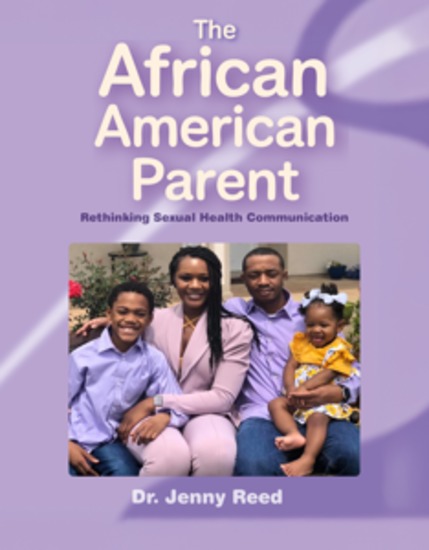
The African American Parent - Rethinking Sexual Health Communication - cover

The African American Parent - Rethinking Sexual Health Communication

Jenny Dr. Reed

Publisher: Spines

  • 0
  • 0
  • 0

Summary

Dr. Jenny Reed, author and researcher behind The African American Parent: Rethinking Sex Education, is a social worker and African American evangelical Christian with over 25 years of experience in public health and child welfare. Throughout her career, she has conducted numerous interviews with individuals connected to the child welfare system—foster parents, abused children, alleged perpetrators, pregnant teens, and young mothers. These conversations were often sex-negative in tone and revealed a striking pattern: highly religious African American parents rarely engaged in open, informed discussions about sex with their children.Dr. Reed recognized that religious culture plays a central role in how African American families approach sexual health, often emphasizing silence, shame, or abstinence over education and open dialogue. This cultural dynamic, she observed, sometimes hinders teens from developing healthy, informed sexual behaviors. While Dr. Reed initially attributed her own limited sex education to being raised in a conservative, baby boomer era, her research confirmed that minimal parent-teen communication persists even in today's information age, reinforcing generational cycles of misinformation and poor outcomes.In her public health role, Dr. Reed witnessed firsthand the negative consequences of these communication gaps. Many teens made risky sexual decisions—such as not using contraception—due to a lack of guidance from their parents. The cycle of teen pregnancy, particularly among African American youth, continued without interruption. Motivated by these experiences, Dr. Reed turned her attention to exploring how faith, morality, and sex education intersect within the African American evangelical community.
Available since: 06/24/2025.
Print length: 90 pages.

Other books that might interest you

  • Shakespeare Without a Life - cover

    Shakespeare Without a Life

    Margreta de Grazia

    • 0
    • 0
    • 0
    A fascinating account of how Shakespeare's works were understood and valued by readers and writers from the seventeenth to the nineteenth century, before Shakespeare's biography came to dominate readings of his plays and poetry. 


    For almost two centuries after his death, Shakespeare had no biography. The makings of one were not available. No chronology had been devised by which to coordinate the events in his life with the writing of his works. Nor was there an archive of primary materials on which to base a life. And the only work by Shakespeare written in the first person, the Sonnets, had yet to be critically edited and incorporated into the canon. Without a biography, how could Shakespeare have been valued and understood? 


    In Shakespeare Without a Life, Margreta de Grazia looks at aspects of Shakespeare's reception between 1600 and 1800 that have been all but lost to the now still prevailing biographical impulse. It recovers the anecdote as a form of literary criticism, retrieves the ancient category of genre as the canon's organizing rubric, demonstrates how the quest for authentic documents invalidated other forms of literary record, and reveals how the desire to forge connections between Shakespeare's life and the Sonnets occluded his self-presentation as the 'deceasèd I' of a posthumous poet.
    Show book
  • End of History and the Last Man The: Book Summary & Analysis - cover

    End of History and the Last Man...

    Briefly Summaries

    • 0
    • 0
    • 0
    This is a concise summary and analysis of The End of History and the Last Man, by  
    Francis Fukuyama.
     
    It is not the original book and is not affiliated with or endorsed by Francis Fukuyama.
     
    Ideal those seeking a quick and insightful overview.
    The End of History and the Last Man explores the profound idea that history, as a dynamic process driven by ideological conflict, may have reached its conclusion with the triumph of liberal democracy. Combining political philosophy, history, and sociology, this groundbreaking work examines how liberal democracy emerged as the dominant form of governance, its strengths and vulnerabilities, and whether human fulfillment can truly be achieved within this framework. The book delves into the implications of this "end of history," questioning whether material progress and individual freedoms are enough to satisfy the human desire for recognition, identity, and meaning.
    Show book
  • No Self No God No Clue - David Hume and the Joy of Destroying Everything - cover

    No Self No God No Clue - David...

    Sophia Blackwell

    • 0
    • 0
    • 0
    ohn Locke: Enlightenment philosopher, father of liberalism, inventor of “natural rights,” and accidental spiritual patron of land developers, libertarians, and your uncle who won’t shut up about property taxes. 
    In this gloriously sarcastic takedown of one of Western philosophy’s most over-quoted minds, Sophia Blackwell (Kant You Not, No Self, No God, No Clue) guides you through Locke’s greatest hits—including: 
    The blank slate theory, which basically says you’re born dumb and the world makes you worse 
    His ideas on identity, which collapse the second you forget your phone password 
    His version of consent, which mostly consists of “You didn’t leave, so I assume you’re fine with it.” 
    And of course, property rights—where mixing your labor with the earth somehow makes it yours, and stealing land becomes morally correct as long as you bring a shovel 
    Locke’s political philosophy inspired democracies, revolutions, and every 400-comment Reddit thread titled “Taxation is theft.” 
    This is not a respectful biography. 
    This is a roast. A eulogy. A survival guide for understanding how Locke gave us: 
    Liberalism 
    Landlords 
    Legal headaches 
    And a political system that thinks fencing off a patch of dirt = moral superiority 
    Perfect for: 
    Recovering philosophy students 
    Political skeptics 
    Enlightenment haters 
    Property law survivors 
    And anyone who wants to laugh while questioning whether government is just a giant metaphor for a really passive-aggressive roommate agreement 
    You don’t need to read Two Treatises of Government. 
    You just need to know Locke said, “I think I own that,” and people believed him.
    Show book
  • A People's Guide to Capitalism - An Introduction to Marxist Economics - cover

    A People's Guide to Capitalism -...

    Hadas Thier

    • 0
    • 0
    • 0
    A lively, accessible, and timely guide to Marxist economics for those who want to understand and dismantle the world of the 1%. 


    Economists regularly promote Capitalism as the greatest system ever to grace the planet. With the same breath, they implore us to leave the job of understanding the magical powers of the market to the "experts." 


    Despite the efforts of these mainstream commentators to convince us otherwise, many of us have begun to question why this system has produced such vast inequality and wanton disregard for its own environmental destruction. This book offers answers to exactly these questions on their own terms: in the form of a radical economic theory.
    Show book
  • Fewer Rules Better People - The Case for Discretion - cover

    Fewer Rules Better People - The...

    Barry Lam

    • 0
    • 0
    • 0
    A philosopher argues that the proliferation of rules and mandates is making us dumber, less moral, more deceptive, and less able to govern important institutions. 


    Wherever there's a rule, there is someone with the power to apply or ignore it—or add to it, in the interest of justice. From enforcing chores to issuing life sentences, decision-makers deliver flawed and sometimes arbitrary outcomes. But is their use of discretion good or bad overall? As a society, should we seek to minimize or maximize discretion, with all its potential for bias and other kinds of human error? 


    Reframing our understanding of justice and ethics, philosopher Barry Lam argues that while use of discretion—whether by a sports referee, a parent, a police officer, or a judge—can never be perfect, removing it has even more problematic effects. Mandatory arrests and sentencing laws have not eliminated bias, but have corrupted the courtroom, institutionalized lying, and brought about even more unjust and arbitrary results. Fewer Rules, Better People is a bold, riveting treatise that sheds new light on political debates about law and justice while aiming to prepare us for the imminent threat of more "perfect," discretion-less rule enforcement by AI.
    Show book
  • Learning Our Names - Asian American Christians on Identity Relationships and Vocation - cover

    Learning Our Names - Asian...

    Sabrina S. Chan, Linson Daniel,...

    • 0
    • 0
    • 0
    What's your name?
    Asian Americans know the pain of being called names that deny our humanity. We may toggle back and forth between different names as a survival strategy. But it's a challenge to discern what names reflect our true identities as Asian Americans and as Christians. In an era when Asians face ongoing discrimination and marginalization, it can be hard to live into God's calling for our lives.
    Asian American Christians need to hear and own our diverse stories beyond the cultural expectations of the model minority or perpetual foreigner. A team from East Asian, Southeast Asian, and South Asian backgrounds explores what it means to learn our names and be seen by God. They encourage us to know our history, telling diverse stories of the Asian diaspora in America who have been shaped and misshaped by migration, culture, and faith. As we live in the multiple tensions of being Asian American Christians, we can discover who we are and what God may have in store for us and our communities.
    Show book