Join us on a literary world trip!
Add this book to bookshelf
Grey
Write a new comment Default profile 50px
Grey
Subscribe to read the full book or read the first pages for free!
All characters reduced
The Complete Works - Enriched edition - cover

The Complete Works - Enriched edition

Jean-Jacques Rousseau

Translator Barbara Foxley, G. D. H. Cole, Samuel William Orson

Publisher: DigiCat

  • 0
  • 0
  • 0

Summary

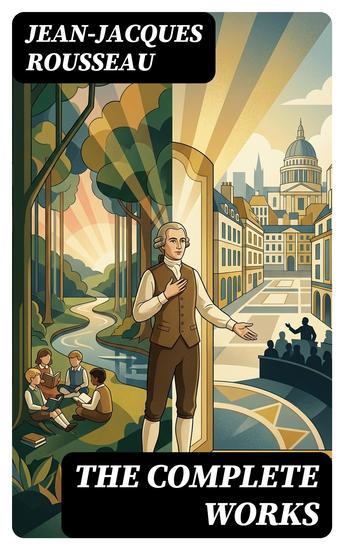
In "The Complete Works," Jean-Jacques Rousseau encapsulates his revolutionary thoughts that laid the groundwork for modern political philosophy and education theory. Spanning essays, treatises, and letters, this collection showcases Rousseau's lyrical prose and provocative ideas on nature, society, and individual freedom, particularly as expressed in seminal texts such as "The Social Contract" and "Emile, or On Education." Set against the backdrop of the Enlightenment, his work critically examines the tensions between civilization and natural human instincts, making it a cornerstone for subsequent thoughts on democracy, ethics, and personal identity. Rousseau, born in Geneva in 1712, lived through a period rife with intellectual upheaval. His varied background, from a humble education to a life filled with personal turmoil, deeply influenced his perspectives on social inequality and the inherent goodness of man. As a thinker, he challenged conventions, advocating for the emotional over the rational, ultimately positioning himself as a precursor to Romanticism. His unique voice combined with a profound understanding of human nature inspired generations of thinkers and activists, shaping philosophical and pedagogical discourses. This comprehensive volume is essential for scholars, students, and anyone keen to explore the depths of Rousseau's thought. By engaging with these works, readers will not only grasp the transformative ideas of Rousseau but also reflect on their resonance in contemporary society, making it a vital addition to any literary or philosophical collection.

In this enriched edition, we have carefully created added value for your reading experience:
- A comprehensive Introduction outlines these selected works' unifying features, themes, or stylistic evolutions.
- The Author Biography highlights personal milestones and literary influences that shape the entire body of writing.
- A Historical Context section situates the works in their broader era—social currents, cultural trends, and key events that underpin their creation.
- A concise Synopsis (Selection) offers an accessible overview of the included texts, helping readers navigate plotlines and main ideas without revealing critical twists.
- A unified Analysis examines recurring motifs and stylistic hallmarks across the collection, tying the stories together while spotlighting the different work's strengths.
- Reflection questions inspire deeper contemplation of the author's overarching message, inviting readers to draw connections among different texts and relate them to modern contexts.
- Lastly, our hand‐picked Memorable Quotes distill pivotal lines and turning points, serving as touchstones for the collection's central themes.
Available since: 10/11/2022.
Print length: 1434 pages.
Other books that might interest you

  • Hollywood’s Favorite Screwball Actresses: The Lives and Legacies of the Women Who Popularized the Comedy Genre - cover

    Hollywood’s Favorite Screwball...

    Editors Charles River

    • 0
    • 0
    • 0
    “If I couldn't laugh, I'd rather die.” – Claudette Colbert 
    The 1930s were the height of the classical Hollywood era, known for lavish studio productions by heavyweights like MGM, RKO, Warner Brothers, Paramount, and 20th Century Fox, which were operating at the height of their powers. Every major studio possessed a long roster of contract players, and films were released at such a rapid pace that it made for an especially competitive environment within the industry. Even while America remained in the throes of the Great Depression, the film industry continued to flourish, and movies easily supplanted the theater as the main attraction for American entertainment. Indeed, it would be no exaggeration to claim that the film industry reached its zenith during the decade precisely because it offered an affordable (if very temporary) escape from the anxieties of the economic woes of the era. 
    When the American Film Institute ranked its top 50 screen legends of the 20th century, many of the people named had careers spanning several decades, but one of them managed the feat despite living less than three decades. Ranked as the 22nd greatest actress of the 20th century, Jean Harlow was on the screen for less than 10 years, but in that time the “Blonde Bombshell” became the most popular actress of the 1930s, eclipsing superstars like Joan Crawford and Norma Shearer along the way. In fact, the platinum blonde accomplished that feat as a leading lady for just five years before her premature death of renal failure at the age of 26. 
    Carole Lombard has been memorialized in many fitting ways as an actress, and one of her biggest contributions to Hollywood was the blond archetype that the film industry used successfully for decades in screwball comedies, paving the way for the success of women like Marilyn Monroe. Perhaps the most remarkable aspect of that fact is that it was actually based on Carole’s gushing personality. 
    Show book
  • Secrets of the Sprakkar - Iceland’s Extraordinary Women and How They Are Changing the World - cover

    Secrets of the Sprakkar -...

    Eliza Reid

    • 0
    • 0
    • 0
    For the past twelve years, the World Economic Forum's Global Gender Gap Report has ranked Iceland number one on its list of countries closing the gap in equality between men and women. What is it about Iceland that makes many women's experience there so positive? Why has their society made such meaningful progress in this ongoing battle, from electing the world's first female president to passing legislation specifically designed to help even the playing field at work and at home? And how can we learn from what Icelanders have already discovered about women's powerful place in society and how increased fairness benefits everyone? 


    Eliza Reid, the First Lady of Iceland, examines her adopted homeland's attitude toward women—the deep-seated cultural sense of fairness, the influence of current and historical role models, and, crucially, the areas where Iceland still has room for improvement. Reid's own experience as an immigrant from small-town Canada who never expected to become a first lady is expertly interwoven with interviews with dozens of sprakkar ("extraordinary women") to form the backbone of an illuminating discussion of what it means to move through the world as a woman, and how the rules of society play more of a role in who we view as "equal" than we may understand.
    Show book
  • On the Duty of Civil Disobedience - cover

    On the Duty of Civil Disobedience

    Henry David Thoreau

    • 0
    • 0
    • 0
    Henry David Thoreau's essay, On the Duty of Civil Disobedience, is a masterful exploration of the moral imperative to resist unjust laws and unjust governmental systems. By deploying a carefully crafted philosophical argument, Thoreau contends that citizens have an obligation to disobey any law that violates their conscience or enshrines injustice. Read in English, unabridged.
    Show book
  • Heaven - cover

    Heaven

    Emerson Whitney

    • 0
    • 0
    • 0
    Emerson Whitney writes, "Really, I can't explain myself without making a mess." What follows is that mess-electrifying, gorgeous, defiant.
     
    At Heaven's center, Whitney seeks to understand their relationship to their mother and grandmother, those first windows into womanhood and all its consequences. Whitney retraces a roving youth in deeply observant, psychedelic prose-all the while folding in the work of thinkers like Judith Butler, Donna Haraway, and C. Riley Snorton-to engage transness and the breathing, morphing nature of selfhood.
     
    An expansive examination of what makes us up, Heaven wonders what role our childhood plays in who we are. Can we escape the discussion of causality? Is the story of our body just ours? With extraordinary emotional force, Whitney sways between theory and memory in order to explore these brazen questions and write this unforgettable book.
    Show book
  • Apocalypse of Mark - cover

    Apocalypse of Mark

    Caleb Deassis

    • 0
    • 0
    • 0
    The Apocalypse of Mark is a Christian book written in the ancient style of apocalyptic literature designed to read like a short narrative book one would find in the Bible, like Job, Ruth, or Esther. Narrator John Mark presents a linear retelling of the Biblical meta-narrative, heavily quoting from and alluding to the Biblical text. Beginning prior to creation and ending in the "new heavens and earth" incorporating enigmatic Biblical passages, it demonstrates how they are indispensable to the overall redemption story. The text also offers the reader hope by exposing the Gospel of Jesus as the central focus of God's relational plan. The text is packed with theological teachings and shows how they are all interconnected. The author began the project by trying to solve the question, "Where do demons come from?" Bolstered by years of research, he presents his findings in a creative and engaging narrative style.
    Show book
  • The Prison of Perspective - cover

    The Prison of Perspective

    Rudolph Bader

    • 0
    • 0
    • 0
    A chance encounter, a road accident, an air crash, a hold-up at a bank:How do such events connect people?How do people see the situations from their different perspectives?Three narrative strands follow the lives of three individuals – Peter, Cathy and Ivan – through the second half of the 20th century, from post-war austerity and mediocrity in the 1950s and 1960s to the fast-moving life-style of the present decade, whereby the plot is embedded in real events of the period. The three biographies intersect at crucial points, which reveals their internal landscapes and the different ways of understanding reality. Things are not always what they seem, and we do not always know the whole truth.Playing with various time-levels, this novel of the mind deals primarily with potential fallacies of perception, sexual awakening, emotional exploitation and the proximity of death.How do we store the memorable events in our lives?And how do we cope with these memories as we grow older?
    Show book