Join us on a literary world trip!
Add this book to bookshelf
Grey
Write a new comment Default profile 50px
Grey
Subscribe to read the full book or read the first pages for free!
All characters reduced
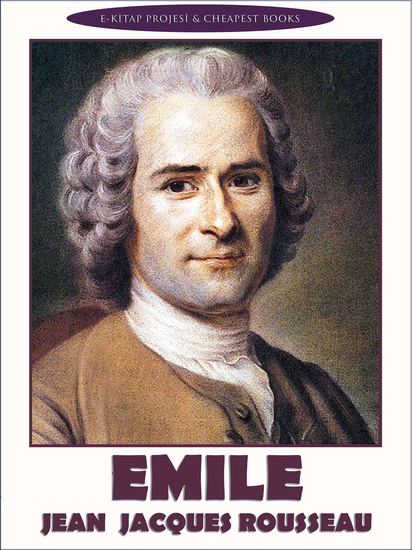
Emile - cover

Emile

Jean Jacques Rousseau, Barbara Foxley

Publisher: E-Kitap Projesi & Cheapest Books

  • 0
  • 0
  • 0

Summary

Emile, or On Education or Émile, Or Treatise on Education (French: Émile, ou De l'éducation) is a treatise on the nature of education and on the nature of man written by Jean-Jacques Rousseau, who considered it to be the "best and most important of all my writings".

Due to a section of the book entitled "Profession of Faith of the Savoyard Vicar," Emile was banned in Paris and Geneva and was publicly burned in 1762, the year of its first publication. During the French Revolution, Emile served as the inspiration for what became a new national system of education.

The work tackles fundamental political and philosophical questions about the relationship between the individual and society— how, in particular, the individual might retain what Rousseau saw as innate human goodness while remaining part of a corrupting collectivity.

Its opening sentence: "Everything is good as it leaves the hands of the Author of things; everything degenerates in the hands of man."

Rousseau seeks to describe a system of education that would enable the natural man he identifies in The Social Contract (1762) to survive corrupt society. He employs the novelistic device of Emile and his tutor to illustrate how such an ideal citizen might be educated. Emile is scarcely a detailed parenting guide but it does contain some specific advice on raising children.

It is regarded by some as the first philosophy of education in Western culture to have a serious claim to completeness, as well as being one of the first Bildungsroman novels, having preceded Goethe's Wilhelm Meister's Apprenticeship by more than thirty years.
Available since: 01/07/2024.
Print length: 400 pages.
Other books that might interest you

  • The Chimes - cover

    The Chimes

    Charles Dickens

    • 0
    • 0
    • 0
    The second in his series of "Christmas books," after A Christmas Carol. The Chimes is a lesser known, but no less powerful story by Charles Dickens of christmastime and the plight of the poor. Trotty Veck is a poor porter and father, who despairing of the poors lot, is shown a terrifying vision by the "Ghosts of the Chimes" of a world without him. 
    Narrated by Michael Ward.
    Show book
  • A Happy Ending - cover

    A Happy Ending

    Anton Chekhov

    • 0
    • 0
    • 0
    Lyubov Grigoryevna, a matchmaker, visits Stytchkin, the head guard, to discuss his desire to find a wife. Stytchkin is a practical and sober man who values inner qualities over external appearance in a woman.
    He wants a wife who respects him and appreciates the happiness he provides. Stytchkin does not want a wealthy bride, but also cannot marry a poor girl due to the cost of living and potential children.
    The matchmaker offers Stytchkin options of French and Greek brides, but he declines. Stytchkin is surprised by the matchmaker's fee of 25 rubles and considers it expensive.
    The matchmaker explains that earnings from matchmaking have decreased over time. Stytchkin compliments the matchmaker, suggesting she could find a practical husband for herself.
    Stytchkin reveals his salary and additional earnings from catching fare evaders. Stytchkin expresses his desire for a middle-aged wife with qualities similar to the matchmaker.
    The matchmaker giggles and eventually accepts Stytchkin's proposal. Stytchkin explains his expectations for his future wife, emphasizing his strict and respectable nature.
    Overall, the story portrays Stytchkin's search for a wife and his preferences for a practical and respectful partner. The matchmaker plays a role in facilitating this process, and Stytchkin ultimately proposes to her.
    Show book
  • A Christmas Inspiration - cover

    A Christmas Inspiration

    Lucy Maud Montgomery

    • 0
    • 0
    • 0
    Christmas is not in the lights, nor the gifts, nor the glittering decorations—it is in the hands that give, the hearts that open, the kindness that expects nothing in return. A Christmas Inspiration is a tale that shimmers with the quiet beauty of generosity, a story where one small act of warmth illuminates the season far brighter than any candle. With Montgomery's signature grace, the narrative unfolds like freshly fallen snow—soft, luminous, and filled with the hush of something deeply, unmistakably good. This is Christmas distilled to its essence: not what we receive, but what we choose to give.
    Show book
  • Middlemarch (Book 5: The Dead Hand) - cover

    Middlemarch (Book 5: The Dead Hand)

    George Eliot

    • 0
    • 0
    • 0
    Middlemarch (Book 5: The Dead Hand), A Study of Provincial Life is a novel by English author George Eliot, the pen name of Mary Ann Evans. It appeared in eight installments (volumes) in 1871 and 1872. Set in Middlemarch, a fictional English Midlands town, from 1829 to 1832, it follows distinct, intersecting stories with many characters. Issues include the status of women, the nature of marriage, idealism, self-interest, religion, hypocrisy, political reform, and education. Leavened with comic elements, Middlemarch approaches significant historical events in a realist mode: the Reform Act 1832, early railways, and the accession of King William IV. It looks at medicine of the time and reactionary views in a settled community facing unwelcome change. Eliot began writing the two pieces that formed the novel in 1869–1870 and completed it in 1871. Initial reviews were mixed, but it is now seen widely as her best work and one of the great English novels.
    Show book
  • Lot No 249 - cover

    Lot No 249

    Arthur Conan Doyle

    • 0
    • 0
    • 0
    "...he’s a man whom I, for one, would rather not know."  
    So says Abercrombie Smith's friend to him one night about the man in the room directly below his: Edward Bellingham.  
    But Smith soon finds himself drawn into the acquaintance of the strange, Egypt obsessed man, and his room full of strange antiquities... and especially the pride of Bellinghams collection: A well preserved mummy, known only by the title "Lot No 249"... And soon, Abercrombie Smith comes to understand just how right his friend was to warn him, and just what murderous powers Bellingham has in his thrall...  
    A short story of supernatural horror written by Arthur Conan Doyle, and narrated by Michael Ward.
    Show book
  • What Is Man? - cover

    What Is Man?

    Mark Twain

    • 0
    • 0
    • 0
    Locked in his desk for 25 years, What Is Man? was Twain's most serious, philosophical, and private work. The narrative appears in the form of a Socratic dialogue between a romantic young idealist and an elderly cynic. The pair debate issues of mankind, such as whether man is free to act or is more of a machine, whether personal merit is meaningless given how the environment shapes us, and if man truly has impulses other than to pursue pleasure and avoid pain. An unflinching critic of human affection, a bittersweet humorist, and a master of comic asides, Mark Twain speaks to us across time with verve and wisdom in this rare work. This recording is performed by comedy legend Carl Reiner, a recipient of the Kennedy Center's Mark Twain Prize for American Humor.
    Show book