Join us on a literary world trip!
Add this book to bookshelf
Grey
Write a new comment Default profile 50px
Grey
Subscribe to read the full book or read the first pages for free!
All characters reduced
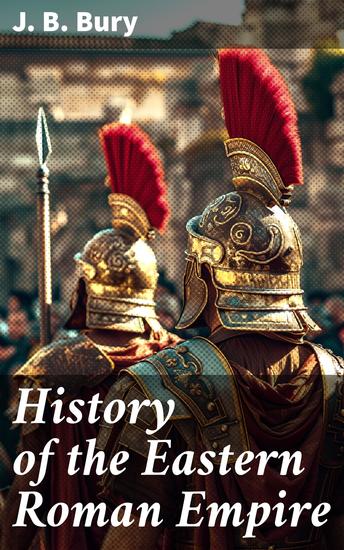
History of the Eastern Roman Empire - From the Fall of Irene to the Accession of Basil I - cover

History of the Eastern Roman Empire - From the Fall of Irene to the Accession of Basil I

J.B. Bury

Publisher: Good Press

  • 0
  • 0
  • 0

Summary

In 'History of the Eastern Roman Empire', J. B. Bury presents a comprehensive and meticulously researched account of the Byzantine Empire from its inception to its decline. Written in a narrative style that seamlessly intertwines historical analysis with engaging storytelling, Bury employs a broad scholarly approach, emphasizing political, military, and cultural developments while remaining accessible to both specialists and general readers. The work serves as both a continuation and a critical reevaluation of classical scholarship, expanding upon themes introduced in earlier historical texts and situating the Eastern Roman Empire within the larger context of European history and its legacy. J. B. Bury, a distinguished historian and scholar of late antiquity, was deeply influenced by the prevailing academic discourse of his time, which emphasized the evolution of civilizations. His background in classical studies and his commitment to rigorous primary source analysis informed his approach to writing this book. Bury'Äôs aim was not only to document the rich history of the Eastern Roman Empire but also to shed light on its significance in shaping modern Europe and the Mediterranean world. This book is highly recommended for anyone interested in Byzantine history, as it offers invaluable insights into an often-overlooked era. Readers will find Bury's work an essential resource, rich in detail and infused with scholarly rigor, engagingly illuminating the complexities of the Eastern Roman Empire's political, social, and cultural landscape.
Available since: 12/03/2023.
Print length: 310 pages.

Other books that might interest you

  • Ashanti Empire - Kingdom of the Golden Stool - cover

    Ashanti Empire - Kingdom of the...

    Rolf Hedger

    • 0
    • 0
    • 0
    The Ashanti Empire, flourishing from the 17th to the 19th century in what is now Ghana, stands as a testament to the resilience and sophistication of African states. This powerful kingdom was established through a unique blend of indigenous cultural traditions and political innovations, creating a centralized authority that not only governed a vast territory but also unified diverse ethnic groups under a single national identity. At the heart of this unity was the revered Golden Stool, a symbol of divine providence and the collective spirit of the Ashanti people. 
    Emerging from a landscape rich in natural resources and strategic trade routes, the Ashanti Empire developed robust economic foundations. Gold, kola nuts, and other valuable commodities flowed through well-established networks, facilitating both internal prosperity and external exchanges with neighboring regions and distant trading partners. This economic strength enabled the empire to invest in military expansion and administrative structures that further consolidated its power. 
    The political organization of the Ashanti Empire was characterized by a sophisticated hierarchy led by the Asantehene, whose authority was both political and spiritual. This dual role was crucial in maintaining social order and ensuring loyalty among the various clans and communities within the empire. The administration was further supported by councils of elders and local chiefs, who played significant roles in the governance process by mediating disputes and enforcing the laws that held the society together.
    Show book
  • The Divine Comedy - Exploring the Mythic Landscapes of Dante's Vision - cover

    The Divine Comedy - Exploring...

    Odessa Nightshade

    • 0
    • 0
    • 0
    Few works in literary history have shaped the cultural and spiritual imagination of the Western world as profoundly as *The Divine Comedy*. Written in the early 14th century by the Florentine poet Dante Alighieri, this epic journey through Hell, Purgatory, and Paradise is more than just a tale of the afterlife—it is a meditation on justice, redemption, and the human soul’s search for divine truth. As both a poet and a visionary, Dante crafted a work that bridges medieval theology, classical influences, and deeply personal reflections, creating a narrative that continues to resonate with readers across centuries.  
      
    To fully appreciate *The Divine Comedy*, it is essential to understand the world that shaped Dante and the literary traditions that influenced him. Born in 1265, Dante lived in a politically tumultuous Italy, marked by factional strife between the Guelphs and Ghibellines, conflicts that would deeply impact his life and writing. Exiled from his native Florence, he poured his exile’s anguish and his longing for justice into the verses of *The Divine Comedy*, transforming personal suffering into an allegorical masterpiece. His work reflects not only his political frustrations but also his devotion to philosophy, theology, and the poetic traditions of Virgil and the classical world.  
      
    At its core, *The Divine Comedy* is an allegory of the soul’s journey toward God. Each of its three realms—*Inferno*, *Purgatorio*, and *Paradiso*—represents stages of moral and spiritual transformation. *Inferno* exposes the consequences of sin, *Purgatorio* explores the trials of purification, and *Paradiso* reveals the ultimate joy of divine enlightenment. This structure serves not only as a vivid depiction of the afterlife but also as a guide for readers seeking moral and spiritual understanding in their own lives. 
    Show book
  • NASA’s Deadly Accidents - The History of the Disasters that Killed 17 Astronauts - cover

    NASA’s Deadly Accidents - The...

    Charles River Editors

    • 0
    • 0
    • 0
    As Apollo 11’s name suggests, there were actually a number of Apollo missions that came before, many of which included testing the rockets and different orbital and lunar modules in orbit. In fact, it wasn’t until Apollo 8 that a manned vehicle was sent towards the Moon and back, and before that mission, the most famous Apollo mission was Apollo 1, albeit for all the wrong reasons.  
    There were no delusions regarding the dangers of manned space travel, but they were brought home on January 27, 1967, when all three astronauts were killed by a fire that ignited in the cabin during a launch rehearsal. To this day, there is still debate over what ignited the fire, but the disaster made clear that the modules being used by NASA had a series of fatal flaws.  
    	In the decades after the Apollo program, American space shuttles flew over 130 missions and successfully completed over 98% of them, but unfortunately, the two most famous missions were the ones that ended tragically aboard the Challenger and Columbia. The Space Shuttle Challenger was the most heavily used space shuttle in the three years it was operational, carrying the first minority astronaut and woman astronaut into space. Challenger was also the first space shuttle to complete a landing at night.  
    	The notorious date of the Challenger disaster was commemorated by the crew of the Columbia while they were in space in 2003, and a few days later, on February 1, the Columbia was due to land at the Kennedy Space Center in Florida at 09:16. Only a few members of the press were present to watch the landing - this was, after all, supposed to be a routine return from a routine mission, the 113th for the shuttle program and the 28th for Columbia, one of the oldest Space Shuttles.
    Show book
  • Meditations: Book Summary & Analysis - cover

    Meditations: Book Summary &...

    Briefly Summaries

    • 0
    • 0
    • 0
    This is a concise summary and analysis of Meditations, by Marcus Aurelius.
     
    It is not the original book and is not affiliated with or endorsed by Marcus Aurelius.
     
    Ideal those seeking a quick and insightful overview.
     
    Meditations is a timeless collection of personal reflections from a Roman emperor and Stoic philosopher. Written as a private journal, it explores themes of self-discipline, resilience, and the pursuit of virtue. These meditations offer profound insights into human nature, the importance of rational thinking, and living in harmony with the universe. Grounded in Stoic philosophy, this classic work continues to inspire readers to find peace and purpose in an unpredictable world.
    Show book
  • Brandy Station and the March to Gettysburg: The History of the Confederate Invasion of Pennsylvania Before the Biggest Battle of the Civil War - cover

    Brandy Station and the March to...

    Editors Charles River

    • 0
    • 0
    • 0
    As Lee’s army moved into Pennsylvania, Stuart’s cavalry screened his movements, thereby engaging in the more traditional cavalry roles, but it’s widely believed that he was still smarting over the results of June 9. As a result, many historians think it likely that he had already planned to remove the negative effect of Brandy Station by duplicating one of his now famous rides around the enemy army, much as he did to McClellan’s Army of the Potomac during the Peninsula Campaign in 1862. This time, however, as Lee began his march north through the Shenandoah Valley in western Virginia, it is highly unlikely that is what he wanted or expected. 
    To complicate matters even more, as Stuart set out on June 25 on what was probably a glory-seeking mission, he was unaware that his intended path was blocked by columns of Union infantry that would invariably force him to veer farther east than he or Lee had anticipated. Ultimately, his decision would prevent him from linking up with Ewell as ordered and deprive Lee of his primary cavalry force as he advanced deeper and deeper into unfamiliar enemy territory. According to Halsey Wigfall (son of Confederate States Senator Louis Wigfall) who was in Stuart’s infantry, “Stuart and his cavalry left [Lee’s] army on June 24 and did not contact [his] army again until the afternoon of July 2, the second day of the [Gettysburg] battle.” 
    As it would turn out, Lee’s army inadvertently stumbled into Union cavalry and then the Union army at Gettysburg on the morning of July 1, 1863, unaware of the force in their front. From July 1-3, Lee’s army tried everything in its power to decisively defeat George Meade’s Union Army of the Potomac, unleashing ferocious assaults that inflicted nearly 50,000 casualties in all. Lee would try and fail to dislodge the Union army with attacks on both of its flanks during the second day and Pickett’s Charge on the third and final day. 
    Show book
  • Book Everyone With Adult ADHD Needs (2 in 1) The: Written For Neurodiverse Men & Women To Stay Organized Succeed In Relationships Work & At Home & Embrace Themselves (Self Care) - cover

    Book Everyone With Adult ADHD...

    Natalie M. Brooks

    • 0
    • 0
    • 0
    If You've Longed To Break Free From The Chains Of Your Past, Overcome Obstacles, And Unleash The Inner Peace You Deserve, Then This 2-In-1 Practical Bundle Is Your Guiding Light!  
    Packed with over 100 exercises, strategies, and practices, along with 10+ hours of transformative teachings, this bundle is not just theory—it's a practical guide designed to kickstart your healing journey today. 
    You deserve to embark on a path of healing, and we are committed to helping you achieve that. 
    .Inside, You'll Discover… 
    Book 1 -The Book Women With Adult Adhd NeedThe 7 Essential Ways To Navigate The Realms Of Your Subconscious And Initiate Powerful Shadow WorkThe 4 Key Insights You Should Know About Self-Love And Healing Through Shadow WorkUnveiling Why Certain Approaches That Seem Right Are Actually Hindering Your Progress—And What To Do InsteadA Unique Trick Used By Renowned Therapists And Spiritual Leaders, Guiding You To Delve Into Your Shadow Self 
    Book 2 - The Book Men With Adult Adhd NeedA Unique Trick Used By Renowned Therapists And Authorities In The Field, Assisting You In Delving Into Your Inner ChildThe Biggest Mistake People Make In Their Inner Child Healing Journey And How To Avoid ItThe 7 Essential Steps To Actually Healing Your Inner Child And Releasing The Trauma Within You50 Exercises You Can Start Using Today To Supercharge Your Healing Journey 
    Imagine Gaining Over 10 Hours Of Teachings That Will Empower You To Become Your Best Version By Healing Your Subconscious Trauma And Unleashing The Inner Peace You Desire. The Time For Transformation Is Now! 
    Scroll Up And Click "Buy This Book" To Begin Your Transformative Journey Today!
    Show book