Join us on a literary world trip!
Add this book to bookshelf
Grey
Write a new comment Default profile 50px
Grey
Subscribe to read the full book or read the first pages for free!
All characters reduced
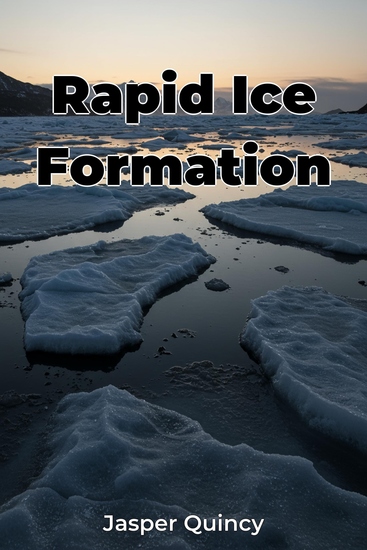
Rapid Ice Formation - cover

Rapid Ice Formation

Jasper Quincy

Translator A AI

Publisher: Publifye

  • 0
  • 0
  • 0

Summary

Rapid Ice Formation explores the science and practical challenges of sudden ice development in extreme cold environments, a phenomenon impacting travel, rescue operations, and cold-weather engineering. It highlights the factors contributing to rapid ice formation, such as supercooling and nucleation, which can quickly turn calm waters into perilous ice sheets. Understanding these processes is crucial for effective risk management in polar regions and during cold-weather disasters, as rapid icing can severely impede transportation and emergency response efforts.

 
The book examines the environmental conditions that lead to rapid ice formation, the effects of ice accumulation on vehicle performance and navigation, and the challenges faced by search and rescue teams. It uses real-world examples and case studies to illustrate key concepts and provides guidance for risk assessment, mitigation strategies, and equipment selection.

 
By combining scientific analysis with practical advice, Rapid Ice Formation offers actionable strategies for enhancing safety and operational effectiveness in freezing conditions, making it a valuable resource for professionals working or traveling in cold regions. The book progresses logically, first establishing the scientific principles behind rapid ice formation, then moving to practical implications for travel and rescue, and concluding with guidelines for risk assessment and mitigation. This approach ensures readers gain a comprehensive understanding of the dangers and how to navigate them.
Available since: 04/07/2025.
Print length: 126 pages.


Other books that might interest you

  • The Petroleum Papers - Inside the Far-Right Conspiracy to Cover Up Climate Change - cover

    The Petroleum Papers - Inside...

    Geoff Dembicki

    • 0
    • 0
    • 0
    Burning fossil fuels will cause catastrophic global warming: this is what top American oil executives were told by scientists in 1959. But they ignored that warning. Instead, they developed one of the biggest, most polluting oil sources in the world—the oil sands in Alberta, Canada. As investigative journalist Geoff Dembicki reveals in this explosive book, the decades-long conspiracy to keep the oil sands flowing into the US would turn out to be one of the biggest reasons for the world's failure to stop the climate crisis. 


    In The Petroleum Papers, Dembicki draws from confidential oil industry documents to uncover for the first time how companies like Exxon, Koch Industries, and Shell built a global right-wing echo chamber to protect oil sands profits—a misinformation campaign that continues to this day. He also tells the high-stakes stories of people fighting back: a Seattle lawyer who brought down Big Tobacco and is now going after Big Oil, a Filipina activist whose family drowned in a climate disaster, and a former Exxon engineer pushed out for asking hard questions. 


    With experts now warning we have less than a decade to get global emissions under control, The Petroleum Papers provides a step-by-step account of how we got to this precipice—and the politicians and companies who deserve our blame.
    Show book
  • Paleozoic Era The: The History of the Geologic and Evolutionary Changes that Began Over 500 Million Years Ago - cover

    Paleozoic Era The: The History...

    Editors Charles River

    • 0
    • 0
    • 0
    The current view of science is that Earth is around 4.6 billion years old, and the first 4 billion years of its development are known as the Precambrian period. For the first billion years or so, there was no life in Earth. Then the first single-celled life-forms, early bacteria and algae, began to emerge. It’s unclear where they came from or even if they originated on this planet at all, but this gradual development continued until around four billion years ago when suddenly (in geological terms) more complex forms of life began to emerge.  
    	Scientists call this time of an explosion of new forms of life the Paleozoic Era, and it stretched from around 541 to 250 million years ago. In the oceans and then on land, new creatures and plants began to appear in bewildering variety, and by the end of this period, life on Earth had diversified into a myriad of complex forms that filled virtually every habitat and niche available in the seas and on the planet’s only continent, Pangea. 
    	The Precambrian Period is divided into three eons: the Hadean, the Archaean, and the Proterozoic. One layer of carbon in rocks that date to the Archaean Eon, found on islands west of Greenland, seems to have fossilized tracks that may have been left by some form of organic life, but scientists simply are not certain. The oldest confirmed remains of life date from the same eon and were found in rocks in Western Australia, which were found to contain fossilized bacteria estimated to be 3.46 billion years old. It seems likely that there were thousands, perhaps even millions of forms of life in these early periods, and most seem to have been microscopic in size and very simple in developmental terms.
    Show book
  • Transform Your Grade: Secrets to Effortless AP Physics Success - "Achieve effortless AP Physics mastery with our engaging audio lessons designed for top grades!" - cover

    Transform Your Grade: Secrets to...

    Caelan Drummore

    • 0
    • 0
    • 0
    Transform Your Grade: Secrets to Effortless AP Physics Success 
    Are you eager to advance in your studies and solidify your understanding by excelling in AP Physics? 
    In search of a comprehensive resource that covers all the essentials for mastering this subject? 
    Look no further! 
    This guide acts as your ultimate companion for deepening your comprehension, applying your knowledge, and engaging in practical exercises. With this resource, you're set for achievement. 
    Updated to reflect the latest AP Physics exam structure. 
    Key features of this enhanced guide: 
    - In-depth insights into AP Physics concepts 
    - Clear explanations of fundamental physics principles 
    - Effective strategies for exam preparation and problem-solving techniques 
    What sets our guide apart is its thorough coverage, which is crucial for your success. Concepts are explored in-depth, ensuring a clear understanding rather than superficial treatment. 
    This guide is an independent resource created solely for your benefit and is not affiliated with any official AP organization. 
    Crafted with a logical structure and straightforward language, our AP Physics Success Guide ensures smooth transitions between topics. Bid farewell to complex jargon and embrace clear, precise, and technically accurate content. 
    So, why delay? Click the BUY NOW button, secure your guide, and embark on your journey toward effortless success in AP Physics!
    Show book
  • Structuring Inequality - How Schooling Housing and Tax Policies Shaped Metropolitan Development and Education - cover

    Structuring Inequality - How...

    Tracy L. Steffes

    • 0
    • 0
    • 0
    How inequality was forged, fought over, and forgotten through public policy in metropolitan Chicago. As in many American metropolitan areas, inequality in Chicagoland is visible in its neighborhoods. These inequalities are not inevitable, however. They have been constructed and deepened by public policies around housing, schooling, taxation, and local governance, including hidden state government policies.In Structuring Inequality, historian Tracy L. Steffes shows how metropolitan inequality in Chicagoland was structured, contested, and naturalized over time even as reformers tried to change it through school desegregation, affordable housing, and property tax reform. While these efforts had modest successes in the city and the suburbs, reformers faced significant resistance and counter-mobilization from affluent suburbanites, real estate developers, and other defenders of the status quo who defended inequality and reshaped the policy conversation about it. Grounded in comprehensive archival research and policy analysis, Structuring Inequality examines the history of Chicagoland’s established systems of inequality and provides perspective on the inequality we live with today.
    Show book
  • AI for Beginners - A Complete Guide for Educators and Students - cover

    AI for Beginners - A Complete...

    Kronborg Books

    • 0
    • 0
    • 0
    Accelerate your teaching with AI in less than 30 days, even if you've never touched a code! 
    Introducing AI for Beginners, a groundbreaking guide designed to simplify AI by balancing theoretical understanding with practical application, ultimately empowering you to transform your teaching strategies. 
    Inside AI for Beginners, you’ll discover: 
    ●	ten straightforward explanations of AI concepts, breaking down technical jargon into understandable language 
    ●	the blueprints for five AI in-class projects across different subjects, equipping you to bring theory into practice 
    ●	five budget-friendly AI tools you can start using in your classroom today 
    ●	strategies to sync with AI trends and inclusive AI tools that are reshaping education 
    ●	the secrets behind creating personalized learning experiences with AI that cater to diverse students 
    ●	twenty expert interviews providing varied perspectives on AI in education 
    ●	AI's role in grading assessments, providing accurate, timely, and fair student evaluation 
    ●	guidance on measuring the impact of AI on student learning and engagement 
    ●	ten inspiring examples of AI's successful application across classrooms worldwide 
    Whether you’re a student looking to leverage AI in your studies, or an educator worried about technical jargon, complex implementation, and ethical dilemmas, this book ensures that you’ll be catered for! Our guidelines are simple and easily executable, even including a variety of ready-to-use lesson plans spanning different subjects and age groups. 
    It’s time to step into the future of education and teach with confidence in this AI-driven world. Read AI for Beginners now!
    Show book
  • Environmental and Geological Sciences - Forces Shaping the World (3 in 1) - cover

    Environmental and Geological...

    Mike Crawford

    • 0
    • 0
    • 0
    Environmental and Geological Sciences: Forces Shaping the World is a comprehensive guide that examines the dynamic processes and forces responsible for shaping our planet. This 3-in-1 volume delves into the study of Seismology, Volcanology, and Limnology, providing readers with essential knowledge of how natural forces affect the Earth’s surface and its ecosystems. 
    In the first section, Seismology, readers will explore the science of earthquakes, the forces that generate seismic waves, and the tools used to measure and understand these powerful events. This section discusses the Earth’s internal structure, plate tectonics, and how seismic activity is monitored to predict and mitigate the impact of earthquakes, ultimately highlighting the influence of seismic forces on the environment. 
    Next, Volcanology offers an in-depth look at the study of volcanoes and volcanic activity. This section covers the geological processes that lead to the formation and eruption of volcanoes, as well as the environmental and societal consequences of volcanic events. Readers will gain insight into the types of volcanic eruptions, lava flows, and the role of volcanoes in shaping the Earth's landscapes over time. 
    The final section, Limnology, focuses on the study of inland aquatic environments, particularly lakes and rivers. Limnology explores the physical, chemical, and biological characteristics of freshwater ecosystems, as well as the human impact on these vital resources. From the study of water quality to the management of freshwater habitats, this section offers essential insights into how freshwater environments are influenced by natural processes and human activities.
    Show book