Join us on a literary world trip!
Add this book to bookshelf
Grey
Write a new comment Default profile 50px
Grey
Subscribe to read the full book or read the first pages for free!
All characters reduced
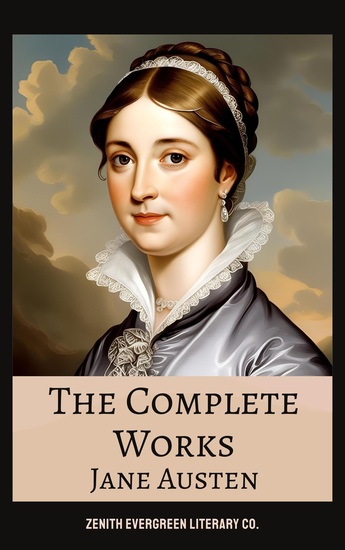
The Complete Works of Jane Austen - Timeless Classics of Love Wit and Social Intrigue in One Elegant Collection - cover

The Complete Works of Jane Austen - Timeless Classics of Love Wit and Social Intrigue in One Elegant Collection

Jane Austen, Zenith Evergreen Literary Co.

Publisher: Zenith Evergreen Literary Co.

  • 0
  • 0
  • 0

Summary

Step into the world of regency romance and razor-sharp social commentary with the unforgettable works of Jane Austen—now collected in one stunning volume.

From the enduring charm of Pride and Prejudice to the quiet brilliance of Persuasion, Jane Austen's novels remain literary treasures that have captivated readers for generations. This complete collection includes all six of her classic novels: Sense and Sensibility, Pride and Prejudice, Mansfield Park, Emma, Northanger Abbey, and Persuasion—as well as lesser-known gems and bonus material.

Whether you're new to Austen or a lifelong admirer, her wit, wisdom, and insight into the human heart will leave you enchanted.

🎖️ Reader Acclaim:
"Austen's genius is eternal—this collection is the perfect keepsake."
"I've read Pride and Prejudice ten times and it never gets old."
"One of the best literary investments I've ever made."

Perfect for fans of historical fiction, classic romance, and brilliant female authors, this collection is a must-have addition to any Kindle library.

📥 Get your complete Jane Austen experience—download now and enter a world of elegance, emotion, and enduring love.
Available since: 04/30/2025.
Print length: 2528 pages.

Other books that might interest you

  • Gulli Danda: MyStoryGenie Hindi Audiobook Album 2 - The Tip-cat Buddies - cover

    Gulli Danda: MyStoryGenie Hindi...

    Munshi Premchand

    • 0
    • 0
    • 0
    Gulli Danda is the story of the annals of time that reverberates in our deep consciousness, where both joy and sadness of the bygone days nurture our memories of the time spent well and its association. Humans outgrow their past, but that past remains rooted in their psyche and keeps drawing them back into its fold as their hearts try to reclaim the magical touch of the moments well past. 
    In this story, legendary litterateur Munshi Premchand, with his characteristic empathetic writing skill, weaves together two yesteryear friends from distinctly differing socio-economic backgrounds. The story unfolds like a thought experiment as it probes the bonding of the two primitive hearts through the filter of social status and class standing in the present. Need we say this literary gem is a collector's souvenir as a testament to a prolific writer's contribution to Hindi literature? 
    Discover many more such Hindi & Bengali audio stories by typing mystorygenie in the search bar without leaving any space between the different English alphabets.
    Show book
  • Grimm's Fairy Tales (Unabridged) - cover

    Grimm's Fairy Tales (Unabridged)

    Brothers Grimm

    • 0
    • 0
    • 0
    Grimms' Fairy Tales, originally known as the Children's and Household Tales, is a German collection of fairy tales by the Grimm brothers or "Brothers Grimm", Jacob and Wilhelm, first published on 20 December 1812. This edition contained 62 stories.
    Show book
  • Aloysha the Pot - From their pens to your ears genius in every story - cover

    Aloysha the Pot - From their...

    Leo Tolstoy

    • 0
    • 0
    • 0
    Leo Tolstoy was born in 1828 in the Russian province of Tula to a wealthy noble family. As a child, he had private tutors but he showed little interest in any formal education. When he went to the University of Kazan in 1843 to study oriental languages and law, he left without completing his courses.  Life now was relaxed and idle but with some writing also taking place.  Gambling debts forced an abrupt change of path and he joined the army to fight in the Crimean War.  He was commended for his bravery and promoted but was appalled at the brutality and loss of life.  He recorded these and other earlier experiences in his diaries which formed the basis of several of his works. 
    In 1852 ‘Childhood’ was published to immediate success and was followed by ‘Boyhood’ and ‘Youth’. 
    His experience in the army and the horrors he witnessed resulted in ‘The Cossacks’ in 1862 and the trilogy ‘Sevastopol Tales’. After the war he travelled around Europe, visiting London and Paris and meeting such luminaries as Victor Hugo and Charles Darwin.  
    It was now that Tolstoy began his masterpiece, ‘War and Peace’. Published in 1869 it was an epic work that changed literature. He quickly followed this with ‘Anna Karenina’.  
    These successes made Tolstoy rich and helped him accomplish many of his dreams but also brought problems as he grappled with his faith and the lot of the oppressed poor. These revolutionary views became so popular that the authorities now kept him under surveillance.  
    He led a life of asceticism and vegetarianism and put his socialist ideals into practice by establishing numerous schools for the poor and food programmes. He also believed in giving away his wealth, which caused much discord with his wife.  
    His writing continued to bring forth classics such as ‘The Death of Ivan Ilyich’ and many brilliant and incisive short stories such as ‘How Much Land Does A Man Need’.  
    In 1901 Tolstoy was excommunicated from the Church and controversially deselected for the Nobel Prize for Literature. 
    Whilst undertaking a pilgrimage by train in October 1910 with his daughter Aleksandra he caught pneumonia in the nearby town of Astapovo.  Leo Tolstoy died on November 9th, 1910, he was 82.
    Show book
  • The Mortal Coil - cover

    The Mortal Coil

    D H Lawrence

    • 0
    • 0
    • 0
    'The Mortal Coil' is one of Lawrence's darker stories. From adversity the lovers find a kind of happiness in each other only for death to snatch it away.
    Show book
  • One Autumn Night - cover

    One Autumn Night

    Maxim Gorky

    • 0
    • 0
    • 0
    It's a touching tale of a young man who finds himself without shelter or food on a cold "Autumn Night" in Moscow. The strong opening lines of the narrator set the stage nicely: "Once in the autumn I happened to be in a very unpleasant and inconvenient position. In the town where I had just arrived and where I knew not a soul, I found myself without a farthing in my pocket and without a night's lodging."Scavenging for something to eat around the "steamship wharves," he encounters another poor wretch, the young woman, Natasha, in similar circumstance if for different reasons. Together they scrounge a loaf of bread and take refuge from the elements (a bitterly cold, freezing rain) under an upside down skiff. Here he learns a little of her circumstances, including how her face came to be marked up, although he could probably already guess that. Her abusive husband has thrown her out, leaving her with a somewhat low opinion of the male of the species: "What wretches all you men are! I'd burn you all in an oven; I'd cut you in pieces. If any one of you was dying I'd spit in his mouth, and not pity him a bit. Mean skunks! You wheedle and wheedle, you wag your tails like cringing dogs, and we fools give ourselves up to you, and it's all up with us! Immediately you trample us underfoot… Miserable loafers."Famous Novels of the author Maxim Gorky: Goremyka Pavel, Published in English as Orphan Paul, Foma Gordeyev, Three of Them,  Also translated as Three Men, The Mother, The Life of a Useless Man,  A Confession, Okurov City, The Life of Matvei Kozhemyakin, The Artamonov Business, Life of Klim Samgin.
    Show book
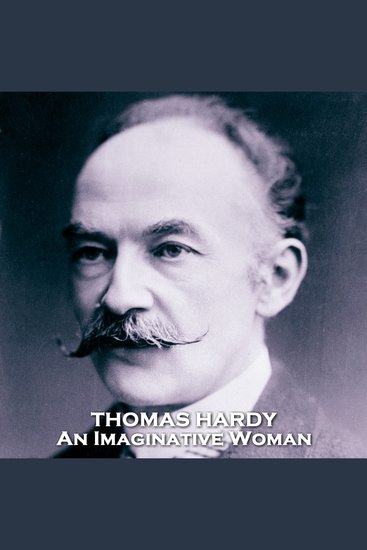
  • Imaginative Woman An - From their pens to your ears genius in every story - cover

    Imaginative Woman An - From...

    Thomas Hardy

    • 0
    • 0
    • 0
    Thomas Hardy was born in the hamlet of Upper Bockhampton about three miles east of Dorchester in Dorset, England, on 2nd June 1840.  
    Despite a fairly wide education and being an avid reader his parents thought it unlikely he would lead a successful scholarly or clerical career and he was apprenticed in 1856, at age 16, to a local architect whose speciality was in church restoration.  Hardy’s only opportunity to read was in the morning before work between the hours of five and eight.  
    On the back of a failed love affair he moved to London and spent five years working as an assistant to the architect Arthur Blomfield, also a restorer and designer of churches. Hardy though had by now become disillusioned with institutionalised forms of Christianity and abandoned any lingering hopes of ordination in the Anglican Church.  However, his writing of poetry was now flourishing, although it was still rejected for publication.  
    His novel ‘Desperate Remedies’, was published anonymously in 1871 and he now resolved to write full time though he was not yet in a position to achieve financial security or literary success. His second novel, ‘Under the Greenwood Tree’, appeared in 1872 and in 1873 ‘A Pair of Blue Eyes’, the most autobiographical of his works arrived. With ‘Far From the Madding Crowd’ in 1874, came critical acclaim, public attention and financial success. This was repeated in 1878 with ‘The Return of the Native’, and the ensuing years saw him rise to ever greater popularity.  
    His classic ‘The Mayor of Casterbridge’ arrived in 1886 and 5 years later ‘Tess of the d’Urbervilles’. The latter only saw publication after extensive alterations to its plot and the deletion of long passages to lessen the shock to the prudish Victorian audience who were dismayed by the seduction and ruin of a young girl by a rakish aristocrat.  
    ‘Jude the Obscure’, his last novel, suffered the same fate when it was published in 1895.  The uproar so disturbed him that he returned to poetry. In 1898 he had an earlier poetry collection, ‘Wessex Poems’ published. 
    Hardy spent the years between 1903 and 1908 writing ‘The Dynasts’, an epic poem on the Napoleonic Wars. 
    In his twilight years came honours and awards from the great and the good in recognition of his stature as one of the most outstanding of British authors across novels, short stories and poetry. George V conferred on him the Order of Merit in 1910. 
    From 1920 to 1927 he worked, in secret, on his autobiography, which was later published after his death as the work of his second wife, Florence Hardy.  
    Thomas Hardy OM died on the 11th January 1928. 
    His heart was buried alongside his first wife in Stinsford churchyard, Dorchester.
    Show book