Join us on a literary world trip!
Add this book to bookshelf
Grey
Write a new comment Default profile 50px
Grey
Subscribe to read the full book or read the first pages for free!
All characters reduced
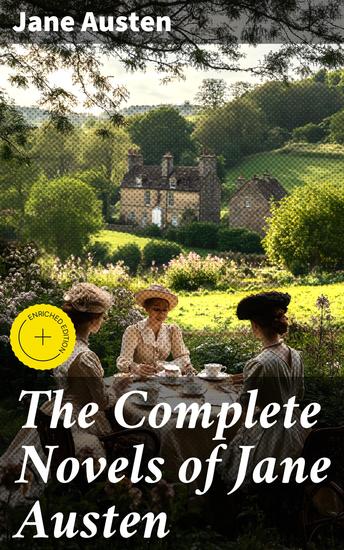
The Complete Novels of Jane Austen - Enriched edition Timeless Tales of Love Society and Social Commentary - cover

The Complete Novels of Jane Austen - Enriched edition Timeless Tales of Love Society and Social Commentary

Jane Austen

Publisher: Good Press

  • 0
  • 0
  • 0

Summary

The Complete Novels of Jane Austen is a meticulously curated anthology that brings together the enduring works of one of the most celebrated authors in English literature. Spanning the diverse social landscapes of late 18th and early 19th-century England, Austen's novels are characterized by their sharp wit, incisive social commentary, and keen psychological insights. Each story, from the romance of Pride and Prejudice to the profound nuances in Sense and Sensibility, reflects her deft ability to blend comedy and critique, revealing the constraints of class, gender, and personal aspiration in her time. The collection offers a comprehensive glimpse into Austen's evolution as a novelist, showcasing her distinctive narrative style that blends irony, realism, and intricate character development. Jane Austen, born in 1775, emerged from a relatively restricted domestic sphere that nonetheless provided her with acute observations of her social milieu. Her experiences as a woman of the gentry informed her exploration of themes such as marriage, morality, and individuality. Residing in various English locales, Austen crafted her narratives with a unique blend of personal insight and keen observation, making her works both timeless and resonant. This anthology is an essential addition to any literary collection, inviting readers to immerse themselves in the rich tapestries of Austen's worlds. For both long-time admirers and those newly introduced to her profound tales, The Complete Novels of Jane Austen provides unparalleled access to the mind of an extraordinary writer, revealing the intricacies of life and love that remain relevant in today's society.

In this enriched edition, we have carefully created added value for your reading experience:
- A comprehensive Introduction outlines these selected works' unifying features, themes, or stylistic evolutions.
- The Author Biography highlights personal milestones and literary influences that shape the entire body of writing.
- A Historical Context section situates the works in their broader era—social currents, cultural trends, and key events that underpin their creation.
- A concise Synopsis (Selection) offers an accessible overview of the included texts, helping readers navigate plotlines and main ideas without revealing critical twists.
- A unified Analysis examines recurring motifs and stylistic hallmarks across the collection, tying the stories together while spotlighting the different work's strengths.
- Reflection questions inspire deeper contemplation of the author's overarching message, inviting readers to draw connections among different texts and relate them to modern contexts.
- Lastly, our hand‐picked Memorable Quotes distill pivotal lines and turning points, serving as touchstones for the collection's central themes.
Available since: 12/29/2023.
Print length: 2007 pages.

Other books that might interest you

  • A Scene from the Ghetto of Venice - From their pens to your ears genius in every story - cover

    A Scene from the Ghetto of...

    Rainer Maria Rilke

    • 0
    • 0
    • 0
    René Karl Wilhelm Johann Josef Maria Rilke was born into a troubled marriage on the 4th December 1875 in Prague, then part of the Austro-Hungarian Empire.  His mother, having previously lost a baby girl, would dress the young boy up in girl’s clothing.   
    Later his father dispatched him to a military academy at age 10 but after a miserable 5 years the young Rilke left due to illness and instead entered first Prague and then Munich and finally Berlin university to study art history, philosophy and literature. 
    His initial forays into literature was in poetry.  His intense, mystical and lyrical style was much admired and over time inspired many in succeeding generations.    
    His short prose collection ‘Stories of God’, written in an impassioned burst over several nights was published in 1900 and offers a beguiling view of much of Rilke’s influences and outlook.  
    The following year he married the pioneering sculptor and artist Clara Westhoff.  The union produced one child, a daughter Ruth.   
    He lived in Paris for most of the Century’s first decade where he mixed with many great minds of the time.  Although he continued to write he also worked as a secretary to the sculptor, Rodin.   
    It was only after they settled in Switzerland in 1919 that his writing output was in full flow.  Here he wrote profusely in both German and French, which included much on his previous travels, his left-wing sympathies, his religious and existential thoughts, all part of a unique and consummate style. 
    From 1923 on, Rilke increasingly struggled with his health which was now in constant decline and often spent time rehabilitating at a sanatorium.   
    Rainer Maria Rilke died of leukaemia on the 29th December 1926 in Montreux, Switzerland.  He was 51.
    Show book
  • Father And Children - cover

    Father And Children

    Iván Turguénev

    • 0
    • 0
    • 0
    "Fathers and Sons" explores the generational conflict between the older, conservative generation of fathers and the younger, more radical generation of sons. Set against the backdrop of social and political changes in 19th-century Russia, the novel delves into the clash of ideologies, values, and lifestyles between the two generations. The central characters are Yevgeny Bazarov, a nihilistic young medical student, and his friend Arkady Kirsanov, who return home and challenge the traditional beliefs and norms of their elders.
    Show book
  • Taming Of The Shrew - Full Cast Drama - cover

    Taming Of The Shrew - Full Cast...

    William Shakespeare

    • 0
    • 0
    • 0
    "The Taming of the Shrew" is one of William Shakespeare's timeless comedies. In this classic play, the story revolves around the courtship of a headstrong woman named Katherina, often referred to as Kate, and the efforts of a suitor, Petruchio, to "tame" her. The play is set in the Italian city of Padua and is filled with humor, wit, and clever wordplay, which are hallmarks of Shakespearean comedy. 
     
    The main plot of the play focuses on the hilarious and sometimes contentious relationship between Kate and Petruchio. Kate is known for her sharp tongue and independent spirit, while Petruchio is a bold and unconventional suitor. Their interactions provide a comedic exploration of gender roles and societal expectations in the Elizabethan era. 
     
    Meanwhile, a secondary plot involves the romantic pursuits of Kate's younger sister, Bianca, who is sweet-tempered and much sought after by several suitors. However, their father, Baptista, has a rule that Kate must marry before Bianca can, leading to various schemes and misunderstandings. 
     
    "The Taming of the Shrew" is a play that has sparked debates and discussions about its portrayal of gender dynamics and relationships. Some view it as a reflection of its time, while others interpret it more critically, considering it a commentary on power and control.
    Show book
  • History of Herodotus The - Book 1: Clio (Unabridged) - cover

    History of Herodotus The - Book...

    Herodotus, George Rawlinson

    • 0
    • 0
    • 0
    One of the masterpieces of classical literature, the "Histories" describes how a small and quarrelsome band of Greek city states united to repel the might of the Persian empire. But while this epic struggle forms the core of his work, Herodotus' natural curiosity frequently gives rise to colorful digressions - a description of the natural wonders of Egypt; an account of European lake-dwellers; and far-fetched accounts of dog-headed men and gold-digging ants. With its kaleidoscopic blend of fact and legend, the "Histories" offers a compelling Greek view of the world of the fifth century BC.
    BOOK 1: CLIO: These are the researches of Herodotus of Halicarnassus, which he publishes, in the hope of thereby preserving from decay the remembrance of what men have done, and of preventing the great and wonderful actions of the Greeks and the barbarians1 from losing their due meed of glory.
    Show book
  • Life on the Mississippi - cover

    Life on the Mississippi

    Mark Twain

    • 0
    • 0
    • 0
    Life on the Mississippi, written by the renowned American author Mark Twain, is a captivating memoir that takes readers on an unforgettable journey along the iconic Mississippi River. With his trademark wit and storytelling prowess, Twain weaves together a fascinating narrative that blends his personal experiences, historical anecdotes, and reflections on the ever-changing landscape of America's greatest river. The story begins with Twain's vivid recollections of his own youthful days as a steamboat pilot on the Mississippi River. Through his keen observations and richly detailed descriptions, readers are transported to a bygone era, where steamboats reigned supreme and the river served as a bustling thoroughfare for trade, transportation, and adventure. As Twain shares his intimate knowledge of the river, he delves into the intricacies of steamboat navigation, regaling readers with tales of treacherous shoals, perilous bends, and the unique challenges faced by pilots. Alongside these captivating stories, Twain introduces a colorful cast of characters he encountered during his time on the river, including fellow pilots, deckhands, passengers, and gamblers, each with their own captivating stories to tell.
    Show book
  • Hunchback of Notre-Dame The (Book 1) - cover

    Hunchback of Notre-Dame The...

    Victor Hugo

    • 0
    • 0
    • 0
    Book 1: The Hunchback of Notre-Dame or Notre-Dame de Paris is a French Gothic novel by Victor Hugo, published in 1831. - The story is set in Paris in 1482 during the reign of Louis XI. The gypsy Esmeralda (born as Agnes) captures the hearts of many men, including those of Captain Phoebus and Pierre Gringoire, but especially Quasimodo and his guardian Archdeacon Claude Frollo. Frollo is torn between his obsessive lust for Esmeralda and the rules of Notre Dame Cathedral. He orders Quasimodo to kidnap her, but Quasimodo is captured by Phoebus and his guards, who save Esmeralda. Gringoire, who attempted to help Esmeralda but was knocked out by Quasimodo, is about to be hanged by beggars when Esmeralda saves him by agreeing to marry him for four years.
    Show book