

Join us on a literary world trip!
Add this book to bookshelf
Grey
Write a new comment Default profile 50px
Grey
Subscribe to read the full book or read the first pages for free!
All characters reduced
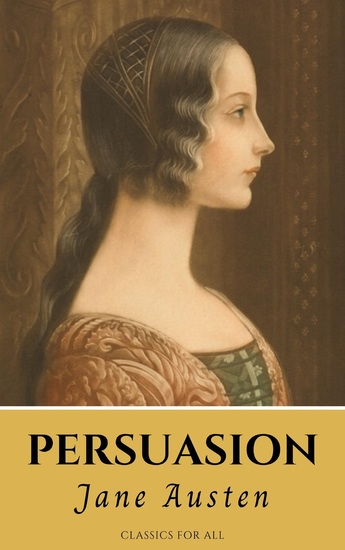
Persuasion - cover

Persuasion

Jane Austen, Classics for all

Publisher: Classics for all

  • 0
  • 0
  • 0

Summary

"You pierce my soul. I am half agony, half hope...I have loved none but you." ― Jane Austen, Persuasion

Persuasion is the last novel fully completed by Jane Austen. It was published at the end of 1817, six months after her death. Persuasion has been the subject of several adaptations, including four made-for-television adaptation, theatre productions, radio broadcasts, and other literary works.

The story concerns Anne Elliot, a young Englishwoman of twenty-seven years, whose family moves to lower their expenses and reduce their debt by renting their home to an Admiral and his wife. The wife's brother, Navy Captain Frederick Wentworth, was engaged to Anne in 1806, but the engagement was broken when Anne was "persuaded" by her friends and family to end their relationship. Anne and Captain Wentworth, both single and unattached, meet again after a seven-year separation, setting the scene for many humorous encounters as well as a second, well-considered chance at love and marriage for Anne in her second "bloom".

The novel was well-received in the early 19th century, but its greater fame came later in the century and continued into the 20th and 21st centuries. Much scholarly debate on Austen's work has since been published. Anne Elliot is noteworthy among Austen's heroines for her relative maturity. As Persuasion was Austen's last completed work, it is accepted as her most maturely written novel, showing a refinement of literary conception indicative of a woman approaching forty years
age. Her use of free indirect discourse in narrative was in full evidence by 1816.

A True Classic that Belongs on Every Bookshelf!
Available since: 08/01/2022.
Print length: 600 pages.
Other books that might interest you

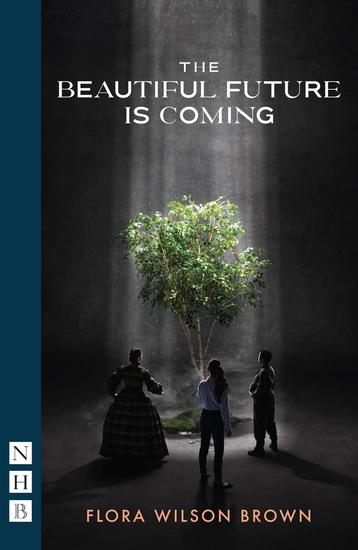
  • The Beautiful Future is Coming - cover

    The Beautiful Future is Coming

    Flora Wilson Brown

    • 0
    • 0
    • 0
    'Can you feel it? Something is hanging in the balance – ready to fall.'
    1856. New York. Eunice sits in what will become Central Park, and wonders if her research into CO2 is telling her something is going horribly wrong.
    
    2027. London. Claire falls in love as the heatwave breaks, and the streets begin to flood.
    
    2100. Svalbard. While an 86-day storm rages outside, Ana hears a baby crying in the seed vault.
    The world is ending, sure. But what happens in between?
    A fast-paced, funny and wildly inventive play, Flora Wilson Brown's The Beautiful Future is Coming looks at two hundred and fifty years of real and imagined history through the eyes of three couples. First performed at Jermyn Street Theatre, London, in 2024, this edition was published alongside a new production at Bristol Old Vic in 2025, directed by the theatre's Artistic Director Nancy Medina.
    Show book
  • The Feast of Lights - cover

    The Feast of Lights

    Emma Lazarus

    • 0
    • 0
    • 0
    LibriVox volunteers bring you 9 recordings of The Feast of Lights by Emma Lazarus. This was the Weekly Poetry project for December 18, 2011.Hanukkah, or the Festival of Lights, is the Jewish festival commemorating the rededication of the Holy Temple in Jerusalem during the 2nd century BCE.This poem celebrating Hanukkah was written by Emma Lazarus, a Jewish American poet. Emma Lazarus also wrote 'The New Colossus,' a sonnet which is inscribed on a plaque on the pedestal of the Statue of Liberty.
    Show book
  • Prison Poetry - cover

    Prison Poetry

    Scott T.K Keighran

    • 0
    • 0
    • 0
    Incarceration ... Is it an outcome of past actions, or a pathway for reflection. Perhaps each soul is to decide for themselves?Join the author, as he works through his time in prison and the 'head miles' he travels, reflecting on the decisions and actions that changed the direction of his life forever. Gain an insight into a life behind bars, cellmates, and a society within the prison system through the author's experiences.This book is a powerful collection of thoughts, written in prose and poetry that take you on a journey into and out of incarceration, that will be sure to leave you with a new perspective on the privileges of living.
    Show book
  • Cymbeline King of Britain - cover

    Cymbeline King of Britain

    William Shakespeare

    • 0
    • 0
    • 0
    Cymbeline, also known as The Tragedie of Cymbeline or Cymbeline, King of Britain, is a play by William Shakespeare set in Ancient Britain (c. 10–14)[a] and based on legends that formed part of the Matter of Britain concerning the early Celtic British King Cunobeline. Although listed as a tragedy in the First Folio, modern critics often classify Cymbeline as a romance or even a comedy. Like Othello and The Winter's Tale, it deals with the themes of innocence and jealousy. While the precise date of composition remains unknown, the play was certainly produced as early as 1611.
    Cymbeline, the Roman Empire's vassal king of Britain, once had two sons, Guiderius and Arvirargus, but they were stolen twenty years earlier as infants by an exiled traitor named Belarius. Cymbeline discovers that his only child left, his daughter Imogen (or Innogen), has secretly married her lover Posthumus Leonatus, a member of Cymbeline's court. The lovers have exchanged jewellery as tokens: Imogen with a bracelet, and Posthumus with a ring. Cymbeline dismisses the marriage and banishes Posthumus since Imogen — as Cymbeline's only child — must produce a fully royal-blooded heir to succeed to the British throne. In the meantime, Cymbeline's Queen is conspiring to have Cloten (her cloddish and arrogant son by an earlier marriage) married to Imogen to secure her bloodline. The Queen is also plotting to murder both Imogen and Cymbeline, procuring what she believes to be deadly poison from the court doctor. The doctor, Cornelius, is suspicious and switches the poison with a harmless sleeping potion. The Queen passes the "poison" along to Pisanio, Posthumus and Imogen's loving servant — the latter is led to believe it is a medicinal drug. No longer able to be with her banished Posthumus, Imogen secludes herself in her chambers, away from Cloten's aggressive advances.
    Although the play is named Julius Caesar, Brutus speaks more than four times as many lines as the title character; and the central psychological drama of the play focuses on Brutus' struggle between the conflicting demands of honour, patriotism, and friendship. 
    Among the most significant works William Shakespeare: Hamlet, Othello, King Lear, Macbeth, Orpheus, Romeo and Juliet, Julius Caesar, Troilus and Cressida, The Tempest, Venus and Adonis, Antony and Cleopatra, Measure for Measure, The Winter's Tale and many more.
    Show book
  • This Is Not An Epiphany - cover

    This Is Not An Epiphany

    Tom Branfoot

    • 0
    • 0
    • 0
    Tom Branfoot's This is Not an Epiphany examines inner and outer landscapes that have become inhospitable; where people are 'burnt / by business as usual'. This collection is attentive to shifting landscapes where warehouses spring up on empty land, and the incremental austerities that constitute our living; its lyric absorbs the shocks and crises of survival within them.
    Show book
  • In The Lily Room - cover

    In The Lily Room

    Erica Hesketh

    • 0
    • 0
    • 0
    Erica Hesketh's debut collection In the Lily Room tells a story of early motherhood. It examines a new mother's journey through mental illness, her relationships with her body, her baby and other people, and the often surreal landscape of mothering, against a backdrop of a changing and uncertain world.
    A dreamlike birth sequence full of eels, foxes and floodwater empties onto a London postnatal ward, where reality sets in. Rudderless and anxious, the new mother writes notes to herself, joins support groups and tries medication. She climbs into myth and prayer, nightmare and song, criss-crossing her neighbourhood with a pram, until she starts to feel better. Hesketh's poems speak of the many things motherhood can mean, the structures it is made to fit inside. Clear-eyed and full of hard-won love, this a story of one of the most common experiences there is, told in a dazzlingly original way.
    Show book
