Join us on a literary world trip!
Add this book to bookshelf
Grey
Write a new comment Default profile 50px
Grey
Subscribe to read the full book or read the first pages for free!
All characters reduced
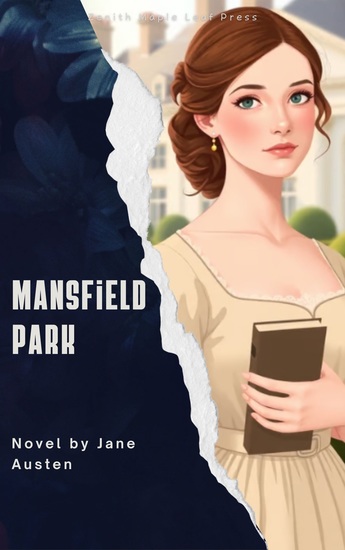
Mansfield Park - Jane Austen's Masterpiece of Morality Class and Love - cover

Mansfield Park - Jane Austen's Masterpiece of Morality Class and Love

Jane Austen, Zenith Maple Leaf Press

Publisher: Zenith Maple Leaf Press

  • 0
  • 0
  • 0

Summary

"A novel of virtue, love, and social ambition from one of the greatest writers in English literature."

First published in 1814, Jane Austen's Mansfield Park is a profound and engaging exploration of morality, society, and the complexities of the human heart.

At the heart of the story is Fanny Price, a quiet and observant young woman sent from her poor home to live with her wealthy relatives at Mansfield Park. As she grows into adulthood, she navigates the challenges of class, morality, and desire while those around her fall into scandal, temptation, and moral ambiguity. Fanny's unwavering sense of integrity makes her a striking heroine, contrasting with the indulgence and recklessness of others in her world.

🌟 Why Readers Love It:

💕 A deeply moving exploration of love, virtue, and loyalty.

🏰 A fascinating look into 19th-century English society and class divisions.

📚 Written with Austen's trademark wit, irony, and sharp observation.

🎖️ Widely regarded as one of Austen's most complex and thought-provoking works, admired for its moral depth and psychological insight.

🎯 Step into the refined world of Mansfield Park, where every choice carries weight and love must stand the test of principle. Click "Buy Now" to experience Austen's timeless brilliance.
Available since: 08/18/2025.
Print length: 293 pages.

Other books that might interest you

  • A Fragment of Stained Glass - From their pens to your ears genius in every story - cover

    A Fragment of Stained Glass -...

    D H Lawrence

    • 0
    • 0
    • 0
    David Herbert Lawrence was born on the 11th September 1885 in Eastwood, Nottinghamshire, a coal mining town where the reality of a harsh life was only useful as experiences for future literary works. 
    He was educated at Beauvale Board School and became the first local boy to receive a scholarship to attend Nottingham High School. After 3 years he became a junior clerk in Haywood’s surgical appliances factory. He was also attempting a literary career which, in the short term, led to a teacher training position in Eastwood and later a teaching qualification from University College, Nottingham.  
    Lawrence’s first efforts were poems, short stories and a draft of ‘The White Peacock’. Moving to London and a teaching position in Croydon his writing attracted the attention of Ford Madox Ford, editor of The English Review, and he commissioned him to write ‘Odour of Chrysanthemums’.  
    Wanting to write full-time he now began work on what would become ‘Sons and Lovers.   
    In 1912 he met the older and married mother-of-three Frieda Weekley. They eloped to Germany and here Lawrence could see for himself the growing tensions with France.  So keen was his interest that he was arrested and accused of being a British spy.  
    In early 1914 Frieda obtained her divorce and they returned to Britain to be married just days before the outbreak of war. Owing to her German parentage, and his own public dislike of militarism and violence, the couple were treated with contempt and suspicion throughout the war years.  
    Despite this he continued to write but his reputation in England was so tarnished and, mirrored by his own disdain for the country, he and Frieda left England in November 1919, first for Europe and then America via Ceylon and Australia. 
    They bought a ranch in Taos, New Mexico and visited Mexico several times. The third visit in March 1925 caused a near fatal attack of malaria. To convalesce they moved to Florence. Here he continued work on ‘Lady Chatterley’s Lover’ which for many years would cause controversy. A renewed interest in oil painting resulted in an exhibition in 1929 which was raided by the police and several works were confiscated.  
    D H Lawrence died of complications arising from a bout of tuberculosis on the 2nd of March 1930 in Vence, France.  He was 44.
    Show book
  • Jam For The Enemy - Former soldier and journalist that became a revered author and screenwriter - cover

    Jam For The Enemy - Former...

    Edgar Wallace

    • 0
    • 0
    • 0
    Richard Horatio Edgar Wallace was born on the 1st April 1875 in Greenwich, London.  Leaving school at 12 because of truancy, by the age of fifteen he had experience; selling newspapers, as a worker in a rubber factory, as a shoe shop assistant, as a milk delivery boy and as a ship’s cook.  
     
    By 1894 he was engaged but broke it off to join the Infantry being posted to South Africa. He also changed his name to Edgar Wallace which he took from Lew Wallace, the author of Ben-Hur.  
     
    In Cape Town in 1898 he met Rudyard Kipling and was inspired to begin writing. His first collection of ballads, The Mission that Failed! was enough of a success that in 1899 he paid his way out of the armed forces in order to turn to writing full time.  
     
    By 1904 he had completed his first thriller, The Four Just Men. Since nobody would publish it he resorted to setting up his own publishing company which he called Tallis Press. 
      
    In 1911 his Congolese stories were published in a collection called Sanders of the River, which became a bestseller. He also started his own racing papers, Bibury’s and R. E. Walton’s Weekly, eventually buying his own racehorses and losing thousands gambling.  A life of exceptionally high income was also mirrored with exceptionally large spending and debts.  
     
    Wallace now began to take his career as a fiction writer more seriously, signing with Hodder and Stoughton in 1921. He was marketed as the ‘King of Thrillers’ and they gave him the trademark image of a trilby, a cigarette holder and a yellow Rolls Royce. He was truly prolific, capable not only of producing a 70,000 word novel in three days but of doing three novels in a row in such a manner. It was estimated that by 1928 one in four books being read was written by Wallace, for alongside his famous thrillers he wrote variously in other genres, including science fiction, non-fiction accounts of WWI which amounted to ten volumes and screen plays. Eventually he would reach the remarkable total of 170 novels, 18 stage plays and 957 short stories. 
     
    Wallace became chairman of the Press Club which to this day holds an annual Edgar Wallace Award, rewarding ‘excellence in writing’.  
     
    Diagnosed with diabetes his health deteriorated and he soon entered a coma and died of his condition and double pneumonia on the 7th of February 1932 in North Maple Drive, Beverly Hills. He was buried near his home in England at Chalklands, Bourne End, in Buckinghamshire.
    Show book
  • Poirot investigates - cover

    Poirot investigates

    Agatha Christie

    • 0
    • 0
    • 0
    This audiobook is based on literature that was written in a past cultural or historical context, and includes language and depictions of people or cultures that are considered offensive to listeners. Please keep this in mind when deciding if, how and when you’ll listen.
    The third book in Agatha Christie's famous detective series takes readers on an exciting journey through a collection of Poirot's trickiest cases. From finding the Prime Minister to solving a bank robbery, these 11 cases illustrate why Poirot is still considered one of the greatest literary detectives of all time.
     
    This collection includes:
     
    The Adventure of “The Western Star”
     
    The Tragedy at Marsdon Manor
     
    The Adventure of the Cheap Flat
     
    The Mystery of Hunter’s Lodge
     
    The Million Dollar Bond Robbery
     
    The Adventure of the Egyptian Tomb
     
    Jewel Robbery at the Grand Metropolitan
     
    The Kidnapped Prime Minister
     
    The Disappearance of Mr. Davenheim
     
    The Adventure of the Italian Nobleman
     
    The Case of the Missing Will
    Show book
  • The Trial - cover

    The Trial

    Franz Kafka

    • 0
    • 0
    • 0
    In the end, out of nothing at all, an enormous fabric of guilt will be conjured up. 
    One morning Josef K. is arrested for a crime he did not commit. In fact, he is never even told the nature of the offense. His life is thrown into turmoil as he becomes enmeshed in a struggle to prove his innocence. As the confounding case unfolds, K. is ultimately powerless - battling against a remote and uncaring bureaucracy. 
    This edition features a new translation by Isabel Tucker. Due to its posthumous publication, The Trial 's original text is largely unedited and Tucker emends certain details while retaining the enigmatic and surreal style which marks Kafka's brilliance. 
    Filled with psychological tension and disconcerting parallels with the modern world, The Trial is a dystopian masterpiece by one of the greatest writers in the German-language.
    Show book
  • Frankenstein - Or The Modern Prometheus - cover

    Frankenstein - Or The Modern...

    Mary Shelley

    • 0
    • 0
    • 0
    Unleash the timeless story of ambition, responsibility, and consequences with Mary Shelley's groundbreaking masterpiece, "Frankenstein." Victor Frankenstein, a brilliant young scientist, driven by a thirst for knowledge and the ambition to create life, discovers a way to animate a patchwork of human remains. His creation, however, is not the beautiful life he envisioned. Instead, it is a grotesque creature that Frankenstein instantly rejects. 
    Abandoned by his creator and shunned by the world, the monster embarks on a quest for acceptance and understanding. His journey is fraught with isolation and tragedy, leading him back to his creator, demanding recompense for his lonely existence. What follows is a gripping saga of horror, empathy, and revenge that delves deep into the ethical boundaries of scientific discovery and the responsibilities therein. 
    Mary Shelley's "Frankenstein" is a profound exploration of the human condition and the dangers of unchecked ambition. Written during the infancy of the Industrial Age, this novel is as relevant today as it was two centuries ago, challenging the readers to ponder the moral implications of scientific advancement. 
    Ideal for lovers of classic literature, gothic horror, and philosophical reflection, "Frankenstein" offers an unforgettable journey through the depths of human emotion and the stark consequences of playing God. 
    Experience the haunting beauty and tragedy of this timeless novel that continues to challenge and captivate readers around the world.
    Show book
  • Gone Astray - cover

    Gone Astray

    Anton Chekhov

    • 0
    • 0
    • 0
    "Gone Astray" is one of Chekhov's earlier comedic short stories that is a light-hearted romp about two drunken lawyers trying to find their way home at night. Chekhov's masterful use of irony is present here as one of the lawyers, Kozyavkin, accidentally violates the law by breaking into a house he believes to be his own.
    Show book