Join us on a literary world trip!
Add this book to bookshelf
Grey
Write a new comment Default profile 50px
Grey
Subscribe to read the full book or read the first pages for free!
All characters reduced
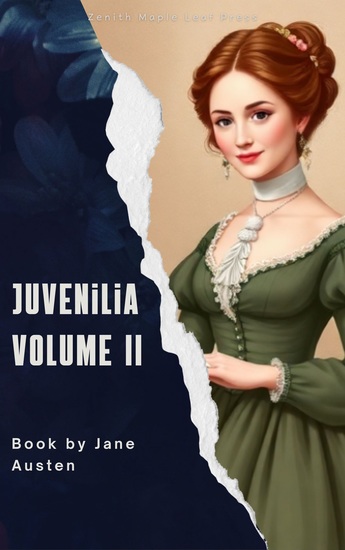
Juvenilia Volume II - The Playful and Satirical Early Works of a Literary Legend - cover

Juvenilia Volume II - The Playful and Satirical Early Works of a Literary Legend

Jane Austen, Zenith Maple Leaf Press

Publisher: Zenith Maple Leaf Press

  • 0
  • 0
  • 0

Summary

The wit was there from the very beginning.

Juvenilia – Volume II continues the delightful journey into Jane Austen's earliest writings, offering more short stories, satirical sketches, and playful narratives penned during her teenage years. These works brim with spirited heroines, absurd adventures, and Austen's unmistakable gift for poking fun at society and romance.

From clever parodies of sentimental fiction to sharp character studies, this collection captures Austen's youthful imagination in full bloom—providing a rare, unfiltered look at the genius that would one day create Pride and Prejudice, Emma, and Sense and Sensibility.

"An intimate window into Austen's early creative genius." – Literary Classics Review
"Hilarious, bold, and brilliantly satirical—proof that Austen's wit was innate." – The Guardian

✅ Why Readers Love It:

✍ A deeper exploration of Austen's formative years

😂 Biting humor and playful social commentary

📚 Essential for Austen fans and literary historians

🎯 Click 'Buy Now' to enjoy the lively charm and fearless humor of Jane Austen's teenage pen.
Available since: 08/15/2025.
Print length: 146 pages.
Other books that might interest you

  • The Awakening and Selected Short Stories (Legend Classics) - cover

    The Awakening and Selected Short...

    Kate Chopin

    • 0
    • 0
    • 0
    “The bird that would soar above the level plain of tradition and prejudice must have strong wings. It is a sad spectacle to see the weaklings bruised, exhausted, fluttering back to earth.” 
    The Awakening follows Edna Pontellier, a resident of coastal Grand Isle of Louisiana, in her late twenties, who has a quintessential set-up for a content housewife. Indeed, her husband makes good money, and her daily routine should gleefully hinge on the two children, but, Edna is neither a self-sacrificing mother, nor a devoted wife. Instead, she is gradually awoken to rebel against this ‘perfect set-up’. Edna finds herself in the middle of two extremes. On one hand, she finds selfless Madame Ratignolle, who is a model wife. On the other, there is dejected Mademoiselle Reisz, who pursues her artistic aspiration in solitude. While taking bold decisions and carving her niche, she explores her sexuality with a womanizer, Alcee and an intimate understanding with a young man, Robert Lebrun. Will this awakening predetermine her ultimate happiness or signpost personal tragedy? Will the duality of the ‘outward existence’ and ‘inward life’ be reconciled for Edna to signify her emancipation? 
    This short novel is widely acknowledged to do both, encapsulating the features of fin de siècle realism in its linear narrative, and anticipates literary modernism of the early twentieth century. Edna’s defiance of the American alternative of Victorian ‘Angel in the House’ is reminiscent of such classics as Anna Brontë’s Tenant of the Wildfell Hall. The Awakening also procures modernist works where the heroines look for the self - namely, Mrs Dalloway, Their Eyes Were Watching God and The Bell Jar. The condensed and intense prose style gives the novel a cryptic charm in line with Fitzgerald’s classic, The Great Gatsby. Besides, vivid natural symbolism of water, birds and the moon are the calling card of the novel that enhances its level of ambiguity and multivalence. 
    The Legend Classics series:Around the World in Eighty DaysThe Adventures of Huckleberry FinnThe Importance of Being EarnestAlice's Adventures in WonderlandThe MetamorphosisThe Railway ChildrenThe Hound of the BaskervillesFrankensteinWuthering HeightsThree Men in a BoatThe Time MachineLittle WomenAnne of Green GablesThe Jungle BookThe Yellow Wallpaper and Other StoriesDraculaA Study in ScarletLeaves of GrassThe Secret GardenThe War of the WorldsA Christmas CarolStrange Case of Dr Jekyll and Mr HydeHeart of DarknessThe Scarlet LetterThis Side of ParadiseOliver TwistThe Picture of Dorian GrayTreasure IslandThe Turn of the ScrewThe Adventures of Tom SawyerEmmaThe TrialA Selection of Short Stories by Edgar Allan PoeGrimm Fairy TalesThe AwakeningMrs DallowayGulliver’s TravelsThe Castle of OtrantoSilas MarnerHard Times
    Show book
  • The History Of Mr Polly - cover

    The History Of Mr Polly

    H. G. Wells

    • 0
    • 0
    • 0
    Mr. Polly, also known as Alfred Polly, is a fictional character created by the renowned English writer H.G. Wells in his 1910 novel "The History of Mr. Polly." The novel follows the life of Mr. Polly, an ordinary and discontented middle-aged man living in the late 19th and early 20th centuries. Mr. Polly is a relatable figure who embodies the struggles and frustrations of the average person in the face of societal expectations and personal dissatisfaction. 
     
    Set against the backdrop of the Edwardian era, "The History of Mr. Polly" offers a profound exploration of the human condition. Mr. Polly's life is characterized by a series of disappointments, failed ventures, and a general sense of aimlessness. Frustrated with his monotonous existence and a loveless marriage, he reaches a breaking point, deciding to escape the confines of his mundane life and pursue a different path. 
    Wells paints a vivid portrait of Mr. Polly's journey of self-discovery and reinvention. The narrative takes readers through a range of emotions, from the bleakness of Mr. Polly's initial struggles to the optimism and hope that emerges as he embarks on a new adventure. Ultimately, "The History of Mr. Polly" serves as a thought-provoking exploration of the universal human desire for freedom, happiness, and the pursuit of a meaningful existence in an ever-changing world.
    Show book
  • All the Sad Young Men - cover

    All the Sad Young Men

    F. Scott Fitzgerald

    • 0
    • 0
    • 0
    All the Sad Young Men is the third collection of short stories written by F. Scott Fitzgerald, published by Scribners in February 1926. Fitzgerald wrote the stories at a time of disillusionment. He was in financial difficulty, he believed his wife Zelda was romantically involved with another man, she had suffered a series of physical illnesses, and his play The Vegetable had been a failure. The book was dedicated to Ring and Ellis Lardner, who were neighbors at the time the book was published.
    Included in this collection:
    1. The Rich Boy
    2. Winter Dreams
    3. The Baby Party
    4. Absolution
    5. Rags Martin-Jones and the Pr-nce of W-les
    6. The Adjuster
    7. Hot and Cold Blood
    8. "The Sensible Thing"
    9. Gretchen's Forty Winks
    Show book
  • A Lesson on a Tortoise - From their pens to your ears genius in every story - cover

    A Lesson on a Tortoise - From...

    D H Lawrence

    • 0
    • 0
    • 0
    David Herbert Lawrence was born on the 11th September 1885 in Eastwood, Nottinghamshire, a coal mining town where the reality of a harsh life was only useful as experiences for future literary works. 
    He was educated at Beauvale Board School and became the first local boy to receive a scholarship to attend Nottingham High School. After 3 years he became a junior clerk in Haywood’s surgical appliances factory. He was also attempting a literary career which, in the short term, led to a teacher training position in Eastwood and later a teaching qualification from University College, Nottingham.  
    Lawrence’s first efforts were poems, short stories and a draft of ‘The White Peacock’. Moving to London and a teaching position in Croydon his writing attracted the attention of Ford Madox Ford, editor of The English Review, and he commissioned him to write ‘Odour of Chrysanthemums’.  
    Wanting to write full-time he now began work on what would become ‘Sons and Lovers.   
    In 1912 he met the older and married mother-of-three Frieda Weekley. They eloped to Germany and here Lawrence could see for himself the growing tensions with France.  So keen was his interest that he was arrested and accused of being a British spy.  
    In early 1914 Frieda obtained her divorce and they returned to Britain to be married just days before the outbreak of war. Owing to her German parentage, and his own public dislike of militarism and violence, the couple were treated with contempt and suspicion throughout the war years.  
    Despite this he continued to write but his reputation in England was so tarnished and, mirrored by his own disdain for the country, he and Frieda left England in November 1919, first for Europe and then America via Ceylon and Australia. 
    They bought a ranch in Taos, New Mexico and visited Mexico several times. The third visit in March 1925 caused a near fatal attack of malaria. To convalesce they moved to Florence. Here he continued work on ‘Lady Chatterley’s Lover’ which for many years would cause controversy. A renewed interest in oil painting resulted in an exhibition in 1929 which was raided by the police and several works were confiscated.  
    D H Lawrence died of complications arising from a bout of tuberculosis on the 2nd of March 1930 in Vence, France.  He was 44.
    Show book
  • A Knot of Ribbon - From their pens to your ears genius in every story - cover

    A Knot of Ribbon - From their...

    Laurence Alma-Tadema

    • 0
    • 0
    • 0
    The bookshelves of British literature are incredible collections that have gathered together centuries of very talented authors.  From these Isles their fame spread and whilst among their number many are now forgotten or neglected their talents endure.  Among them is Laurence Alma-Tadema.
    Show book
  • The Canterville Ghost - cover

    The Canterville Ghost

    Oscar Wilde

    • 0
    • 0
    • 0
    👻 A hauntingly funny classic by Oscar Wilde. 
    When an American family moves into a haunted English mansion, the ghost gets more than he bargained for. 
    A witty and heartwarming classic from the master of irony, Oscar Wilde.
When a modern American family moves into an old English mansion, they discover it’s haunted — by none other than Sir Simon de Canterville, a ghost doomed to roam the halls for centuries. 
    But this is no ordinary haunting! The practical, skeptical Otis family refuses to be frightened, and soon it’s the ghost who’s terrified.
Wilde’s timeless tale mixes humor, satire, and gentle melancholy, revealing that even the dead can find redemption through kindness and love. 
    📚 Author: Oscar Wilde
🎙️ Audiobook: Logan Keen
📖 Length: approx. 60–80 pages (novella)
🏛️ Genre: Classic literature, ghost story, satire
🌍 Year of publication: 1887 
    ✨ “Death must be so beautiful... To lie in the soft brown earth, with the grasses waving above one's head, and listen to silence.” 
    #OscarWilde #CantervilleGhost #Audiobook #ClassicLiterature #EnglishLiterature #GhostStory #Satire #Humor #Audiobooks #VictorianLiterature
    Show book