Rejoignez-nous pour un voyage dans le monde des livres!
Ajouter ce livre à l'électronique
Grey
Ecrivez un nouveau commentaire Default profile 50px
Grey
Abonnez-vous pour lire le livre complet ou lisez les premières pages gratuitement!
All characters reduced
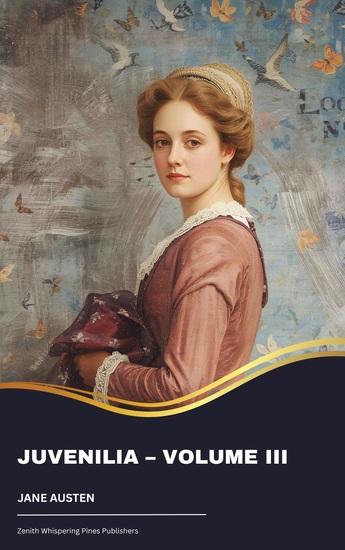
Juvenilia – Volume III - cover

Juvenilia – Volume III

Jane Austen

Maison d'édition: Zenith Whispering Pines Publishers

  • 0
  • 0
  • 0

Synopsis

Bold, witty, and wonderfully unrestrained—Austen's youthful voice shines brighter than ever.
In Juvenilia – Volume III, the young Jane Austen continues her playful exploration of storytelling with tales full of mischievous heroines, dramatic twists, clever satire, and wild imagination. These early pieces capture her developing genius, revealing the humorous, daring mind that would one day craft some of literature's most beloved novels.

Celebrated as "a captivating window into Austen's creative beginnings," this volume offers both laughter and literary insight, showing how her trademark wit and social sharpness took shape long before Pride and Prejudice or Emma.

If you enjoy Austen's humor, lively characters, and sparkling commentary on human behavior, this collection will delight you from beginning to end.

Open the book—and discover Jane Austen as she first learned to dazzle.
Disponible depuis: 11/12/2025.
Longueur d'impression: 74 pages.

D'autres livres qui pourraient vous intéresser

  • Top 10 Short Stories The - Murder - The top ten short murder stories of all time - cover

    Top 10 Short Stories The -...

    Oscar Wilde, Edgar Allan Poe,...

    • 0
    • 0
    • 0
    Short stories have always been a sort of instant access into an author’s brain, their soul and heart.  A few pages can lift our lives into locations, people and experiences with a sweep of landscape, narration, feelings and emotions that is difficult to achieve elsewhere. 
     
    In this series we try to offer up tried and trusted ‘Top Tens’ across many different themes and authors. But any anthology will immediately throw up the questions – Why that story? Why that author?  
     
    The theme itself will form the boundaries for our stories which range from well-known classics, newly told, to stories that modern times have overlooked but perfectly exemplify the theme.  Throughout the volume our authors whether of instant recognition or new to you are all leviathans of literature. 
     
    Some you may disagree with but they will get you thinking; about our choices and about those you would have made.  If this volume takes you on a path to discover more of these miniature masterpieces then we have all gained something. 
     
    In this volume that most heinous of crimes is explored and dissected by the minds of our classic authors who show that the taking of another’s life in print is so real that the possibility arises that they have carried out this deed in reality.  Genius has many names. 
     
    01 - The Top 10 - Murder - An Introduction 
    02 - Lord Arthur Savile's Crime - Part 1 by Oscar Wilde 
    03 - Lord Arthur Savile's Crime - Part 2 by Oscar Wilde 
    04 - The Cask of Amontillardo by Edgar Allan Poe 
    05 - Claude Gueux by Victor Hugo 
    06 - In The Dark by Edith Nesbit 
    07 - Brothers by Sherwood Anderson 
    08 - The Kit Bag by Algernon Blackwood 
    09 - Mateo Falcone by Prosper Merimee 
    10 - A Jury of Her Peers by Susan Glaspell 
    11 - In A Grove by Ryunosuke Akutagawa 
    12 - The Repairer of Reputations - Part 1 by Robert W Chambers 
    13 - The Repairer of Reputations - Part 2 by Robert W Chambers
    Voir livre
  • The Professor’s House - cover

    The Professor’s House

    Willa Cather

    • 0
    • 0
    • 0
    Professor Godfrey St. Peter, on the cusp of moving to a new home, finds himself clinging to his old study and the memories it holds. His mind is gripped by the absence of his brilliant former student, Tom Outland, and the marriages of his daughters have introduced changes that he cannot embrace. As he struggles with grief and gradually retreats from those around him, his mid-life crisis unfolds against the backdrop of a changing 1920s America. Will he embrace the future or succumb to the allure of the past? Cather’s keen exploration of human relationships and the price of progress leaves the listener pondering long after the final words have sounded.
    Voir livre
  • The Garden Lodge - cover

    The Garden Lodge

    Willa Cather

    • 0
    • 0
    • 0
    "The Garden Lodge" is a short story by Willa Cather, first published in 1905. It tells the story of a woman asked by her husband if she would agree to tear down their garden lodge and build a new summer house there instead. She grows nostalgic as she remembers spending fond times there with tenor Raymond d'Esquerre when he was visiting. Although a moderate and no-nonsense woman, the singer rekindled her passion for music during his stay. She had to let go of it after her lazy brother killed himself and her father was crippled with debts. She then proceeds to go to the garden lodge and plays a piece of opera that she played with the tenor the previous summer. However, after a night's sleep she comes around and tells her husband she agrees the lodge should go.
    Voir livre
  • From the Memoirs of Satan - From their pens to your ears genius in every story - cover

    From the Memoirs of Satan - From...

    William Hauff

    • 0
    • 0
    • 0
    The bookshelves of European literature are incredible collections that have gathered together centuries of very talented authors.  From this continent their fame spread and whilst among their number many are now forgotten or neglected their talents endure.  Among them is William Hauff.
    Voir livre
  • The Vixen - From their pens to your ears genius in every story - cover

    The Vixen - From their pens to...

    Aleister Crowley

    • 0
    • 0
    • 0
    Edward Alexander Crowley was born on 12th October 1875 to wealthy parents in Royal Leamington Spa in Warwickshire. 
    He was educated at Malvern College, Tonbridge School, Eastbourne College and finally Trinity College, Cambridge where he focused on his passions of mountaineering and poetry and published several volumes. 
    Life for Crowley was to abandon his parents’ Christian faith and instead to inject himself into Western esotericism.  In 1898, he joined the esoteric Hermetic Order of the Golden Dawn and was trained in ceremonial magic before studying both Hindu and Buddhist practices in India. 
    On his Egyptian honeymoon in 1904 he claimed contact with an entity―Aiwass―who gave him the sacred Book of the Law which served as the basis for the Thelema religion where he identified as its prophet.  During the Great War, which he spent in the United States, he claimed to be working for British Intelligence but by the 1920s he had decamped to pursue a libertine lifestyle in Sicily, and in the ensuing scandals was evicted by the Italian Government. 
    He divided the following two decades between France, Germany, and England, and the continuing promotion of Thelema. 
    During his life he gained widespread notoriety for his drug use, his bisexuality, and his alarming views on society.  In short, polite society frowned on his ways, his thoughts and his influence but to many others his stance had much of value.  Even after death he was a darling for the 60’s counterculture but his influence has since waned.   
    His literary works were both prolific and covered many topics.  In the early part of his career he published many poetry books, even plays, before his darker and more forceful works came to dominate his output. 
    Aleister Crowley died on 1st December 1947 at Hastings in England. He was 72.
    Voir livre
  • Not Good Enough - A Simon Iff Occult Detective Story - cover

    Not Good Enough - A Simon Iff...

    Aleister Crowley

    • 0
    • 0
    • 0
    Edward Alexander Crowley was born on 12th October 1875 to wealthy parents in Royal Leamington Spa in Warwickshire. 
     
    He was educated at Malvern College, Tonbridge School, Eastbourne College and finally Trinity College, Cambridge where he focused on his passions of mountaineering and poetry and published several volumes. 
     
    Life for Crowley was to abandon his parents’ Christian faith and instead to inject himself into Western esotericism.  In 1898, he joined the esoteric Hermetic Order of the Golden Dawn and was trained in ceremonial magic before studying both Hindu and Buddhist practices in India. 
     
    On his Egyptian honeymoon in 1904 he claimed contact with an entity―Aiwass―who gave him the sacred Book of the Law which served as the basis for the Thelema religion where he identified as its prophet.  During the Great War, which he spent in the United States, he claimed to be working for British Intelligence but by the 1920s he had decamped to pursue a libertine lifestyle in Sicily, and in the ensuing scandals was evicted by the Italian Government. 
     
    He divided the following two decades between France, Germany, and England, and the continuing promotion of Thelema. 
     
    During his life he gained widespread notoriety for his drug use, his bisexuality, and his alarming views on society.  In short, polite society frowned on his ways, his thoughts and his influence but to many others his stance had much of value.  Even after death he was a darling for the 60’s counterculture but his influence has since waned.   
     
    His literary works were both prolific and covered many topics.  In the early part of his career he published many poetry books, even plays, before his darker and more forceful works came to dominate his output. 
     
    Aleister Crowley died on 1st December 1947 at Hastings in England. He was 72.
    Voir livre