Join us on a literary world trip!
Add this book to bookshelf
Grey
Write a new comment Default profile 50px
Grey
Subscribe to read the full book or read the first pages for free!
All characters reduced
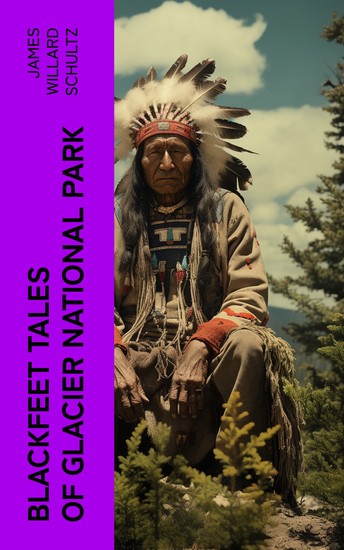
Blackfeet Tales of Glacier National Park - cover

Blackfeet Tales of Glacier National Park

James Willard Schultz

Publisher: e-artnow

  • 0
  • 0
  • 0

Summary

This is a book of stories collected from the Blackfeet Tribe from the Glacier National Park written by a man who had married a Blackfeet, lived among the people from the tribe for many years, and was considered one of them. It gives many places names in Glacier, such as just who was Running Eagle or Pitamakin, familiar to all people who visited this wonderful area. These stories are captured from oral Blackfoot tradition and tell about ancient indigenous cultures, which carry their outstanding actions to our times.
Available since: 11/23/2023.
Print length: 1425 pages.

Other books that might interest you

  • Ancient Australia - The World of Aboriginal Culture - cover

    Ancient Australia - The World of...

    Lillian Brooks

    • 0
    • 0
    • 0
    Aboriginal culture is one of the oldest and most complex systems of human existence, stretching back over 60,000 years in Australia. The richness of this culture is woven through the landscape, the traditions, the language, and the deep spiritual connections the people have with the land. Far from a singular or homogeneous entity, Aboriginal culture is an intricate tapestry made up of diverse languages, customs, and belief systems that reflect the uniqueness of the many nations that have inhabited Australia for millennia. 
    At the heart of Aboriginal culture lies an unbreakable connection to Country. The concept of Country extends beyond mere geography; it encompasses the land, the waterways, the plants, the animals, and even the ancestors that reside within it. This intimate relationship shapes all aspects of life, from spiritual beliefs to daily practices. For Aboriginal people, their land is not simply a place to live, but a living entity that provides, sustains, and is cared for in return. This relationship is integral to the way Aboriginal communities structure their lives, making respect for and care of the environment a fundamental principle. 
    The Dreamtime, or the time of creation, forms the bedrock of Aboriginal spirituality and cultural practices. It is in this time that ancestral beings shaped the land, the people, and the laws that govern life. These stories, which are passed down through generations, guide and influence the way Aboriginal people live, ensuring their survival and cultural continuity. The Dreamtime is not a distant past but a present reality, interwoven with the lives of modern Aboriginal peoples.
    Show book

  • Wizards - David Duke America's Wildest Election and the Rise of the Far Right - cover

    Wizards - David Duke America's...

    Brian Fairbanks

    • 0
    • 0
    • 0
    The '91 Louisiana Governor's race was supposed to be forgettable. But when former KKK Grand Wizard David Duke shocked the nation by ousting incumbent Republican Governor Buddy Roemer in the primary, the world took notice. Democrat Edwin Edwards, a former three-term governor and two-time corruption defendant, was left alone to face Duke in the general election—and he was going to lose. 


    Then a little-known state committeewoman stepped in with evidence of Duke's nefarious past. Could her evidence be enough to sway the minds of fired-up voters, or would Louisiana welcome a far-right radical into the highest office in the state? 


    Journalist Brian Fairbanks explores how the final showdown between Duke and Edwards in November 1991 led to a major shift in our national politics, as well as the rise of the radical right and white supremacist groups, and how history repeated itself in the 2016 presidential election. The story of these political "wizards," almost forgotten by history, remains eerily prescient and disturbingly relevant.
    Show book
  • HOW TO DEAL WITH DIFFICULT PEOPLE - Empowering Yourself to Handle Difficult People: A Comprehensive Approach - cover

    HOW TO DEAL WITH DIFFICULT...

    Jessica Winston

    • 0
    • 0
    • 0
    First and foremost, interacting with difficult people is one of the best ways to hone important life skills such as communication, empathy, and problem-solving. When we are confronted with challenging individuals, we are compelled to engage in productive communication in order to find a solution. We need to make sure that we are actively listening to them so that we can understand their point of view, that we are asking questions to explain their worries, and that we are expressing ourselves in a clear and confident manner. When we have to deal with difficult people, it can provide us with an opportunity to practice and enhance our communication skills, which can be useful in many different aspects of our lives. 
    In addition, interacting with difficult people might help us develop empathy, which is the capacity to comprehend and identify with the emotions of another person. It is very simple for us to become preoccupied with our own feelings and disappointments when we are forced to interact with difficult people. However, taking the time to think about things from the perspective of another person might help us build empathy and compassion for that individual. Building greater relationships with other people enables us to develop empathy, which in turn can help us become better at problem solving and better negotiators. 
    In addition, engaging with difficult people can assist us in developing abilities necessary for problem-solving. When we are confronted with a challenging individual, we have the responsibility of figuring out how to resolve the conflict while still honoring our own boundaries and requirements. 
    Show book
  • Mithras - The Fictional God Who Was Worshipped by the Romans - cover

    Mithras - The Fictional God Who...

    Kelly Mass

    • 0
    • 0
    • 0
    Mithraism was a Roman mystery religion centered around the god Mithras, also referred to as the Mithraic mysteries. While the Roman version of Mithras was inspired by the Iranian worship of the Zoroastrian god Mithra, the iconography and practices associated with Roman Mithras diverged significantly from their Persian counterparts. The degree of continuity between Persian and Greco-Roman rituals is a subject of ongoing debate among scholars. Mithraism flourished from the 1st to the 4th century CE, particularly among the soldiers of the Roman Empire. 
    The worship of Mithras involved a complex system of initiation, with seven distinct levels that initiates progressed through. This initiation process was accompanied by ceremonial feasts, and those who joined the religion were called *syndexioi*, meaning "joined by the handshake." These initiates gathered in vast numbers within underground shrines known as *mithraea*. The religion likely originated in Rome, but its influence spread throughout the western Roman Empire, reaching as far as Roman Africa, Numidia, and Roman Britain. Mithraism also had a lesser presence in Roman Syria in the east, though it was never as widespread in that region. 
    In the early centuries of the Roman Empire, Mithraism and early Christianity were seen as competing religious systems, with Christians later persecuting Mithraists during the 4th century. Over time, Mithraism was gradually repressed and eventually eradicated from the Roman Empire by the end of the 4th century.
    Show book
  • Building a History - The Lego Group - cover

    Building a History - The Lego Group

    Sarah Herman

    • 0
    • 1
    • 0
    The story of these beloved bricks and the people who built an empire with them.   From its inception in the early 1930s right up until today, the LEGO Group’s history is as colorful as the toys it makes. Few other playthings share the LEGO brand’s creative spirit, educational benefits, resilience, quality, and universal appeal. This history charts the birth of the LEGO Group from the workshop of a Danish carpenter and its steady growth as a small, family-run toy manufacturer to its current position as a market-leading, award-winning brand. The company’s growing catalogue of products—including the earliest wooden toys, plastic bricks, play themes and other building systems such as DUPLO, Technic, and MINDSTORMS—are chronicled in detail, alongside the manufacturing process, LEGOLAND parks, licensed toys, and computer games.   Learn all about how LEGO pulled itself out of an economic crisis and embraced technology to make building blocks relevant to twenty-first century children, and discover the vibrant fan community of kids and adults whose conventions, websites, and artwork keep the LEGO spirit alive. Building a History will have you reminiscing about old Classic Space sets, rummaging through the attic for forgotten minifigure friends, and playing with whatever LEGO bricks you can get your hands on (even if it means sharing with your kids).
    Show book
  • Politics and the English Language - cover

    Politics and the English Language

    George Orwell

    • 0
    • 0
    • 0
    This audiobook is narrated by an AI Voice.   
    MOST people who bother with the matter at all would admit that the English language is in a bad way, but it is generally assumed that we cannot by conscious action do anything about it. Our civilization is decadent, and our language—so the argument runs—must inevitably share in the general collapse. It follows that any struggle against the abuse of language is a sentimental archaism, like preferring candles to electric light or hansom cabs to aeroplanes. Underneath this lies the half-conscious belief that language is a natural growth and not an instrument which we shape for our own purposes. 
    Now, it is clear that the decline of a language must ultimately have political and economic causes: it is not due simply to the bad influence of this or that individual writer. But an effect can become a cause, reinforcing the original cause and producing the same effect in an intensified form, and so on indefinitely. A man may take to drink because he feels himself to be a failure, and then fail all the more completely because he drinks. It is rather the same thing that is happening to the English language. It becomes ugly and inaccurate because our thoughts are foolish, but the slovenliness of our language makes it easier for us to have foolish thoughts. The point is that the process is reversible. Modern English, especially written English, is full of bad habits which spread by imitation and which can be avoided if one is willing to take the necessary trouble. If one gets rid of these habits one can think more clearly, and to think clearly is a necessary first step towards political regeneration: so that the fight against bad English is not frivolous and is not the exclusive concern of professional writers. I will come back to this presently, and I hope that by that time the meaning of what I have said here will have become clearer. Meanwhile, here are five specimens of the English language as it is now habitually written.
    Show book